


Mechano-Electric Coupling Effects in Wind and Water Energy Harvesting: Applications and Advances
-
摘要: 随着能源短缺与环境问题的日益凸显, 开发清洁可再生能源已在全球范围内形成共识. 风能和水能因储量巨大和可再生特性, 被视为能量采集技术的理想能源. 力−电耦合机制决定了能量采集器的输出功率与频带适应能力, 是提升能量采集效率的切入点. 系统梳理了力−电耦合效应在风能与水能采集中的应用方法, 阐述基于动力学失稳的能量俘获机理、理论建模方法和性能增强策略. 在风能采集方向, 围绕涡激振动、颤振和驰振等典型流致振动现象, 分析非线性动力学响应特征, 并归纳了通过结构构型调整、引入非线性机制和多自由度耦合设计等途径拓展有效工作频带、提高机电转换效率的研究进展. 在水能采集方面, 总结了宏观波浪能采集方法中的线性共振响应和非线性频率提升等技术在提升能量转换效率方面的效果, 并对微尺度水能采集中的微纳米力学特性进行了讨论. 最后, 对基于力学设计能量收集技术的未来趋势进行了展望.Abstract: With the increasingly prominent challenges of energy shortages and environmental issues, the development of clean and renewable energy has become a global consensus. Owing to their abundant reserves and renewable nature, wind and water energy are regarded as promising sources for energy harvesting. Mechano-electric coupling mechanisms determine the output power and bandwidth adaptability of energy harvesters and therefore provide an important approach to improving energy harvesting efficiency. This review summarizes recent advances in the application of mechano-electric coupling effects to wind and water energy harvesting, with particular emphasis on energy capture mechanisms based on dynamic instabilities, theoretical modeling methods, and performance enhancement strategies. For wind energy harvesting, typical flow-induced vibration phenomena, including vortex-induced vibration, flutter, and galloping, are discussed with a focus on their nonlinear dynamic response characteristics. Recent progress in broadening the effective operating bandwidth and improving electromechanical conversion efficiency through structural configuration optimization, the introduction of nonlinear mechanisms, and multi-degree-of-freedom coupling designs is also reviewed. For water energy harvesting, linear resonance responses and nonlinear frequency-up-conversion techniques used in macroscopic wave energy harvesting are summarized in terms of their effectiveness in improving energy conversion efficiency, and the micro- and nanoscale mechanical characteristics involved in microscale liquid-water energy harvesting are discussed. Finally, future trends in mechanics-based design for energy harvesting technologies are outlined.
-
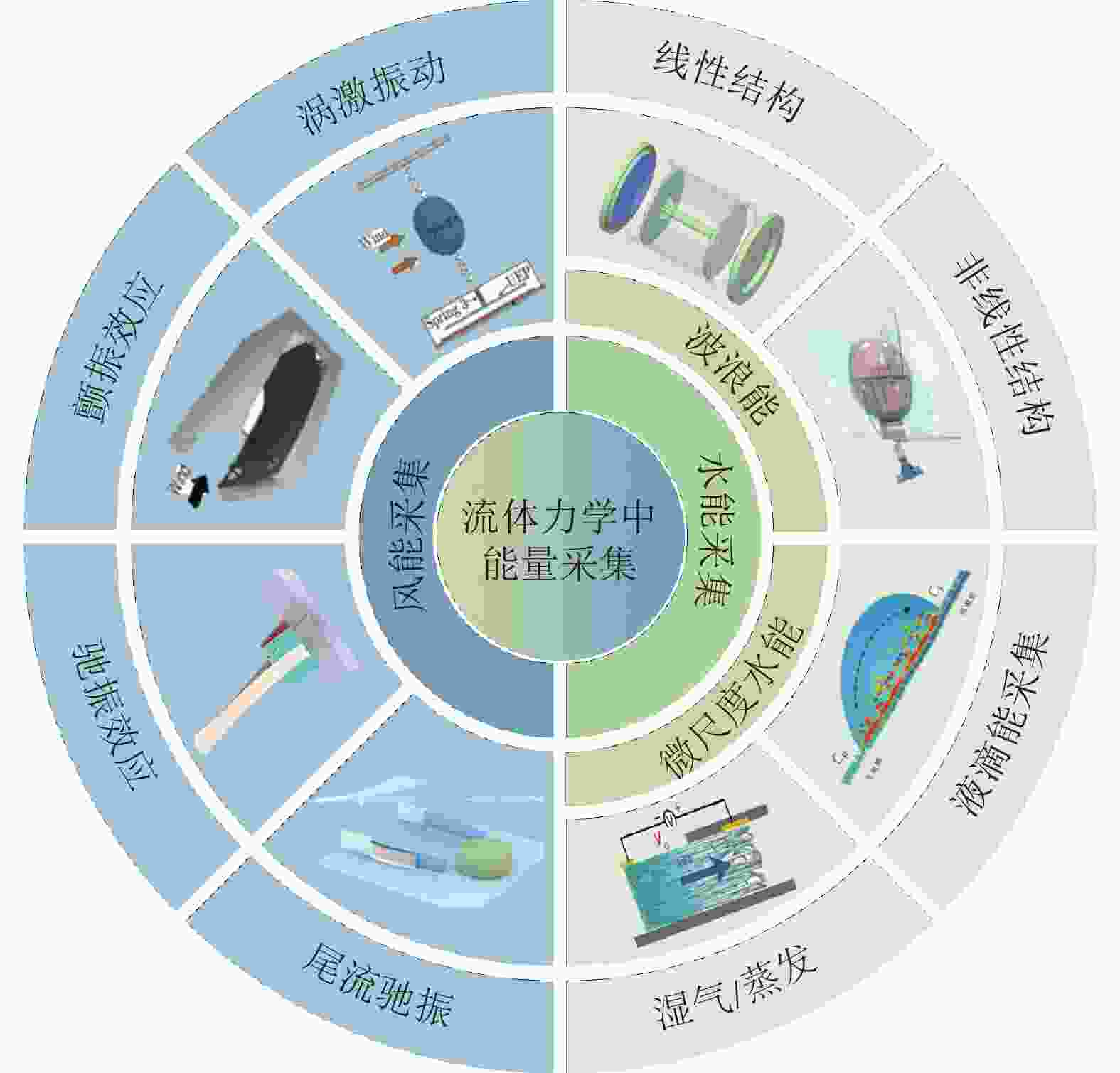
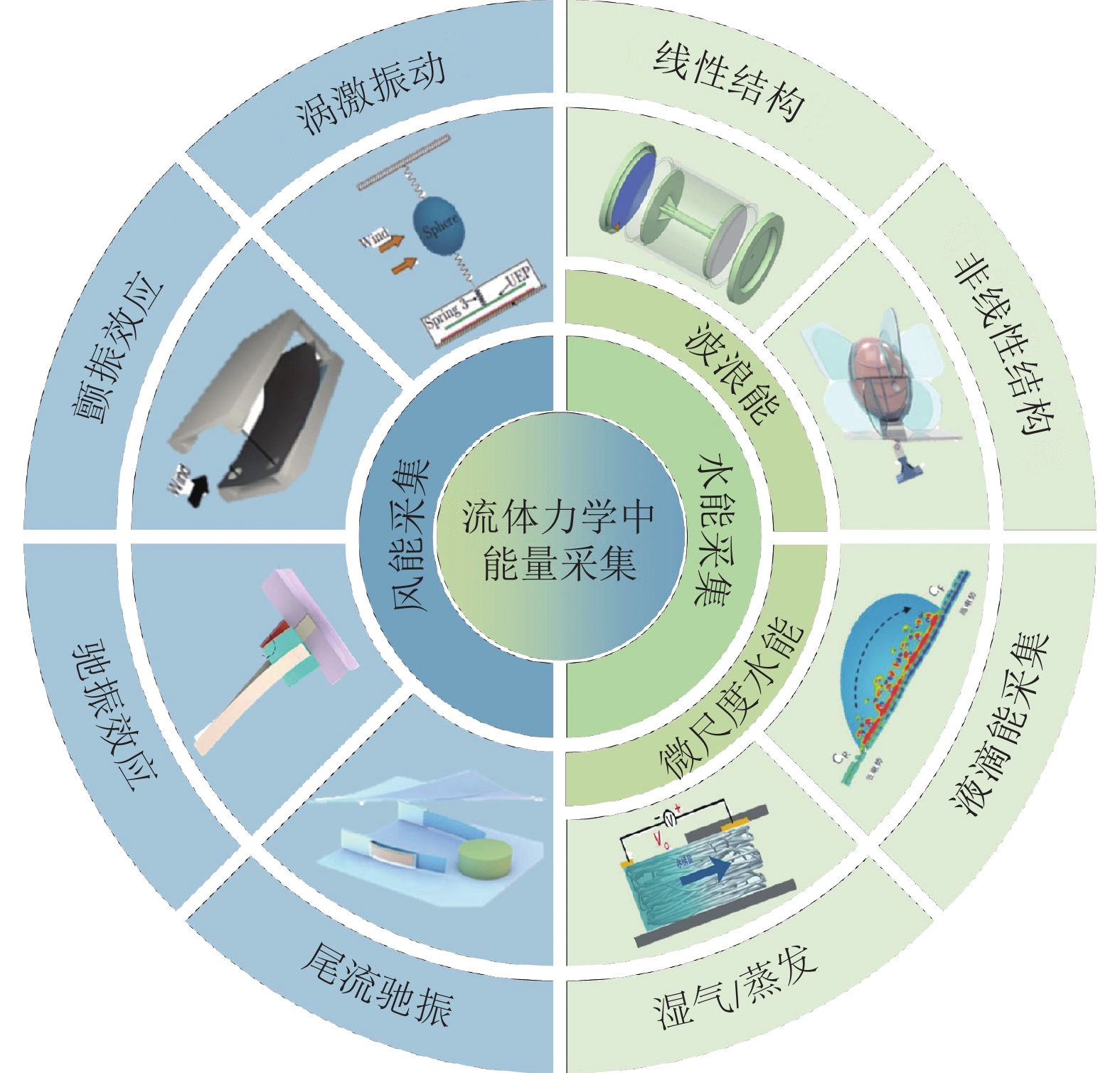
图 1 力−电耦合效应在风能和水能中能量采集的应用概述, 包括: 涡激振动(Zhang L B et al. 2024), 颤振效应(Tcho et al. 2022), 驰振效应(Zhang L B et al. 2020), 尾流驰振(Yuan et al. 2022), 线性结构(Wang Y et al. 2022), 非线性结构(Wang X et al. 2022), 液滴能采集(Yin et al. 2014a), 湿气/蒸发(Liu X M et al. 2020)
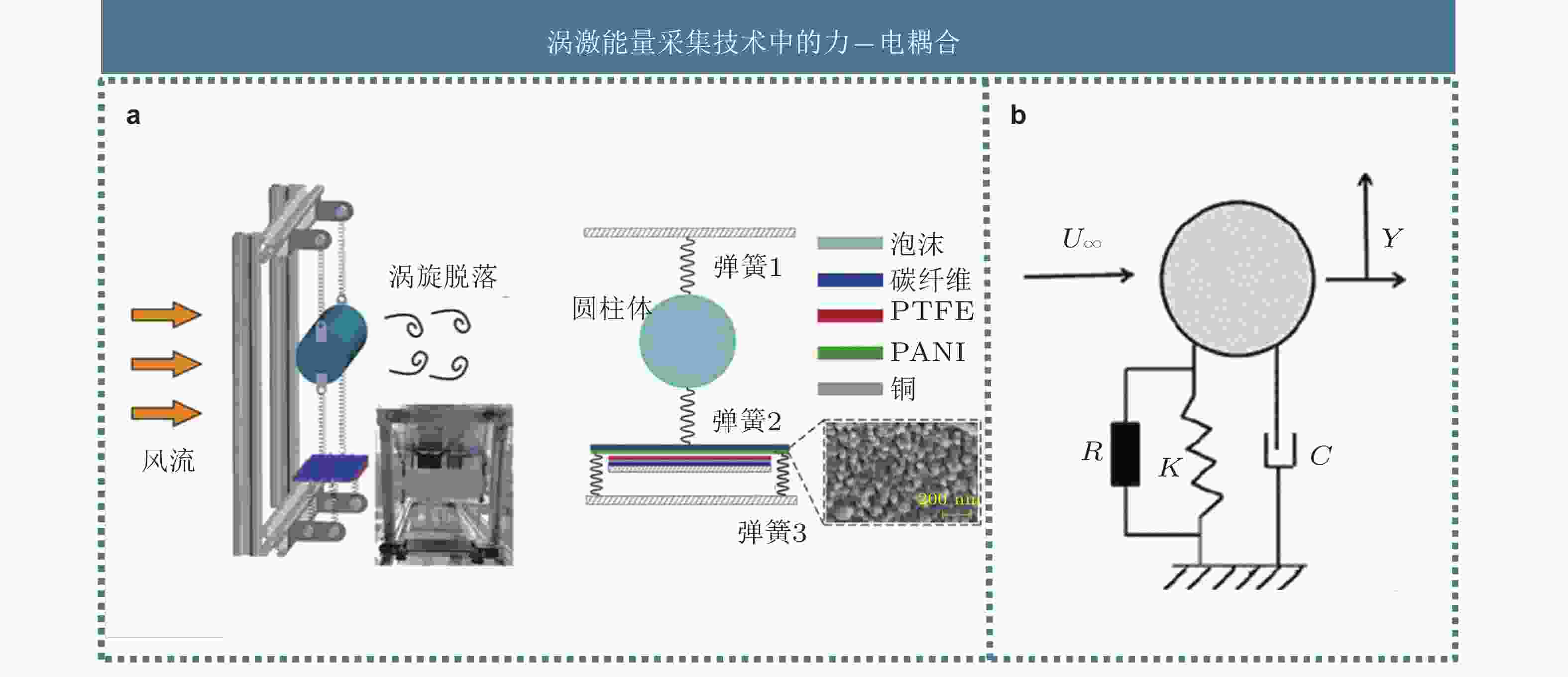
图 2 涡激能量采集器技术中力−电耦合. (a$ ) $涡激振动摩擦纳米发电机结构, 包含轻质圆柱体振子及接触分离式TENG单元(Zhang L B et al. 2022), (b)单自由度压电气动弹性耦合模型, 展示圆柱体与压电换能器及外部电阻负载的耦合关系(Mehmood et al. 2013)
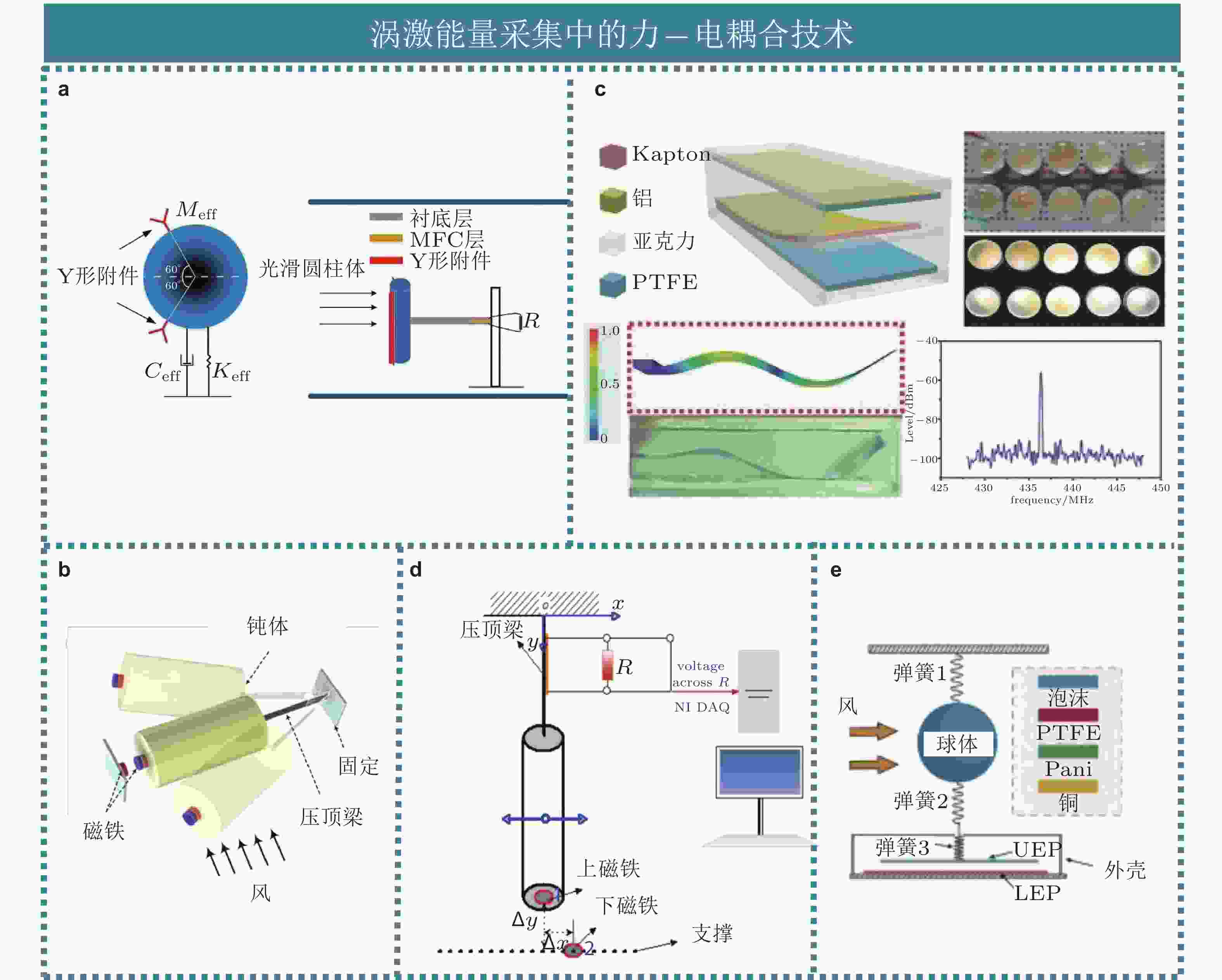
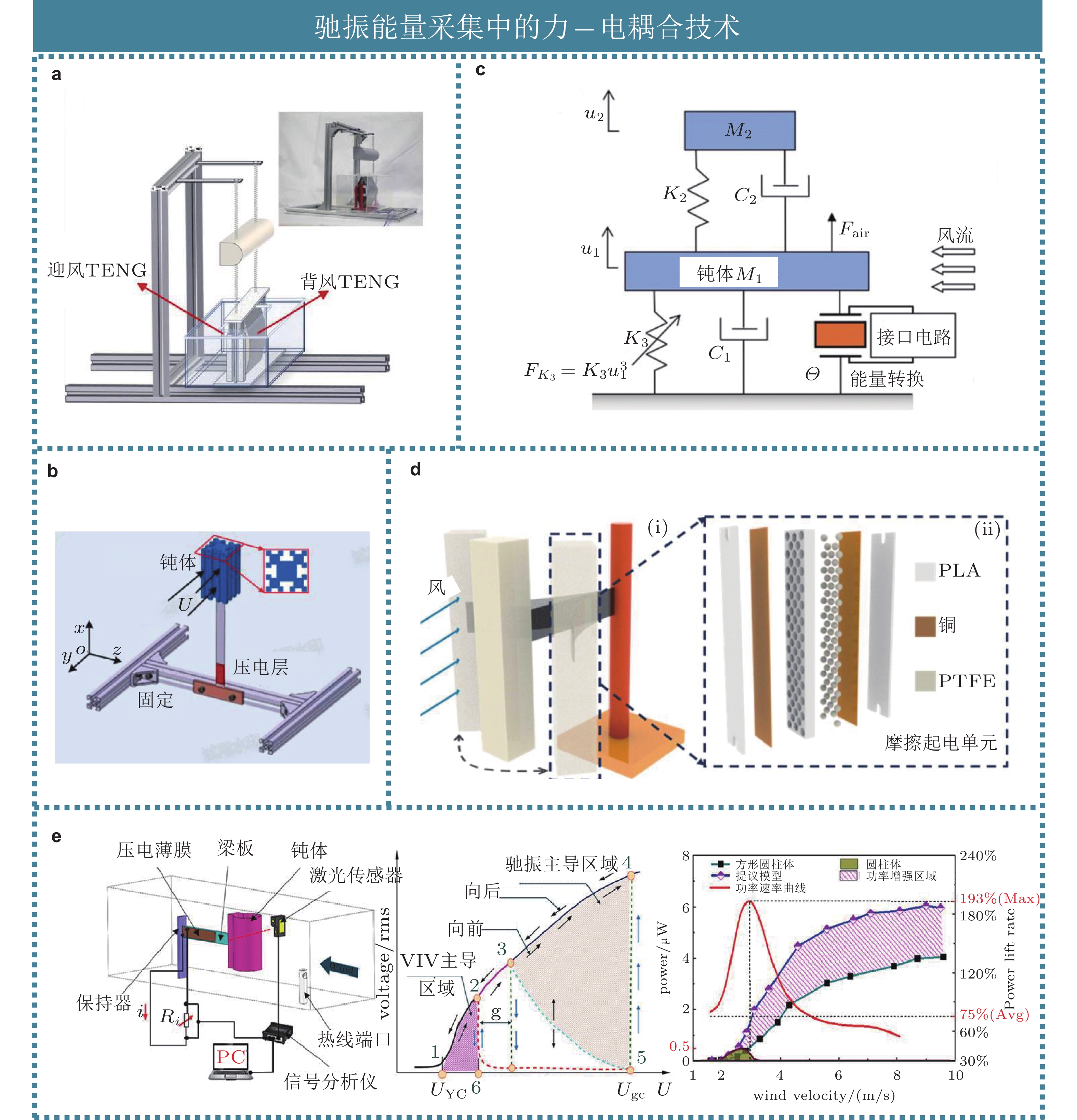
图 3 涡激能量采集中力−电耦合技术: (a)带Y形附件的压电风能收集器, 可在VIV与驰振模式间切换(Wang J et al. 2019), (b)基于负泊松比结构的非线性涡致振动能量收集器(Fang et al. 2024), (c)基于涡街脱落驱动的流动摩擦电发生器, 利用Kapton薄膜振动实现接触分离发电(Wang S H et al. 2015a), (d)采用磁性非线性恢复力调控的VIV能量收集器(Zhang L B et al. 2017), (e)球体多自由度涡致振动采集器, 适用于多方向气流能量收集(Zhang L B et al. 2024)
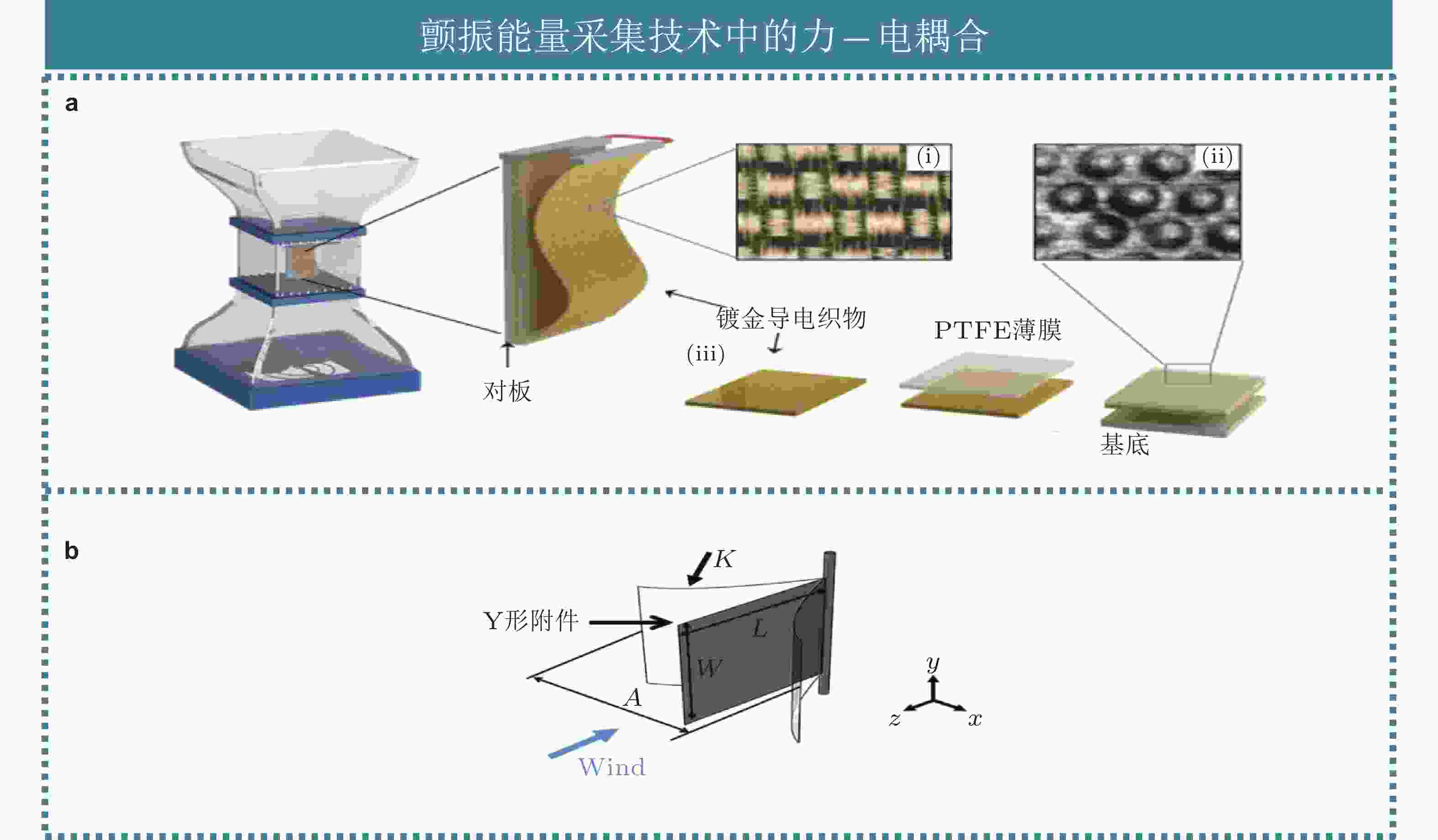
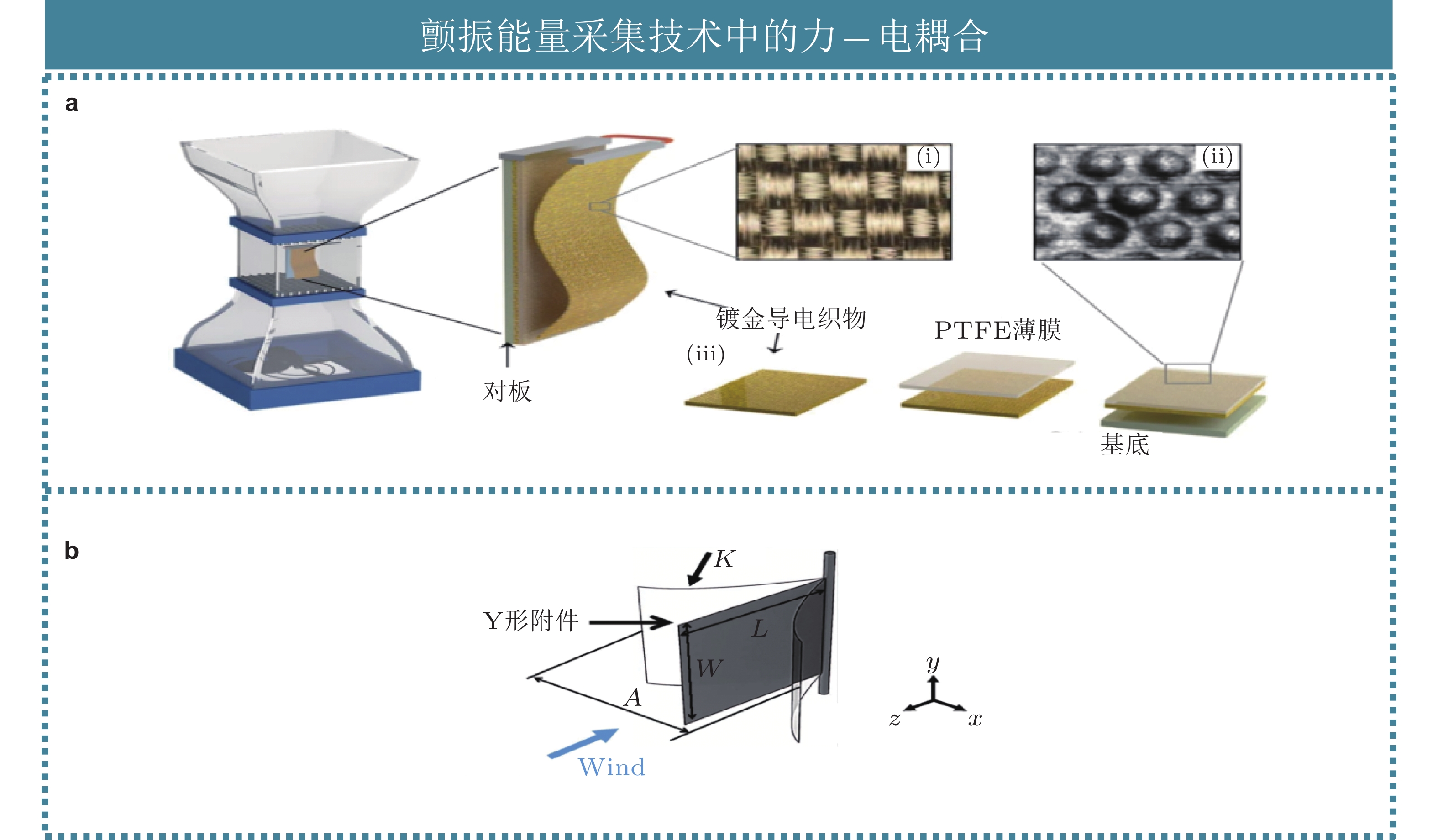
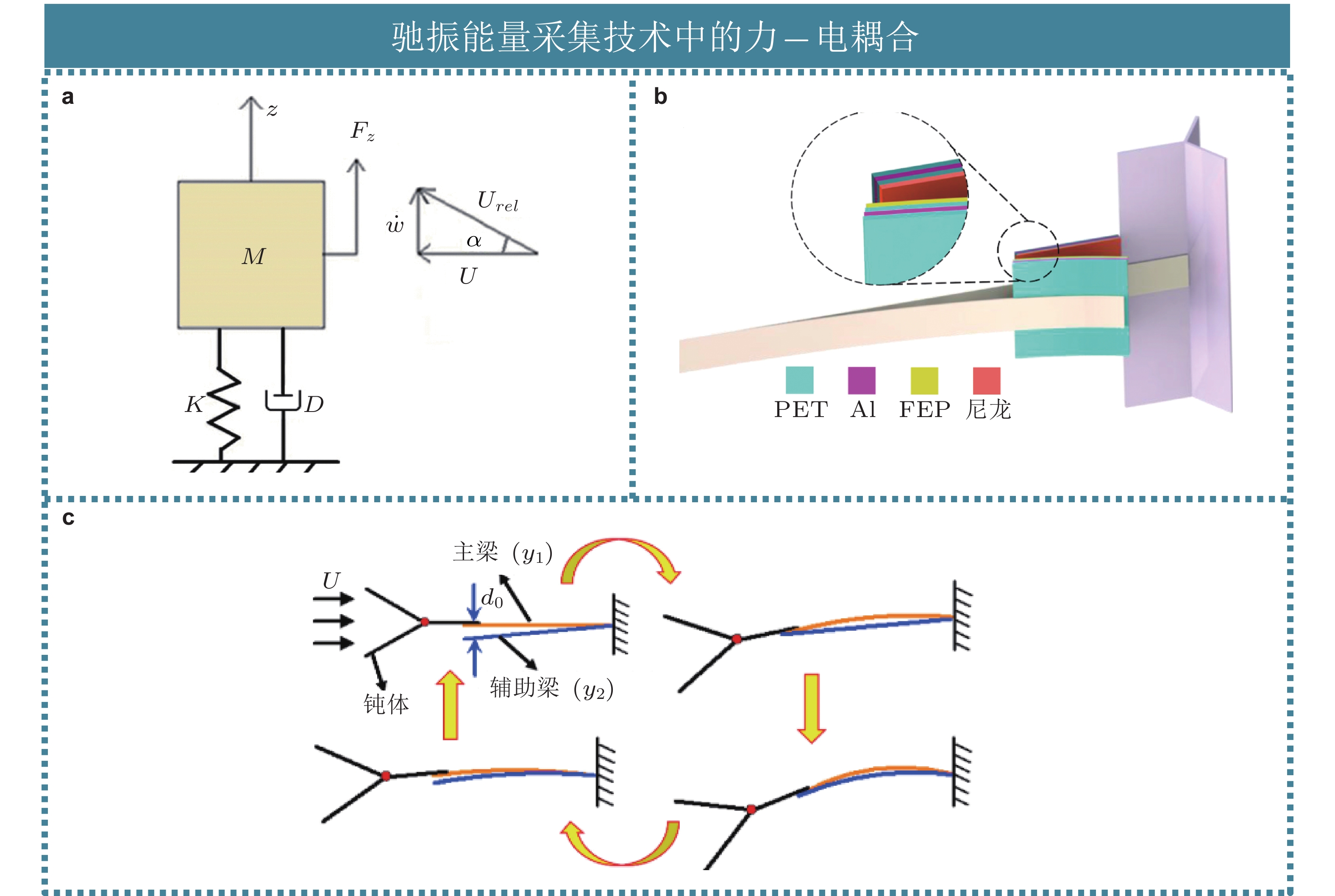
图 4 颤振能量采集技术中的力−电耦合: (a)摩擦电颤振能量采集器结构: 柔性旗帜与刚性极板的接触−分离机制(Bae et al. 2014), (b)倒压电旗结构: 尾缘固定、前缘自由的柔性压电膜(Orrego et al. 2017)
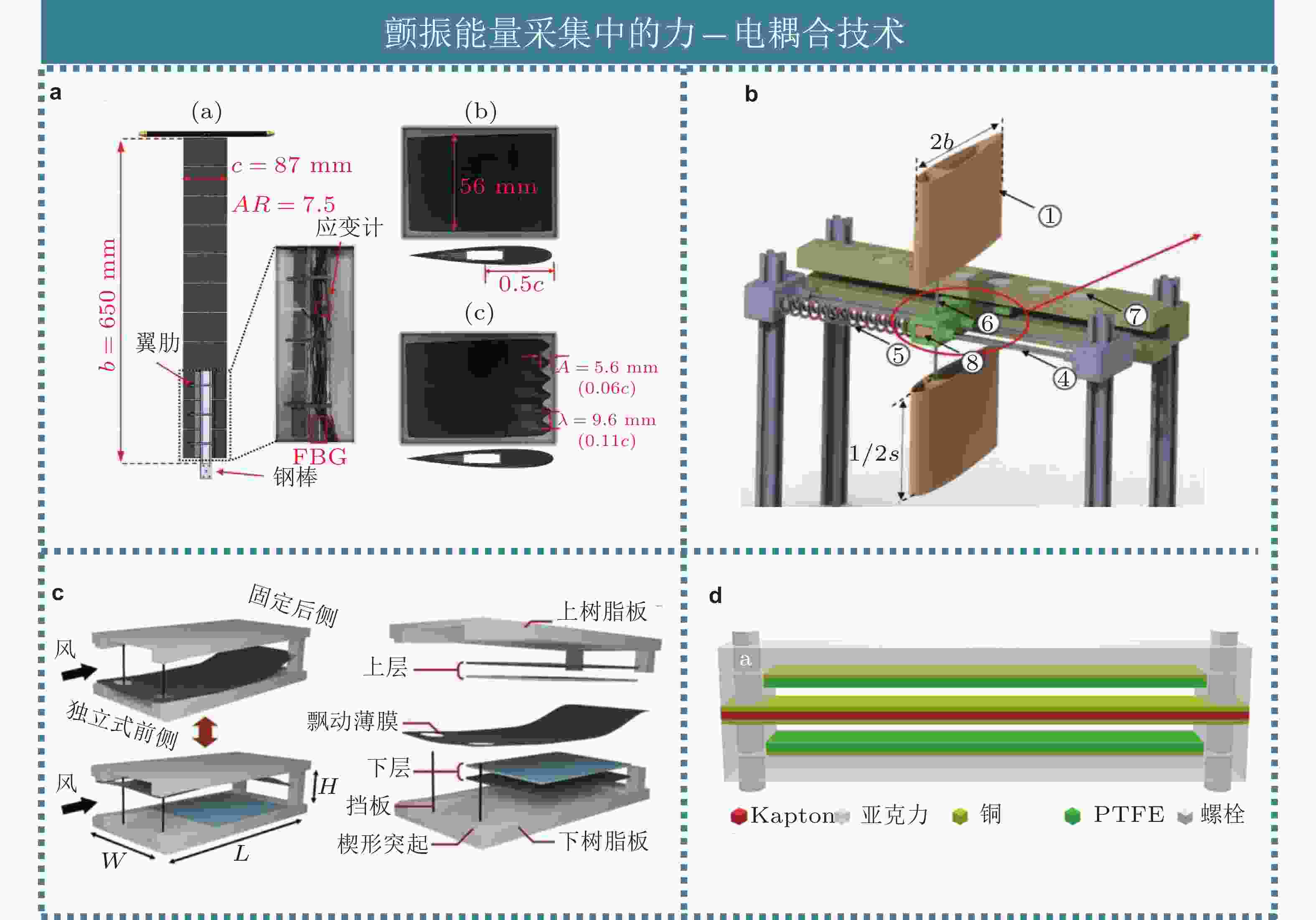
图 5 颤振能量采集中的力−电耦合技术: (a)基于混合颤振的多自由度收集器(Xue et al. 2025); (b)基于翼型段失速颤振的电磁收集器(Li Z et al. 2024), (c)后固定膜颤振驱动的摩擦电纳米发电机(Tcho et al. 2022), (d)弹性气动驱动的摩擦电纳米发电机(Wang S H et al. 2015b)
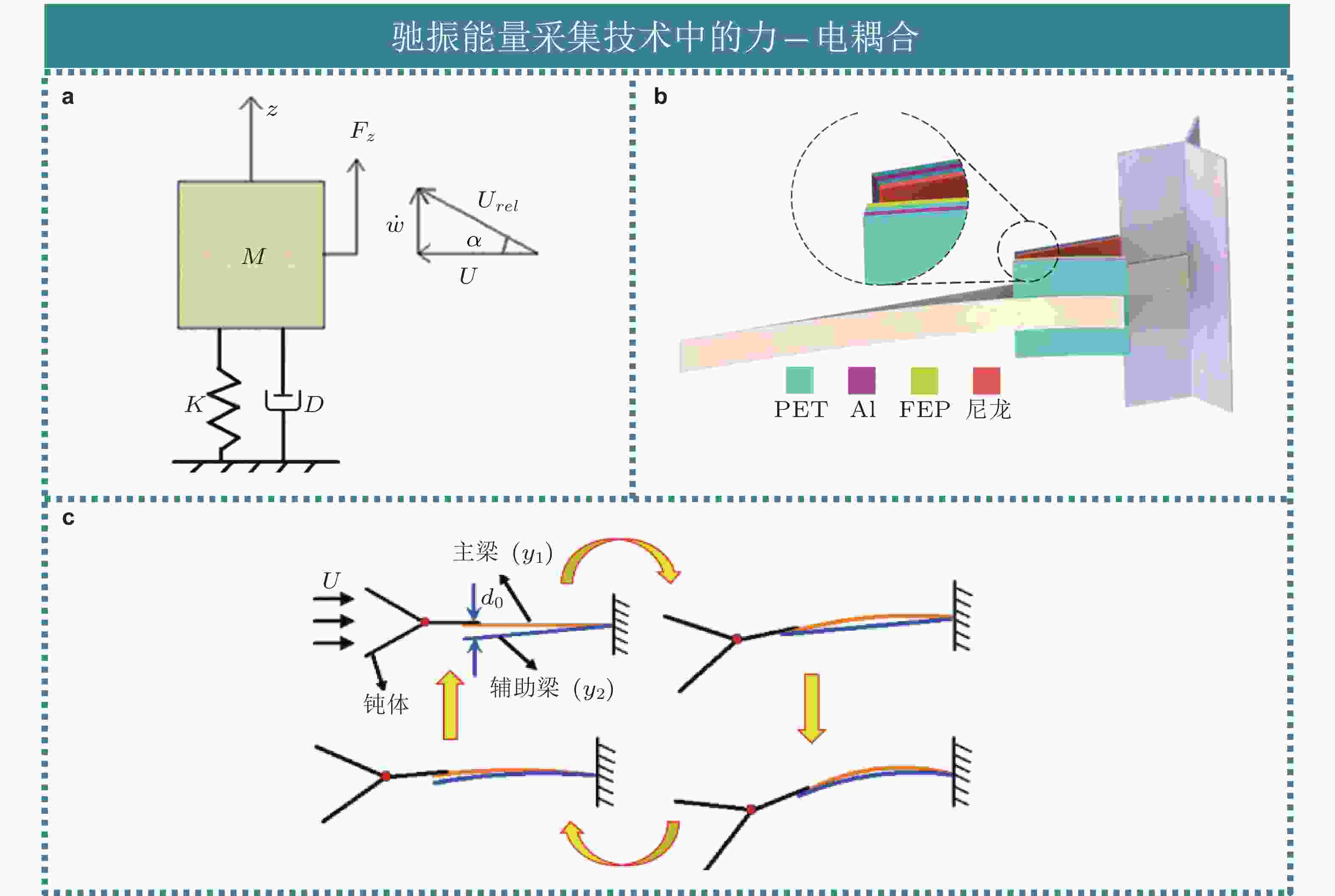
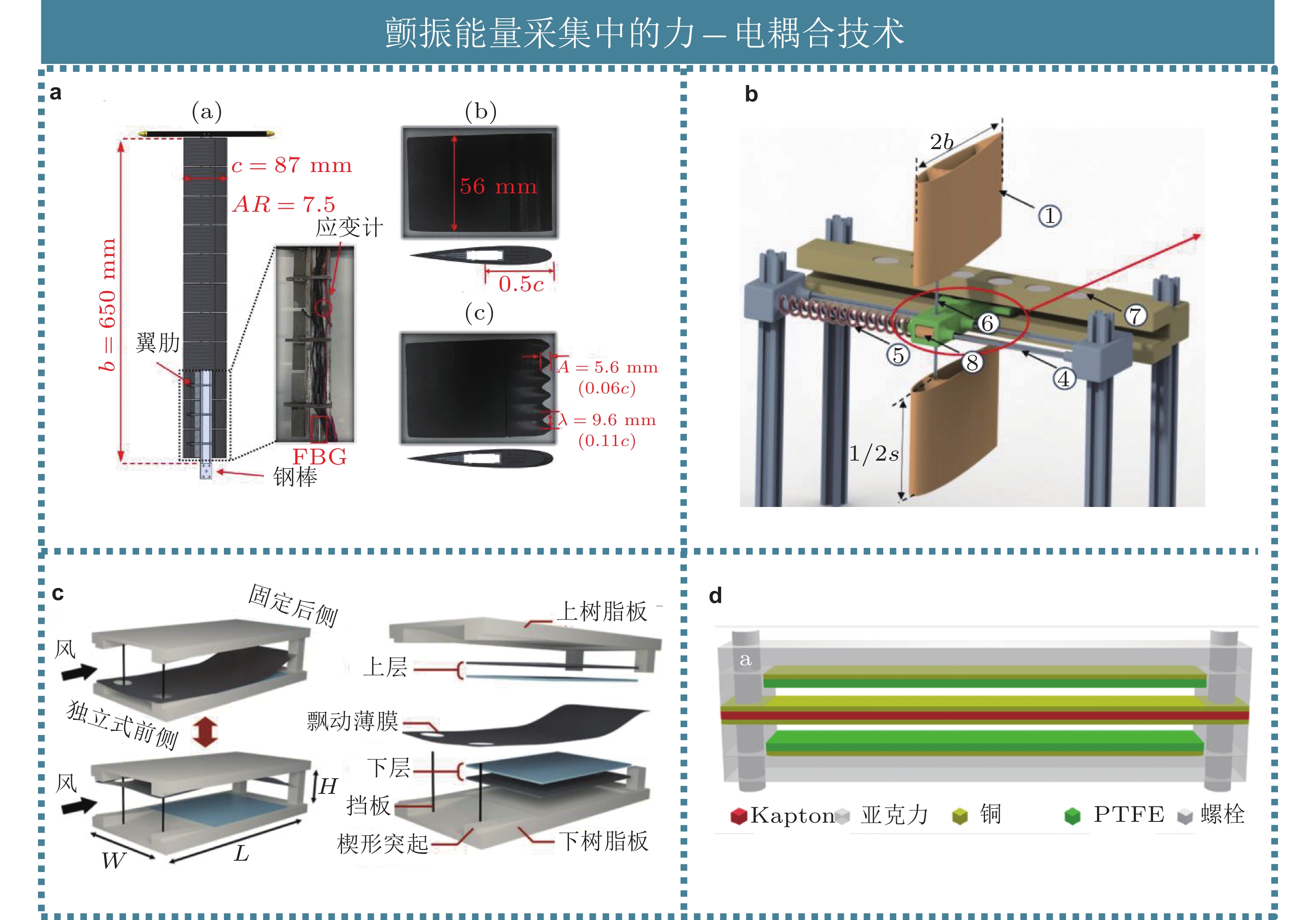
图 6 驰振能量采集技术中的力−电耦合: (a)单自由度集总参数模型(Tang et al. 2014), (b)基础结构(Zhang L B et al. 2020), (c)机电耦合模型(Zhang L B et al. 2020)
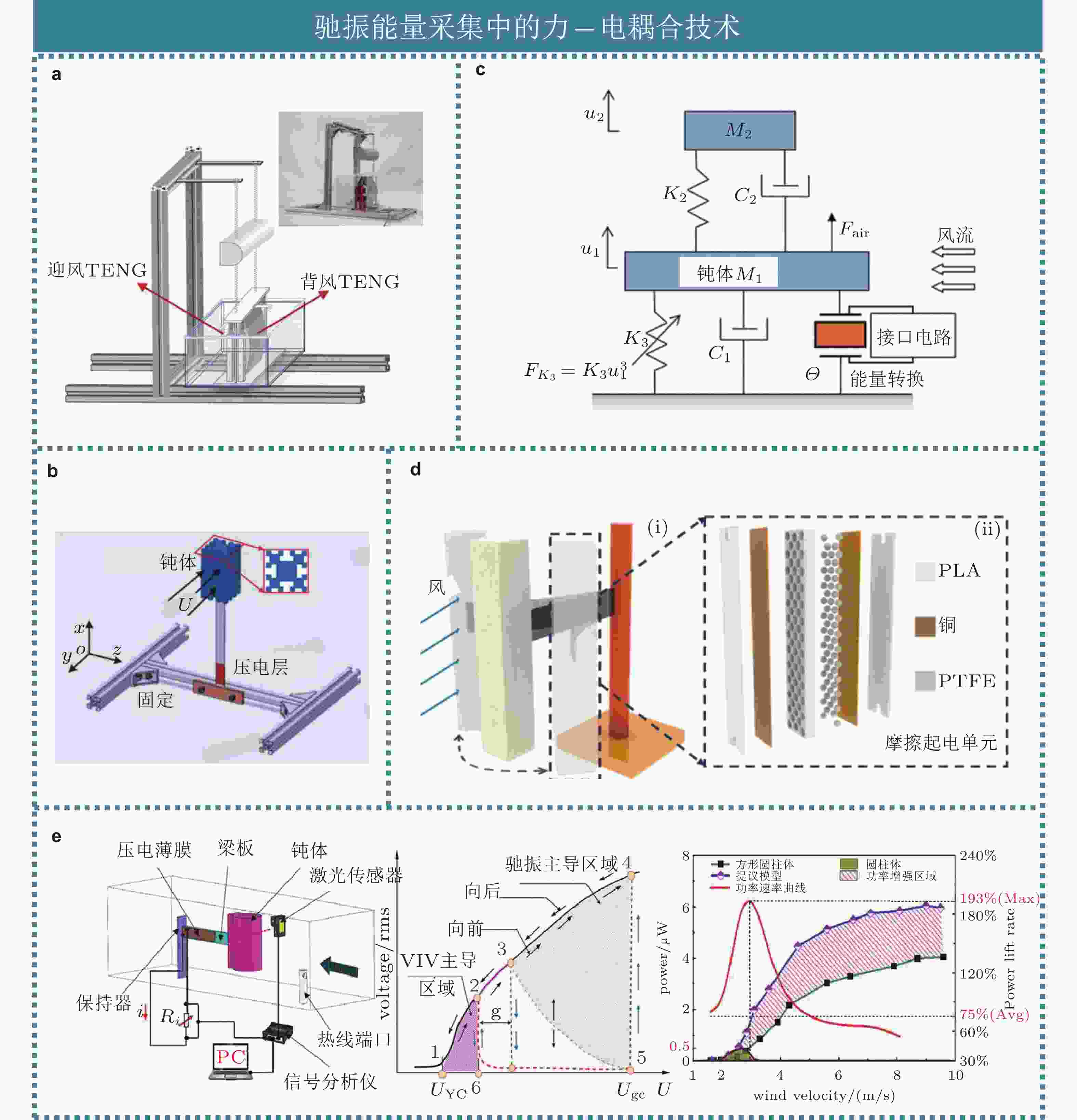
图 7 驰振能量采集中的力−电耦合技术: (a)非线性调控装置(Wang J et al. 2024), (b)混合能量采集装置(Li H et al. 2024a), (c)驰振振荡器模型(Chen S et al. 2023), (d)摩擦电单元结构(Wang Y et al. 2024), (e)耦合振动装置(Sun et al. 2019)
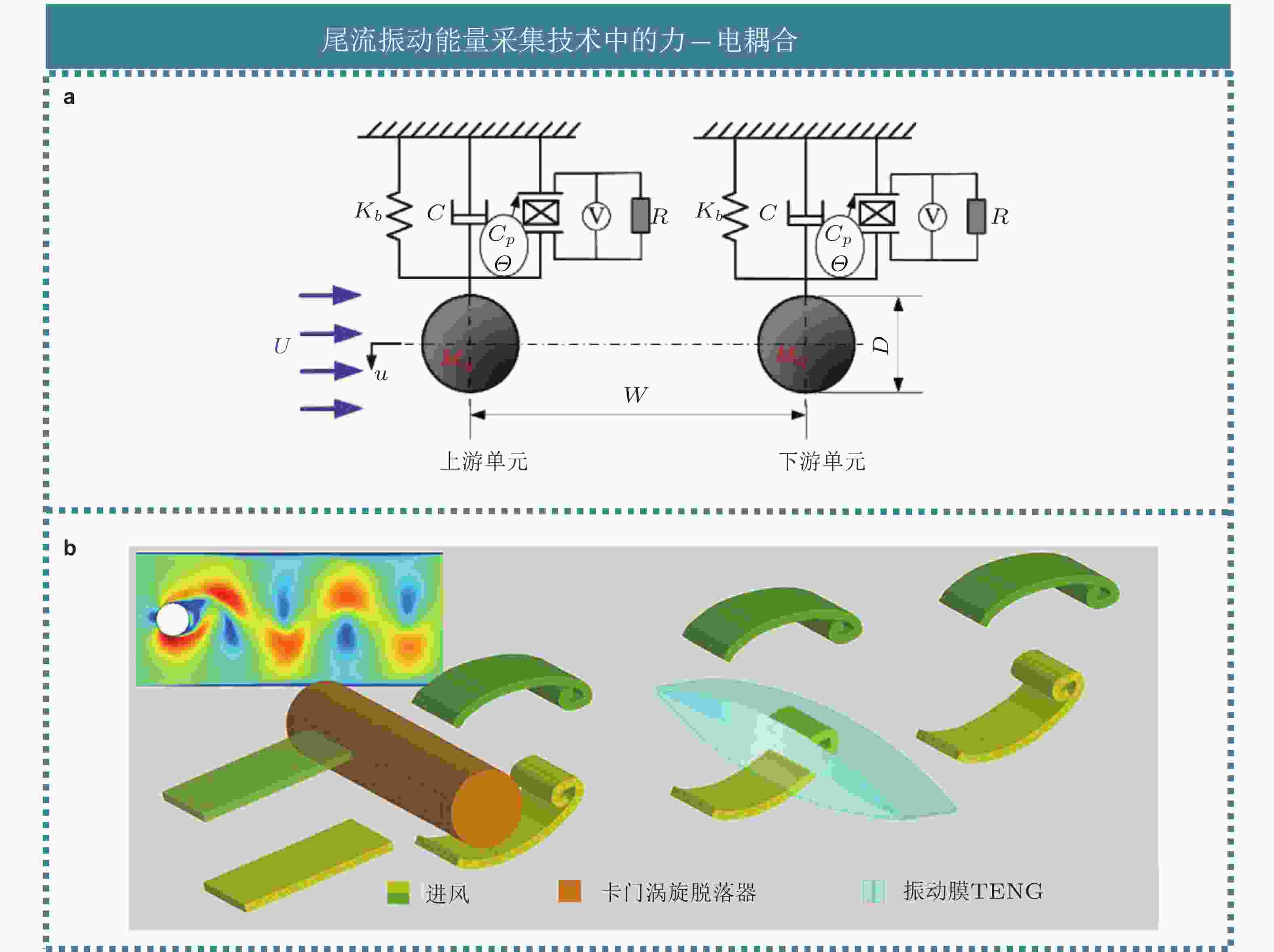
图 8 尾流振动能量采集技术中的力−电耦合: (a)串联双圆柱压电能量采集器(Song et al. 2021), (b)卡门涡街驱动的摩擦纳米发电机(Li W et al. 2022)
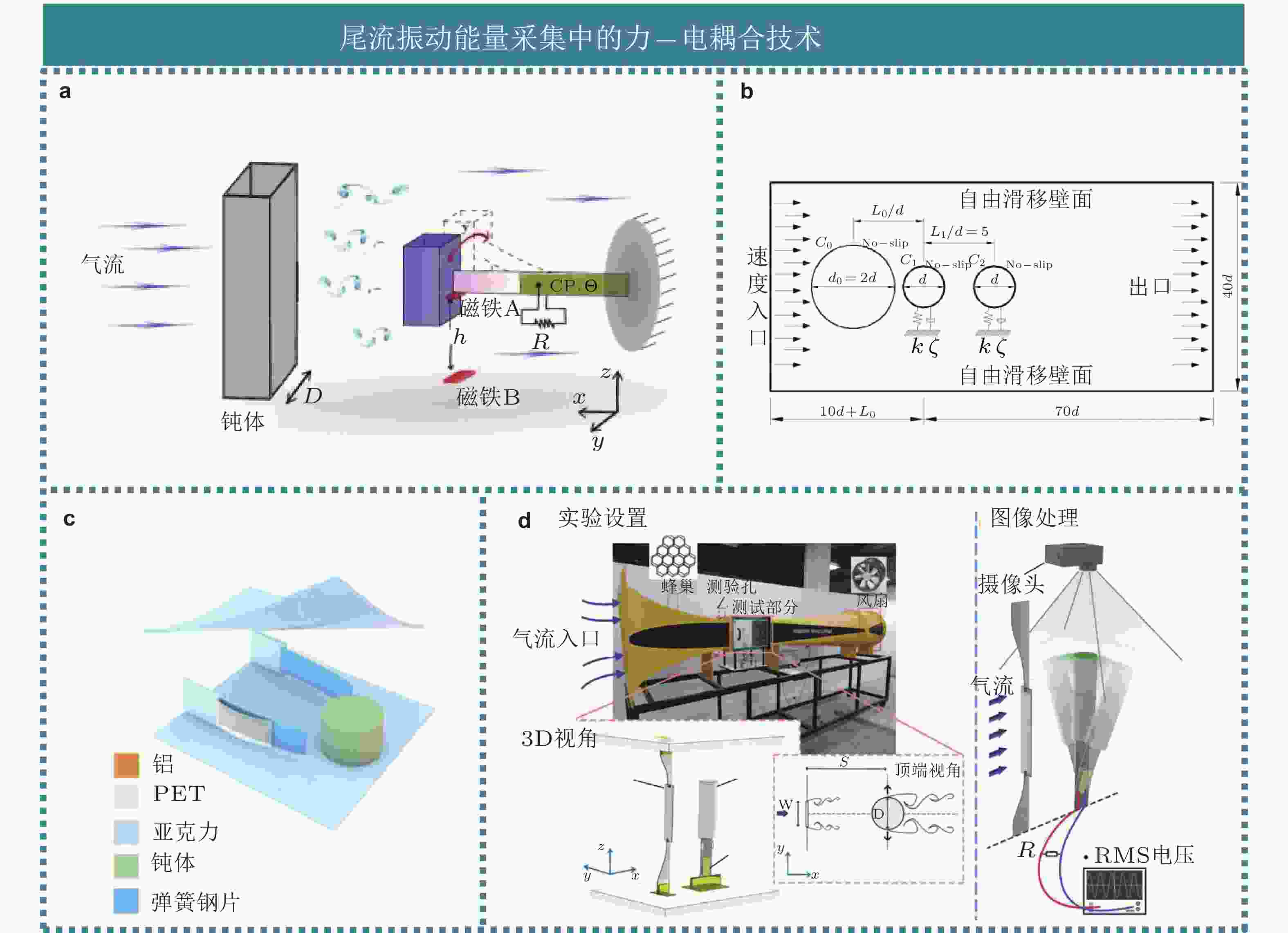
图 9 尾流振动能量采集中的力−电耦合技术: (a)引入非线性刚度恢复力机制的装置(Alhadidi et al. 2016), (b)多缸结构配置(Awadallah et al. 2025), (c)尾迹驰振现象装置(Yuan et al. 2022), (d)串联矩形板−圆柱结构(Najafpour et al. 2025)
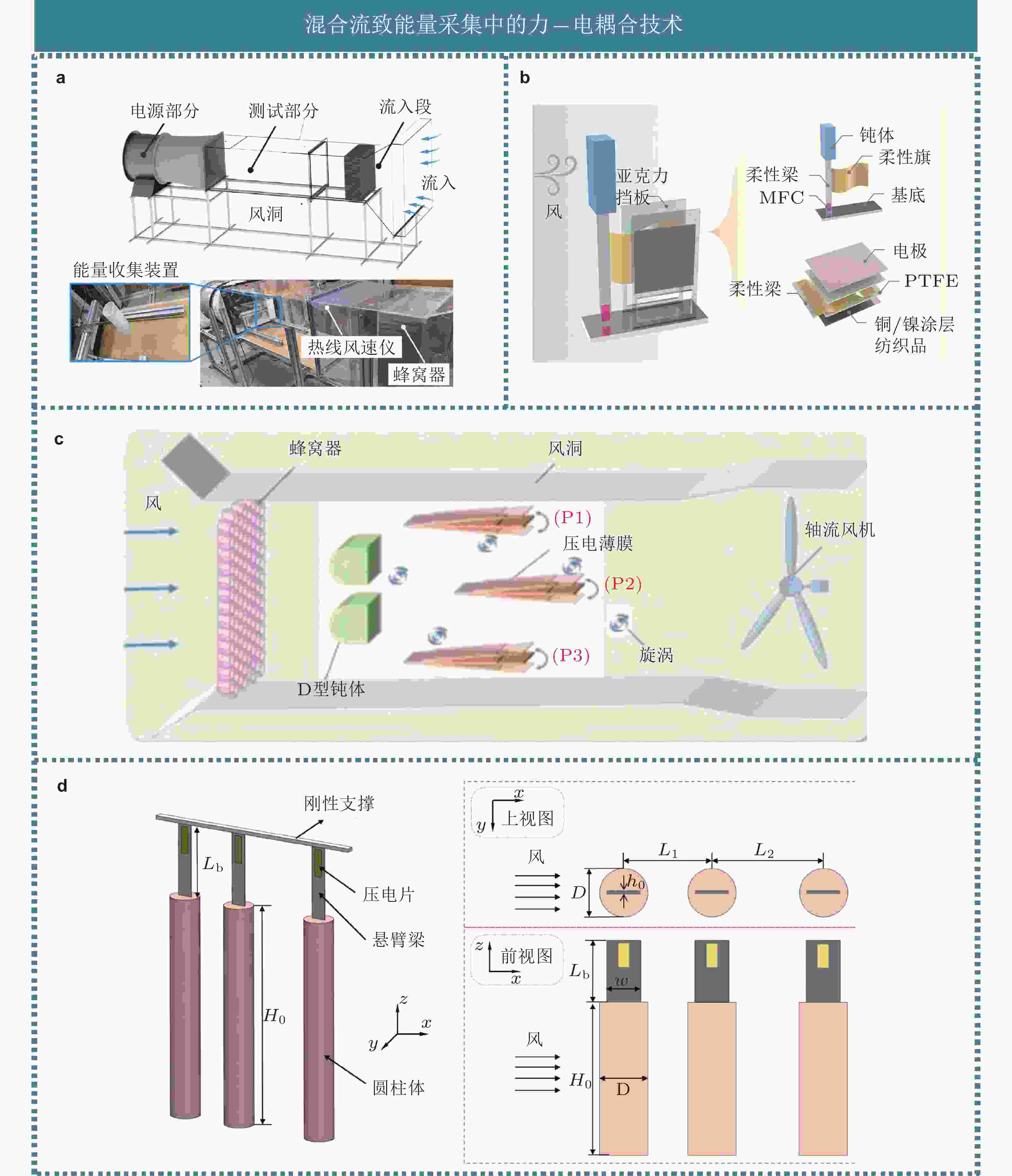
图 10 混合流致能量采集中的力−电耦合技术: (a)前缘切削钝体压电能量收集器(Wang et al. 2025), (b)驰振与颤振协同能量收集器(Dong et al. 2025), (c)双钝体三压电薄膜能量收集器(Lu et al. 2026), (d)间距优化三圆柱压电能量收集器(Cheng et al. 2026)
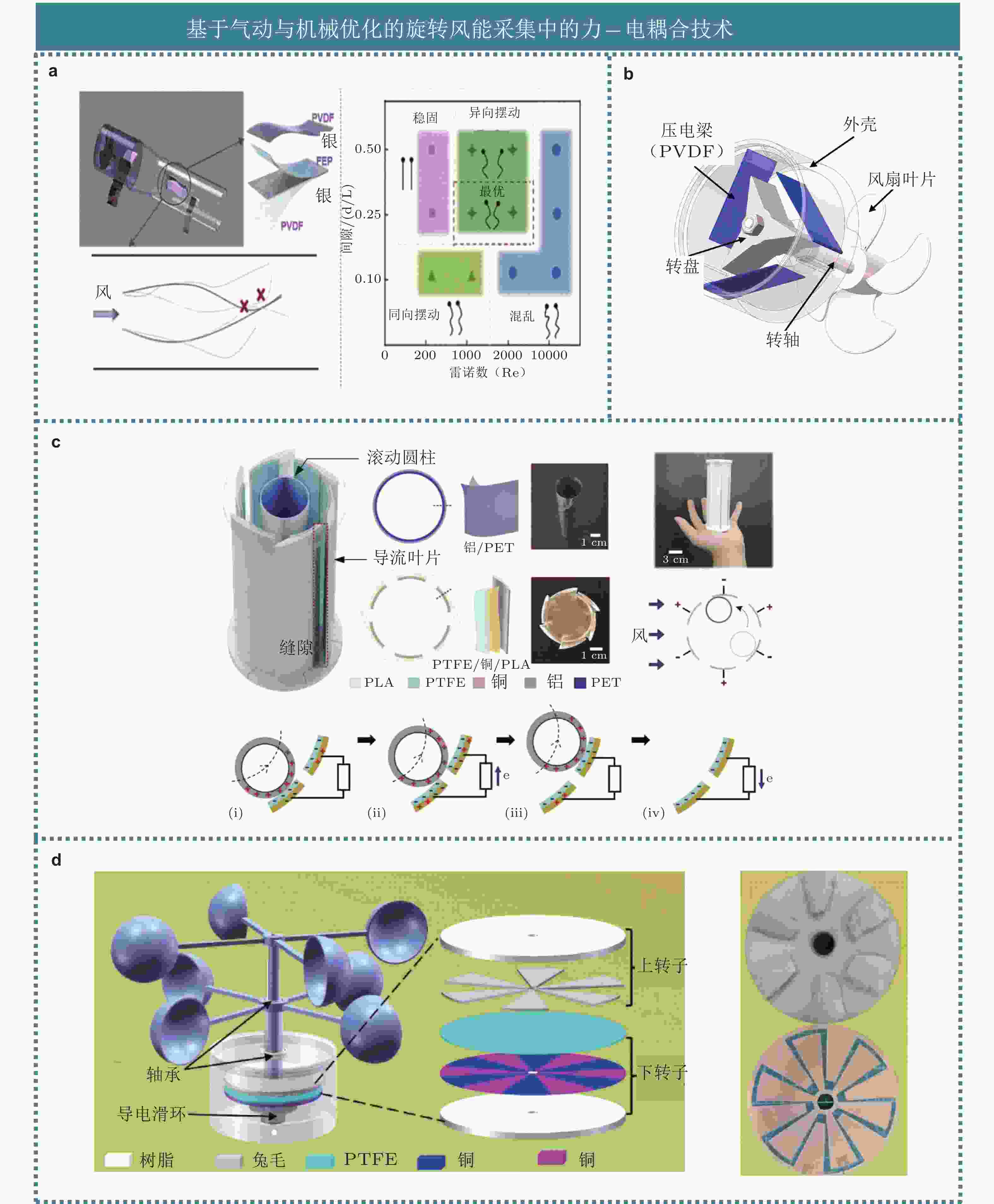
图 11 基于气动与机械优化的旋转风能采集中的力−电耦合技术: (a)利用伯努利效应驱动的摩擦纳米发电机(Chen X et al. 2020b), (b)机械撞击结构(Zhang J T et al. 2017), (c)涡流诱导滚动的风能采集器(Choi et al. 2024), (d)双转子结构(Han et al. 2025)
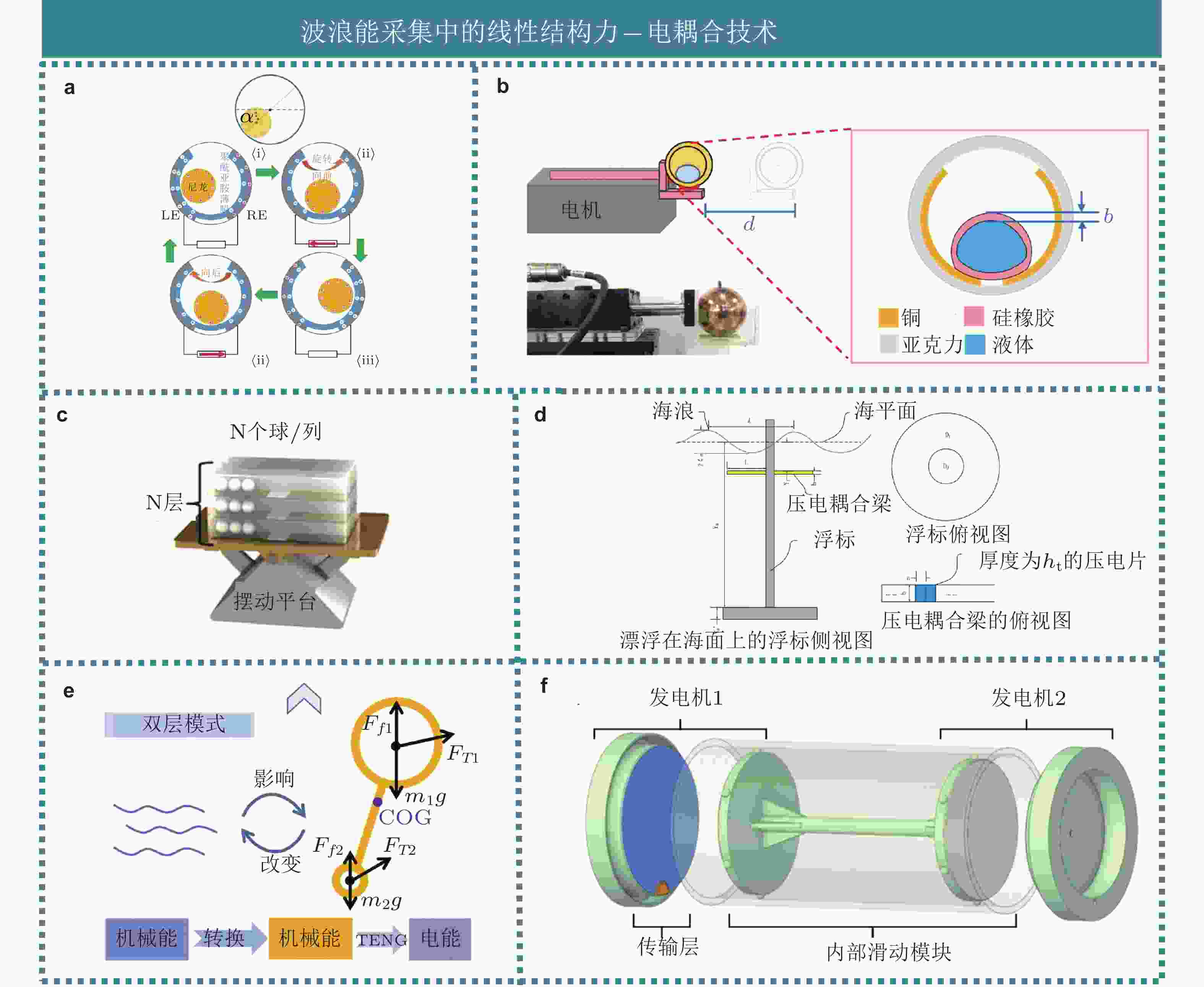
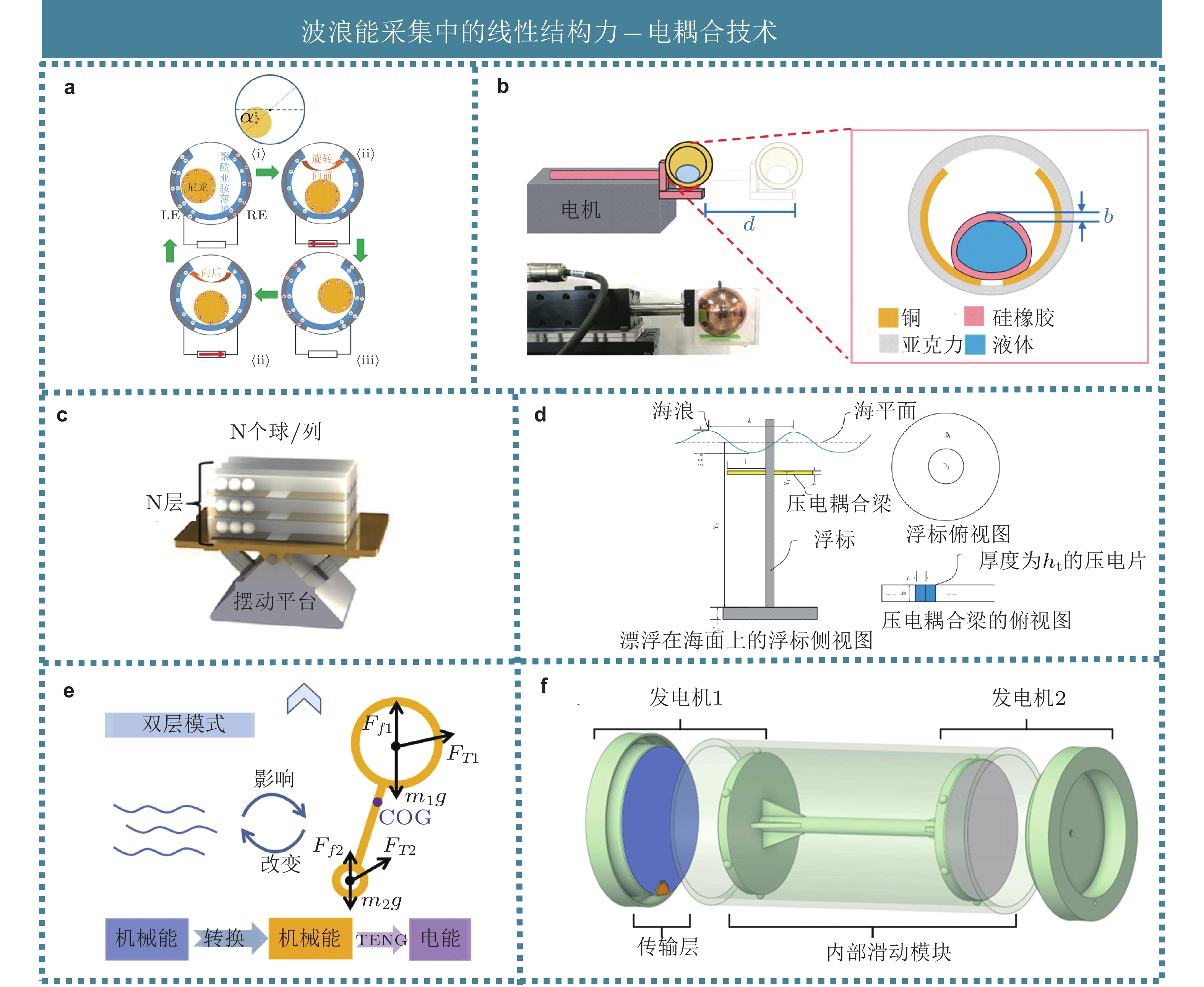
图 12 波浪能采集中的线性结构力−电耦合技术: (a)球形摩擦纳米发电机的摇摆−滚动耦合机制(Wang X et al. 2015), (b)软接触复合球体设计(Cheng et al. 2019), (c)多节耦合摩擦纳米发电机结构(Zhang S L et al. 2018), (d)压电耦合浮标系统(Wu et al. 2015), (e)倒立摆式多层摩擦纳米发电机结构(Zhang X M et al. 2022), (f)圆筒形波浪驱动摩擦纳米发电机结构(Wang Y et al. 2022)
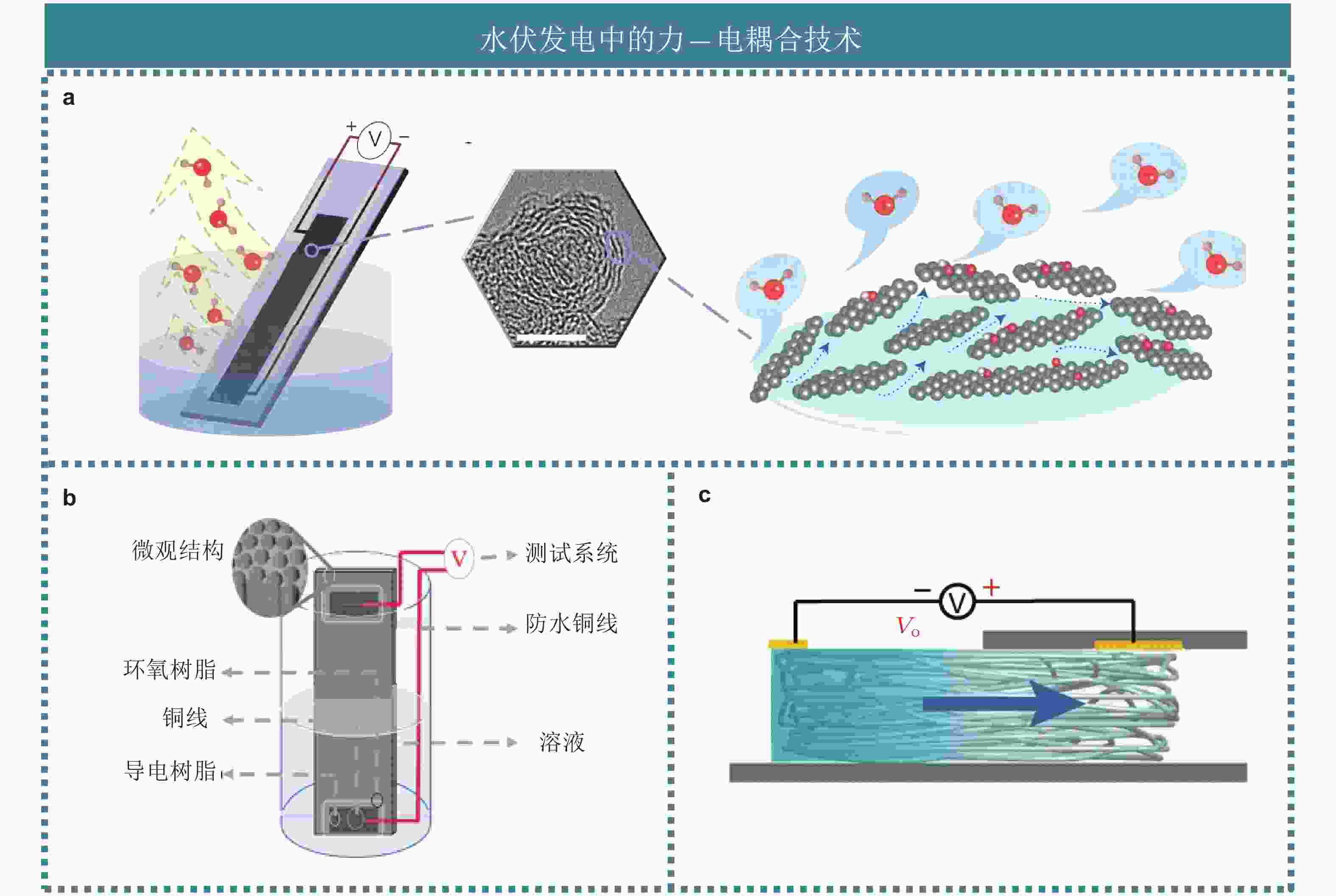
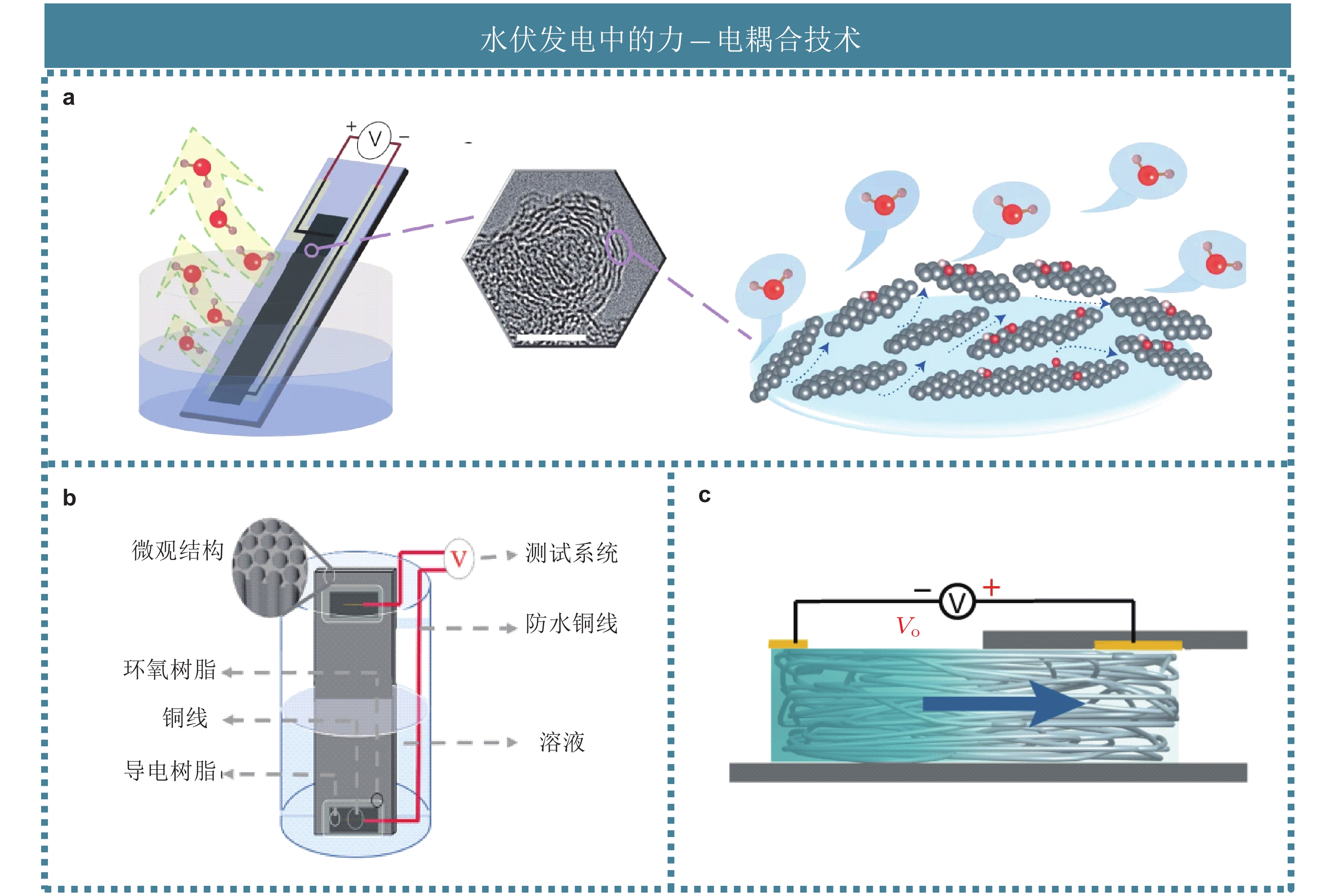
图 15 水伏发电中的力−电耦合技术: (a)基于蒸发驱动与毛细压力的剪切拖拽耦合(Xue G B et al. 2017), (b)垂直微通道结构中的低流阻稳态耦合(Zou et al. 2021), (c)受限空间内湿气梯度驱动的扩散电流耦合(Liu X M et al. 2020)
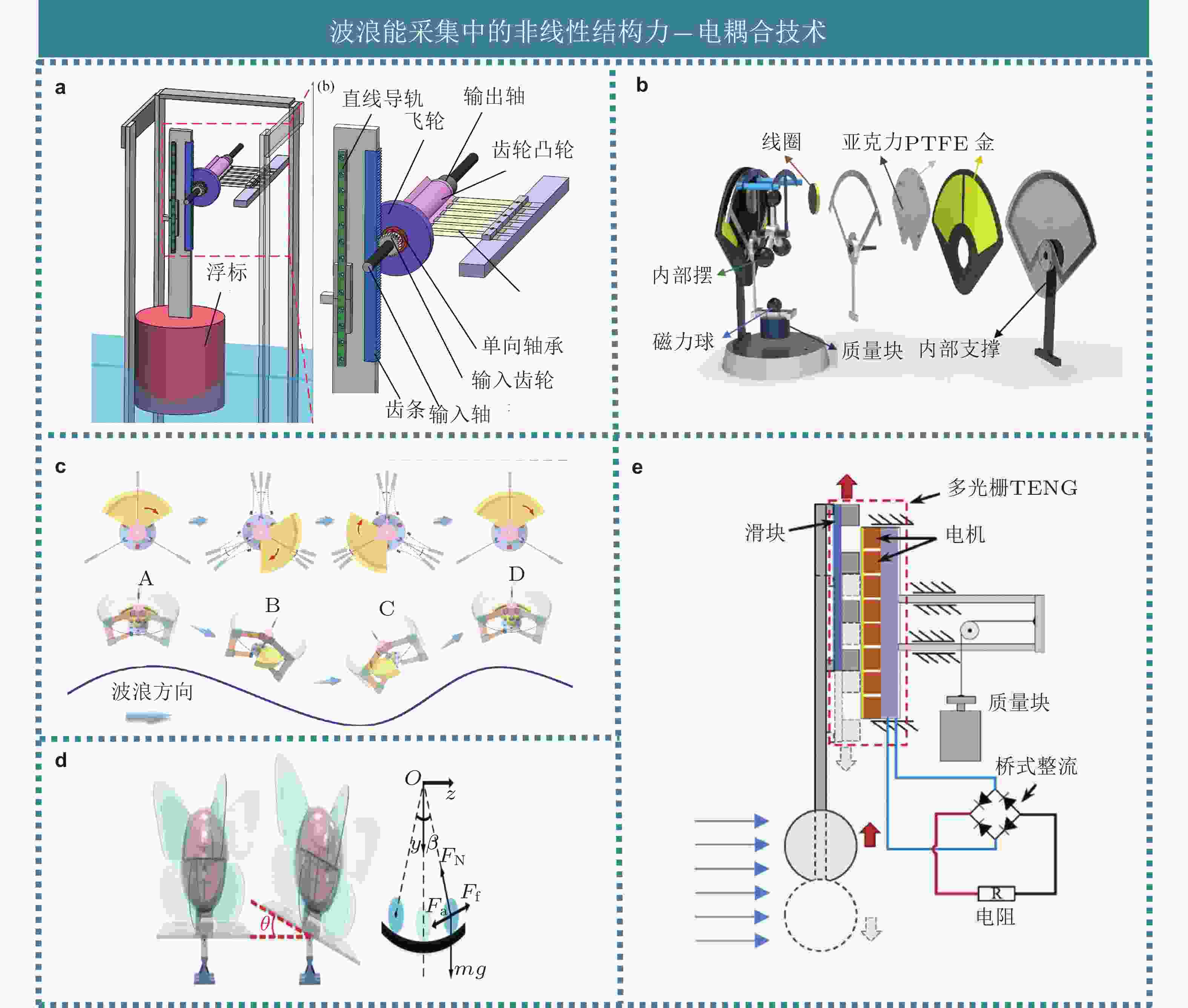
图 13 波浪能采集中的非线性结构力−电耦合技术: (a)机械变频结构(Chen S E et al. 2023), (b)混沌摆结构(Chen X et al. 2020a), (c)磁耦合C型梁结构(Liu et al. 2026), (d) 仿生蝴蝶翼结构的摩擦纳米发电机(Wang X et al. 2022), (e)基于涡激振动的多光栅摩擦纳米发电机 (Li H et al. 2024b)
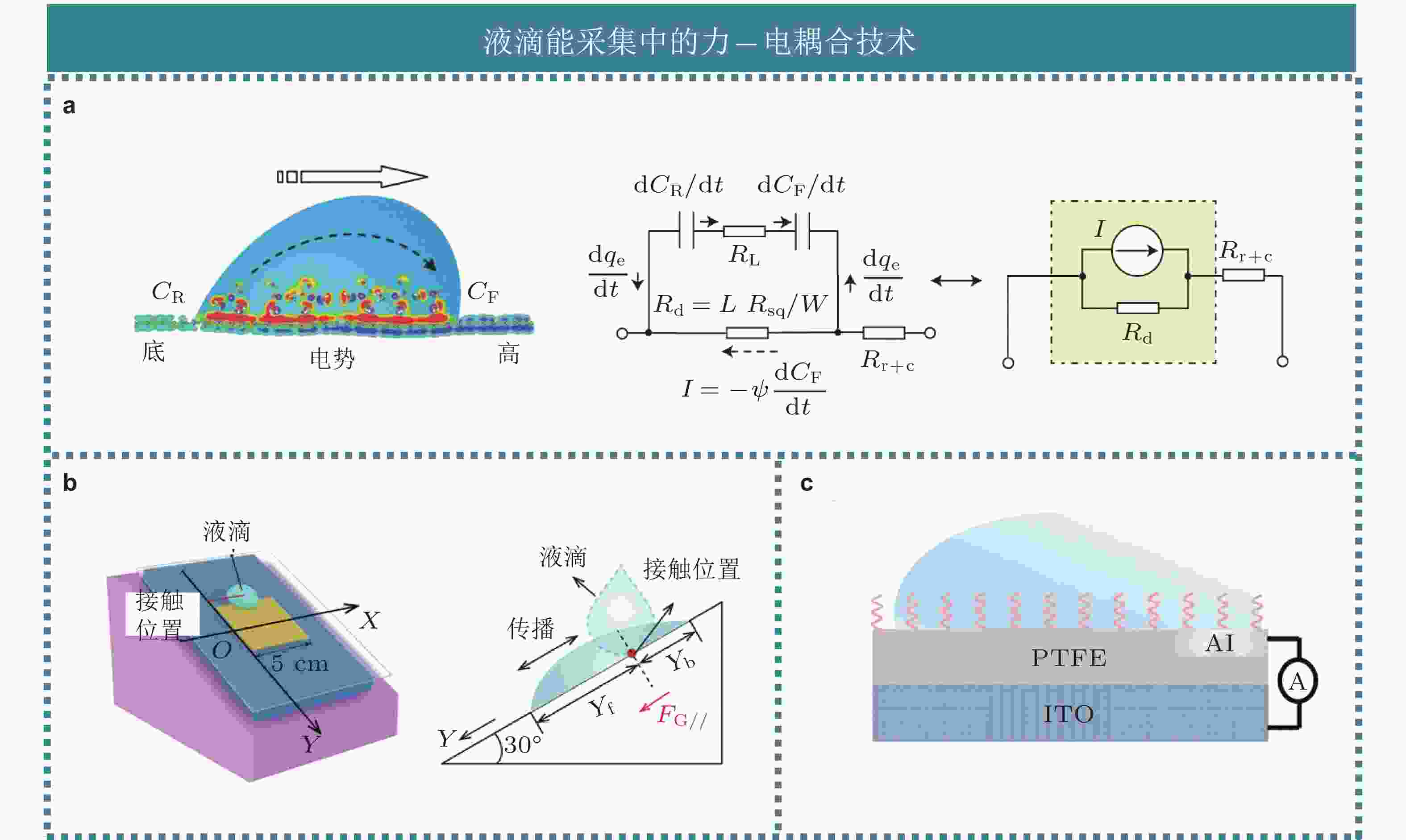
图 14 液滴能采集中的力−电耦合技术: (a)基于移动双电层的线性耦合结构(Yin et al. 2014a), (b)诱导带电增强型摩擦纳米发电机结构(Wang W Q et al. 2023), (c)分子刷表面工程的液滴摩擦纳米发电机结构(Meng et al. 2024)
表 1 四种典型流致振动风能采集技术性能与适用性对比
类别 代表文献 工作风速范围 输出功率/功率密度 适用环境 优势 局限 涡激振动 (Zhang L B et al. 2022) 低速 2.78 m/s时:
392.72 μW;
功率密度96.79 mW/m2低速风、无线传感 结构简单, 低风速输出好 有效频带较窄 (Zhang L B et al. 2017) 低速 ~ 中速 同步区拓宽138%,
采集功率提高29%变风速环境 拓宽工作风速范围 磁距和结构参数需优化 颤振 (Bae et al. 2014) 15 m/s 约0.86 mW
(200 V/60 uA)较强风环境 高电压, 结构简单 高风速
易疲劳(Orrego et al. 2017) 3.5 ~ 9 m/s 功率密度: 0.4 mW/cm3(3.5 m/s); 5.0 mW/cm3(9 m/s) 环境微风 低风速响应好 受旗帜参数
影响大(Li Z et al. 2024) 9.3 m/s 均方根(RMS)电压增加至0.52 V, 输出功率提升4.89倍 中高风速 适合大幅振动 摩擦提高切入风速 驰振 (Zhang L B et al. 2020) 1.4 ~ 6 m/s 1.4 m/s时大于200 V
(到6 m/s时约60%)低风速 切入风速
低高电压接触磨损明显 (Wang Y et al. 2024) 0.6 ~ 12.4 m/s 4.0 m/s时输出功率提升141倍, 功率密度
62.25 W/m3宽风速环境 输出稳定性好 阻尼匹配
要求高(Li H et al. 2024a) 低 ~ 中速 5 m/s时电压提升约51.97%; 功率密度
提高164.1%低中速风 降低切入风速 分形结构加工复杂 尾流驰振 (Li W et al. 2022) 切入0.52 m/s;
1 ~ 2 m/s增强1 m/s时: 0.53uW, 功率密度4 mW/m2; 2 m/s时: 3.72uW, 功率密度
26 mW/m2超低风速、
气流传感切入风速低, 兼具传感 膜结构参
数敏感(Najafpour et al. 2025) 无量纲宽度≤15/32、无量纲间距≤3 最大采集功率提升431%; 平均输出最高30倍 受限风道、
建筑间隙尾流增强效果显著 依赖板宽
和间距 下载: 导出CSV
表 2 混合流致振动与其他气动机制风能采集技术性能与适用性对比
类别 代表文献 工作风速范围 输出功率/功率密度 适用环境 优势 局限 混合流
致振动(Wang J et al. 2019) 涡激: 0.85–1.42 m/s; 驰振: ≥1.28 m/s 驰振输出功率
提高400%低速 ~ 中速 兼具低速响应
和宽频优势受附件形状和
攻角影响(Sun et al. 2019) 约2.95 m/s附近效果明显 平均功率提升约75%; 峰值(2.95 m/s)
提升约193%低中速风 协同增强输出 钝体形状
依赖性强(Wang J Y et al. 2025) 扩展VIV与驰振区; 锁频带宽提高50.0% RMS功率7.47 mW, 功率密度23.34 μW/mm3; 变风速、
低中速风单钝体实现VIV-驰振转换 切削角和分离点位置敏感 (Dong L W et al. 2025) 1.4–10 m/s;
< 6 m/s协同
增强明显最大平均功率6.3 mW; 10 m/s下功率密度
7.1 W/m2;宽风速、无线传感节点 驰振—颤振协同, 低风速输出增强 柔性梁耦合和
摩擦接触耐
久性需优化(Lu J H et al. 2026) 典型风速5 m/s; 阻塞效应使振幅提高695% 5 m/s时最大输出功率11.83 mW 受限风道、
无线传感三压电单元非
接触转换,
功率较高流道比、薄膜
位置和钝体
间距敏感(Cheng Y X et al. 2026) 0.5–10 m/s 平均功率提高15倍, 电压提高4.1倍; 非等间距最大功率提高25% 宽风速、
多圆柱阵列宽带稳定输出, 阵列增益明显 间距与多振子相位控制要求高 其他气
动机制(Chen X et al. 2020b) 切入1.6 m/s;
测试4 ~ 15 m/s8 m/s时峰值2.5 mW、平均约73 μW; 低风速、
受限空间切入风速低, 易于柔性集成 薄膜间隙与流场参数较敏感 (Zhang J T et al. 2017) 实验风速4 ~
15 m/s构型1最大57.4 μW; 构型2最大2.57 mW; 微型旋转
风能采集缓解低频输入
与压电梁固
有频率失配机械碰撞容易
产生磨损(Choi J A et al. 2024) 测试0 ~ 9 m/s; 主要评价
3 ~ 9 m/s8 m/s下RMS功率1.93 mW; RMS面积功率密度89.72 mW/m2 全向风、无外露叶片场景 启动阻力低, 具有全向风能
捕获潜力内部流道和滚动接触状态需优化 (Han H et al. 2025) 采能2.5 ~ 7 m/s; 传感
3 ~ 7 m/s7 m/s峰值3.6 mW; 功率密度0.72 W/m2 低风速、
风速传感提高相对运动
速度, 兼具
风速感知转子、滑环及接触界面的长期可靠性需验证
下载: 导出CSV
表 3 波浪及海流能量采集技术性能与适用性对比
类别 代表文献 工作频带/工况 输出功率/功率密度 适用环境 优势 局限 线性结构
响应型(Wang X et al. 2015) 约1.43 Hz
低频水波瞬时输出功率最高
约10 mW海面/湖面
波浪结构简单, 封闭性好 接触面积有限 (Cheng P et al. 2019) 低频随机水波 峰值功率约10 mW,
输出电荷提升约10倍海浪、湖面
波浪接触充分, 磨损较小 软材料稳定性需验证 (Zhang S L et al. 2018) 低频、低幅值
随机波浪最大功率密度约3 W/m3 海面波浪 适应随机波浪, 减弱水屏蔽 多节封装复杂 (Wu N et al. 2015) 中低频海浪 理论输出功率可达
约24 W海洋浮标 输出潜力高 尺寸较大, 工程实现复杂 非线性调制与流固
耦合型(Chen X et al. 2020a) 约2 Hz, 振幅
3 ~ 7 cmTENG约15.21 μW, EMG约1.23 mW 海洋浮标 随机波适
应性强结构和电
路复杂(Zhang X M et al. 2022) 波高2 ~ 13 cm, 频率0.5 ~
1.25 Hz平均功率约0.845 mW, 效率14.5% 弱波浪 模型清楚, 便于优化 真实海况
预测难(Wang X et al. 2022) 约1 ~ 1.25 Hz
水下波浪峰值功率约0.69 mW; 1.25 Hz下输出约
400 V、2.9 μA水下波浪 可响应多方向激励 结构需CFD
优化(Liu R et al. 2026) 0.8 Hz超低
频波浪峰值功率58.89 mW, RMS功率9.81 mW 超低频海浪 输出高, 低频适应性好 参数优化复杂
下载: 导出CSV
表 4 微尺度液体水能采集技术性能与适用性对比
类别 代表文献 工作频带/工况 输出功率/功率密度 适用环境 优势 局限 液滴界面
发电型(Wang W Q et al. 2023) 单滴下落高度
约30 cm多液滴峰值电压约−110 V, 电流约−140 μA 雨滴/液滴 结构简单, 边界增强明显 对落点和倾角敏感 (Meng H et al. 2024) 少量液滴即可
快速起电开路电压约396 V; 自来水液滴电荷约500 nC 雨滴能 起电快, 输出高 表面改性稳定性需验证 水伏发电型 (Xue G B et al. 2017) 持续蒸发输出 电压约1 V, 短路电流
约150 nA蒸发环境 无需机械激励, 材料低成本 电流较小 (Zou J et al. 2021) 0.5 M NaCl溶液 电压约0.27 V, 电流
约0.62 μA盐溶液/
蒸发环境材料可再生,
孔道天然输出有限 (Liu X M et al 2020) 相对湿度20% ~ 100%, 可持
续输出电压约0.5 V, 电流密度
约17 μA/cm2, 功率密
度约4 mW/cm3环境湿气 可持续发电, 不依赖光照 材料规模化需优化
下载: 导出CSV
-
[1] 顾杰, 唐悦宁, 李佩桥, 等. 2024. 二硫化钼的原位力学和摩擦学研究. 河北工业大学学报, 53: 1-20 (Gu J, Tang Y N, Li P Q, et al. 2024. Research progress on the in-situ mechanical and tribological properties of molybdenum disulphide. Journal of Hebei University of Technology, 53: 1-20).Gu J, Tang Y N, Li P Q, et al. 2024. Research progress on the in-situ mechanical and tribological properties of molybdenum disulphide. Journal of Hebei University of Technology, 53: 1-20 [2] 徐欣宇, 彭嘉馨, 马云宾, 等. 2025. 一种基于多层结构摩擦纳米发电机的海洋装备自供电姿态传感系统. 河北工业大学学报, 54: 83-92 (Xu X Y, Peng J X, Ma Y B, et al. 2025. Attitude sensor of marine equipment based on triboelectric nanogenerator. Journal of Hebei University of Technology, 54: 83-92).Xu X Y, Peng J X, Ma Y B, et al. 2025. Attitude sensor of marine equipment based on triboelectric nanogenerator. Journal of Hebei University of Technology, 54: 83-92 [3] Alhadidi A H, Abderrahmane H, Daqaq M F. 2016. Exploiting stiffness nonlinearities to improve flow energy capture from the wake of a bluff body. Physica D: Nonlinear Phenomena, 337: 30-42. [4] Awadallah M O, Jiang C, Moctar O, et al. 2025. Boosting energy harvesting efficiency from wake-induced vibration using a multi-cylinder configuration. Applied Energy, 381: 125181. [5] Bae J, Lee J, Kim S M, et al. 2014. Flutter-driven triboelectrification for harvesting wind energy. Nature Communications, 5: 4929. [6] Bao C M, Zhang M Y, Liu N M, et al. 2025. A direct current droplet-based triboelectric nanogenerator with a suspended probe and an exposed lower electrode. Nano Energy, 145: 111451. [7] Chen X, Gao L, Chen J, et al. 2020a. A chaotic pendulum triboelectric-electromagnetic hybridized nanogenerator for wave energy scavenging and self-powered wireless sensing system. Nano Energy, 69: 104440. [8] Chen X, Ma X C, Ren W W, et al. 2020b. A Triboelectric Nanogenerator Exploiting the Bernoulli Effect for Scavenging Wind Energy. Cell Reports Physical Science, 1: 100207. [9] Chen S, Zhao L. 2023. A quasi-zero stiffness two degree-of-freedom nonlinear galloping oscillator for ultra-low wind speed aeroelastic energy harvesting. Applied Energy, 331: 120423. [10] Chen S E, Pan F T, Yang R Y, et al. 2023. A multi-physics system integration and modeling method for piezoelectric wave energy harvester. Applied Energy, 349: 121654. [11] Cheng P, Guo H, Wen Z, et al. 2019. Largely enhanced triboelectric nanogenerator for efficient harvesting of water wave energy by soft contacted structure. Nano Energy, 57: 432-439. [12] Cheng Y X, Liu F F, Guo Z W, et al. 2026. Enhanced energy harvesting in spacing optimized three-cylinder systems through coupled vortex-induced vibration and wake-induced galloping. Energy, 347: 140391. [13] Choi J A, Jeong J, Kang M, et al. 2024. Externally motionless triboelectric nanogenerator based on vortex-induced rolling for omnidirectional wind energy harvesting. Nano Energy, 119: 109071. [14] Dale S. 2021. BP Statistical Review of World Energy 2021, 70th ed. BP Plc: London, UK. [15] Dong L W, Hu G B, Tang Q, et al. 2025. Advanced aerodynamics-driven energy harvesting leveraging galloping-flutter synergy. Advanced Functional Materials, 35: 2414324. [16] Falnes J. 2007. A review of wave-energy extraction. Marine Structures, 20: 185-201. [17] Fang S, Du H, Yan T, et al. 2024. Theoretical and experimental investigation on the advantages of auxetic nonlinear vortex-induced vibration energy harvesting. Applied Energy, 356: 122395. [18] Fang S M, Li J D, Xu Y, et al. 2022. Evaporating potential. Joule, 6: 1-12. [19] Han H W, Luo J C, Gao L X, et al. 2025. A triboelectric nanogenerator with efficiency enhancement based on relative inversion for smart agriculture. Nano Materials Science. [20] Hu Z H, Gong S Q, Chen J, et al. 2024. Energy harvesting of droplet-based triboelectric nanogenerators: From mechanisms toward performance optimizations. DeCarbon, 5: 100053. [21] Jang W Y, Yang S J, Sim J. 2023. Flexible Cube-Shaped PTFE-Based Triboelectric Nanogenerator for Improving Wind Energy Harvesting Output. ACS Applied Electronic Materials, 5: 5477-5482. [22] Jiao S P, Li Y, Li J Y, et al. 2024. Water-enabled electricity generation on film structures: From materials to applications. Renewable and Sustainable Energy Reviews, 199: 114461. [23] Li H, Ren H, Zheng T, et al. 2024a. On the use of fractal geometry to boost galloping-based wind energy harvesting. Energy, 312: 133504. [24] Li H, Zhang Z, Xu P, et al. 2024b. A vortex-induced vibration device based on MG-TENG and research of its application in ocean current energy harvesting. Nano Energy, 124: 109457. [25] Li W, Lu L, Fu X, et al. 2022. Kármán Vortex Street Driven Membrane Triboelectric Nanogenerator for Enhanced Ultra-Low Speed Wind Energy Harvesting and Active Gas Flow Sensing. ACS Applied Materials & Interfaces, 14: 51018-51028. [26] Li Z, Lyu W, Gong C, et al. 2024. Experimental investigation and dynamic analysis of a novel electromagnetic energy harvester based on airfoil flutter. Energy Conversion and Management, 326: 119471. [27] Liu R, Pan C L, Zhou H, et al. 2026. Enhancement ultra-low-frequency wave energy harvesting through a piezoelectric energy harvester based on C-shaped cantilever beams. Renewable Energy, 256: 124220. [28] Liu T, Mao Y C, Dou H J, et al. 2025a. Emerging wearable acoustic sensing technologies. Advanced Science, 12: 2408653. [29] Liu T, Zhang M Y, Li Z H, et al. 2025b. Machine learning-assisted wearable sensing systems for speech recognition and interaction. Nature Communications, 16: 2363. [30] Liu T, Yan W W, Li D X, et al. 2026. Intelligent monitoring system for pipeline status based on MEMS acoustic emission sensors. Microsystems & Nanoengineering, 12: 260. [31] Liu X M, Gao H Y, Ward J E, et al. 2020. Power generation from ambient humidity using protein nanowires. Nature, 578: 550-554. [32] Lu J H, Liu S B, Zhang L J, et al. 2026. Multi-physics optimized triple-piezoelectric wind energy harvester: synergistic vortex-induced vibration-galloping coupling and non-contact energy conversion. Renewable Energy, 256: 124580. [33] Mehmood A, Abdelkefi A, Hajj M R, et al. 2013. Piezoelectric energy harvesting from vortex-induced vibrations of circular cylinder. Journal of Sound and Vibration, 332: 4656-4667. [34] Meng H, Zhang J, Zhu R, et al. 2024. Elevating Outputs of Droplet Triboelectric Nanogenerator through Strategic Surface Molecular Engineering. ACS Energy Letters, 9: 2670-2676. [35] Najafpour A, Rajabi M, Esmaeili M, et al. 2025. Augmented wake-induced wind energy harvesting in tandem rectangular plate-cylinder arrangements. Energy, 338: 138769. [36] Orrego S, Shoele K, Ruas A, et al. 2017. Harvesting ambient wind energy with an inverted piezoelectric flag. Applied Energy, 194: 212-222. [37] Salman M, Sorokin V, Aw S. 2024. Systematic literature review of wave energy harvesting using triboelectric nanogenerator. Renewable and Sustainable Energy Reviews, 189: 113987. [38] Shan B Q, Ai T T, Wang K. 2024. Triboelectric nanogenerator for ocean energy harvesting: A review of technological advances and future perspectives. International Journal of Electrochemical Science, 19: 100694. [39] Song R, Hou C, Yang C, et al. 2021. Modeling, validation, and performance of two tandem cylinder piezoelectric energy harvesters in water flow. Micromachines, 12: 872. [40] Stephens G L, Li J L, Wild M, et al. 2012. An update on Earth’s energy balance in light of the latest global observations. Nature Geoscience, 5: 691-696. [41] Sun W, Jo S, Seok J. 2019. Development of the optimal bluff body for wind energy harvesting using the synergetic effect of coupled vortex induced vibration and galloping phenomena. International Journal of Mechanical Sciences, 156: 435-445. [42] Tang L, Zhao L, Yang Y, et al. 2014. Equivalent Circuit Representation and Analysis of Galloping-Based Wind Energy Harvesting. IEEE/ASME Transactions on Mechatronics, 19: 1938-1948. [43] Tcho I W, Kim W G, Kim J K, et al. 2022. A flutter-driven triboelectric nanogenerator for harvesting energy of gentle breezes with a rear-fixed fluttering film. Nano Energy, 98: 107197. [44] Wang J, Li P, Kang X, et al. 2024. Soft-soft contact TENG using nonlinear coupling galloping phenomenon for harvesting wind energy. Nano Energy, 133: 110471. [45] Wang J, Zhou S, Zhang Z, et al. 2019. High-performance piezoelectric wind energy harvester with Y-shaped attachments. Energy Conversion and Management, 181: 645-652. [46] Wang J Y, Xiang H J, Jing H. 2025. Enhancing vortex-induced vibration piezoelectric energy harvesting by cutting the front edge for separation points control. Ocean Engineering, 340: 122297. [47] Wang S H, Mu X, Yang Y, et al. 2015a. Flow-driven triboelectric generator for directly powering a wireless sensor node. Advanced Materials, 27: 240-248. [48] Wang S H, Mu X, Wang X, et al. 2015b. Elasto-Aerodynamics-Driven Triboelectric Nanogenerator for Scavenging Air-Flow Energy. ACS Nano, 9: 9554-9563. [49] Wang W Q, Zhang L, Wang H, et al. 2023. High-Output Single-Electrode Droplet Triboelectric Nanogenerator Based on Asymmetrical Distribution Electrostatic Induction Enhancement. Small, 19: 2301568. [50] Wang X, Gao Q, Zhu M, et al. 2022. Bioinspired butterfly wings triboelectric nanogenerator with drag amplification for multidirectional underwater-wave energy harvesting. Applied Energy, 323: 119648. [51] Wang X, Niu S, Yin Y, et al. 2015. Triboelectric nanogenerator based on fully enclosed rolling spherical structure for harvesting low-frequency water wave energy. Advanced Energy Materials, 5: 1501467. [52] Wang Y, Cai S, Wang Y, et al. 2024. Study on dynamics and power generation performance coupling of galloping-based triboelectric nanogenerator for harvesting broadband wind energy. Nano Energy, 130: 110126. [53] Wang Y, Pham A T, Han X, et al. 2022. Design and evaluate the wave driven-triboelectric nanogenerator under external wave parameters: Experiment and simulation. Nano Energy, 93: 106844. [54] Wu N, Wang Q, Xie X. 2015. Ocean wave energy harvesting with a piezoelectric coupled buoy structure. Applied Ocean Research, 50: 110-118. [55] Xue G B, Xu Y, Ding T P, et al. 2017. Water-evaporation-induced electricity with nanostructured carbon materials. Nature Nanotechnology, 12: 317-321. [56] Xue K, Liu Y, Seok J. 2025. Development of an efficient, novel hybrid flutter-based wind energy harvester and identification of its delay characteristics and hysteretic behavior—Part II: Theoretical modeling, analysis, and simulations. Mechanical Systems and Signal Processing, 241: 113440. [57] Yin J, Li X, Yu J, et al. 2014a. Generating electricity by moving a droplet of ionic liquid along graphene. Nature Nanotechnology, 9: 378-383. [58] Yin J, Zhang Z H, Li X M, et al. 2014b. Waving potential in graphene. Nature Communications, 5: 3582. [59] Yuan S, Zeng Q, Tan D, et al. 2022. Scavenging breeze wind energy by minimalist triboelectric nanogenerator based on the wake galloping phenomenon. Nano Energy, 99: 107369. [60] Zhang H B, Tian B K, Jiang X F, et al. 2024. Dynamical Mechanism for Reaching Ultrahigh Voltages from a Falling Droplet. Advanced Functional Materials, 34: 2315912. [61] Zhang J T, Fang Z, Shu C, et al. 2017. A rotational piezoelectric energy harvester for efficient wind energy harvesting. Sensors and Actuators A: Physical, 262: 123-129. [62] Zhang L B, Abdelkefi A, Dai H L, et al. 2017. Design and experimental analysis of broadband energy harvesting from vortex-induced vibrations. Journal of Sound and Vibration, 408: 210-219. [63] Zhang L B, He Y X, Meng B, et al. 2024. Unlocking multidirectional and broadband wind energy harvesting with triboelectric nanogenerator and vortex-induced vibration of sphere. Applied Mathematics and Mechanics, 45: 1895-1912. [64] Zhang L B, Meng B, Tian Y, et al. 2022. Vortex-induced vibration triboelectric nanogenerator for low speed wind energy harvesting. Nano Energy, 95: 107029. [65] Zhang L B, Meng B, Xia Y, et al. 2020. Galloping triboelectric nanogenerator for energy harvesting under low wind speed. Nano Energy, 70: 104477. [66] Zhang S L, Xu M, Zhang C, et al. 2018. Rationally designed sea snake structure based triboelectric nanogenerators for effectively and efficiently harvesting ocean wave energy with minimized water screening effect. Nano Energy, 48: 421-429. [67] Zhang X M, Yang Q, Ji P, et al. 2022. Modeling of liquid-solid hydrodynamic water wave energy harvesting system based on triboelectric nanogenerator. Nano Energy, 99: 107362. [68] Zhang Z H, Li X M, Yin J, et al. 2018. Emerging hydrovoltaic technology. Nature Nanotechnology, 13: 1109-1119. [69] Zou J, Fang W, He X, et al. 2021. Carbonization temperature dependence of hydrovoltaic conversion of natural wood. Journal of Materials Science, 56: 16387-16398. -

 下载:
下载:






计量
- 文章访问数: 4
- HTML全文浏览量: 2
- PDF下载量: 0
- 被引次数: 0