


-
摘要: 深入理解低空复杂风环境, 推动基于非定常非均匀假设的低空空气动力学的发展, 对保障低空飞行安全具有重要的科学意义和应用价值. 本文阐述了低空非均匀非定常复杂风场的特点及成因, 总结了风洞模拟方法、气动响应理论及流动规律等方面取得的突出成果. 本文报告了建设的国际前沿的低空风洞——“风矩阵”, 该装置通过采用多风机阵列定制化设计非均匀非定常来流来模拟低空复杂风环境, 并展望当前该领域亟待解决的关键问题.Abstract: Deep understanding of complex low-altitude wind environments and promoting the development of low-altitude aerodynamics based on unsteady and non-uniform assumptions are of great scientific significance and practical value for ensuring the safety of low-altitude flight. This paper describes the characteristics and underlying causes of complex low-altitude wind fields that are non-uniform and unsteady, and summarizes the major advances in wind tunnel simulation methods, aerodynamic response theories, and flow mechanisms. The authors’ team has built an internationally cutting-edge low-altitude wind tunnel, the “Wind Matrix”. By adopting a multi-fan array, facility enables the customized generation of non-uniform and unsteady incoming flow to simulate complex low-altitude wind environments. Finally, the paper looks ahead to the key issues in this field that urgently need to be addressed.
-
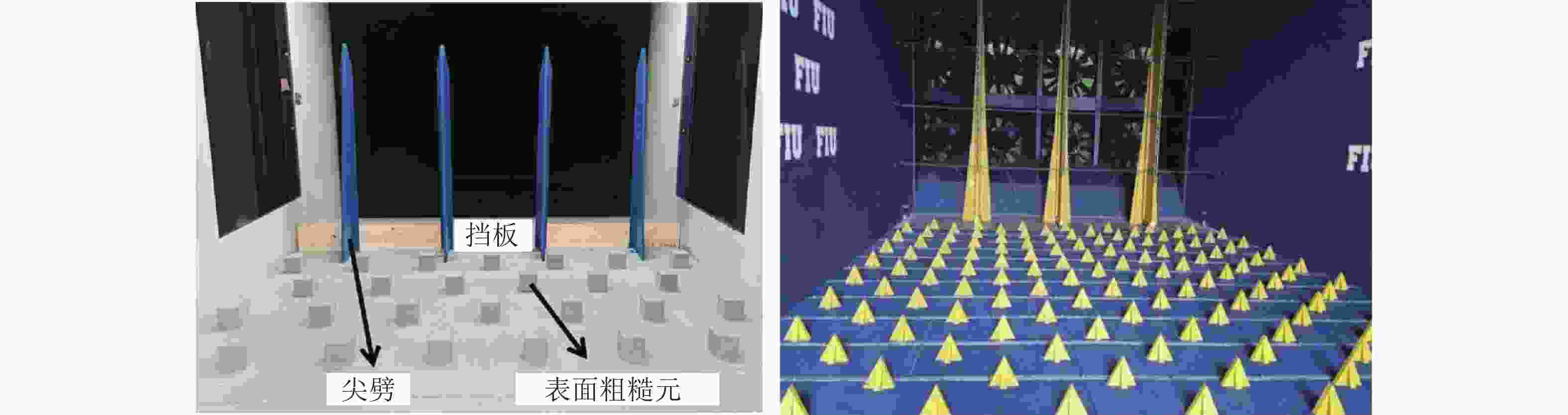
图 5 尖劈, 挡板, 表面粗糙程度单元(Aldereguía Sánchez C et al. 2023, Ludena et al. 2017)
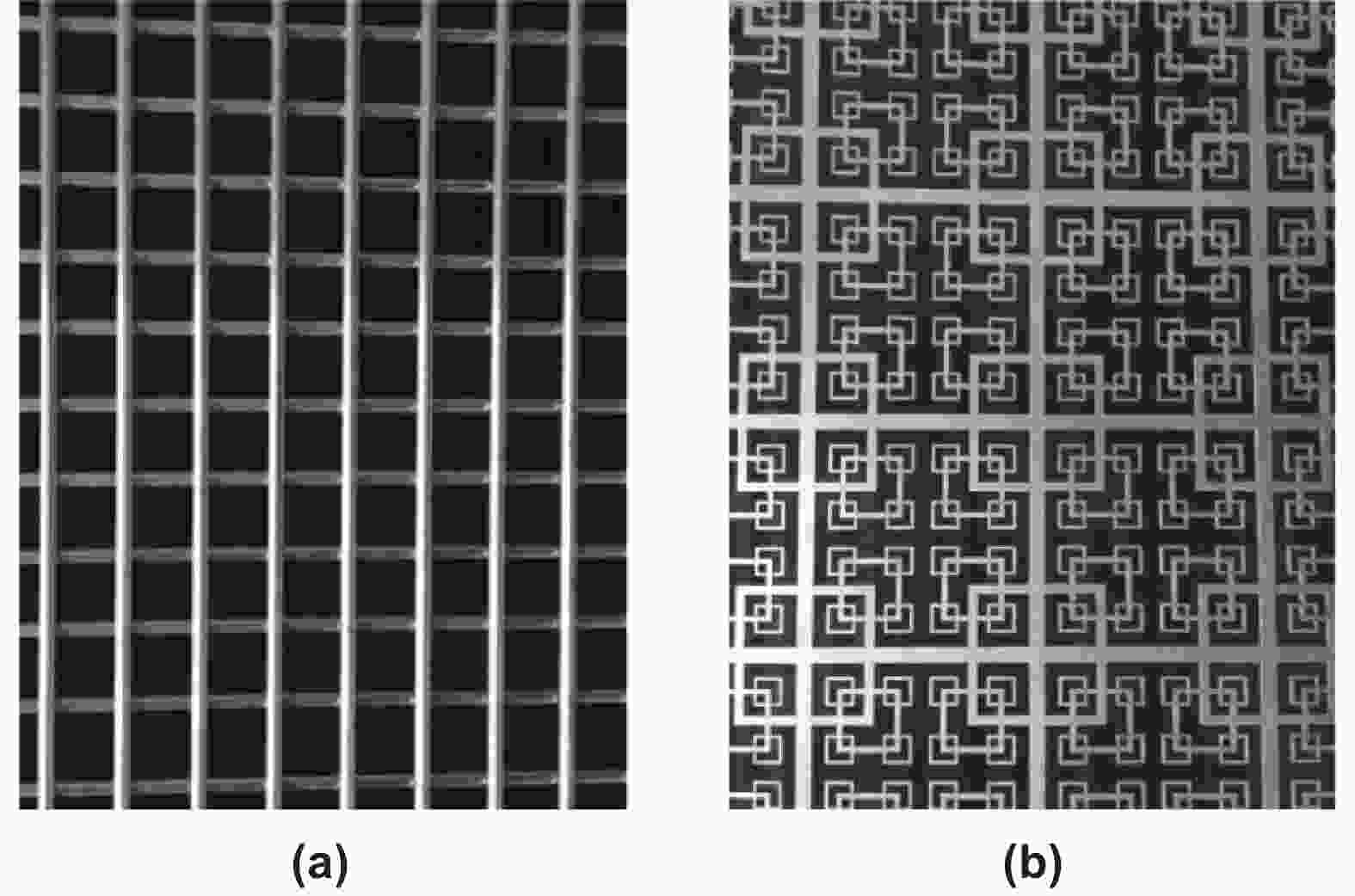
图 6 一些典型的被动湍流格栅装置实物图 (a) 被动湍流格栅, (b) 分型格栅(Hearst 2015)
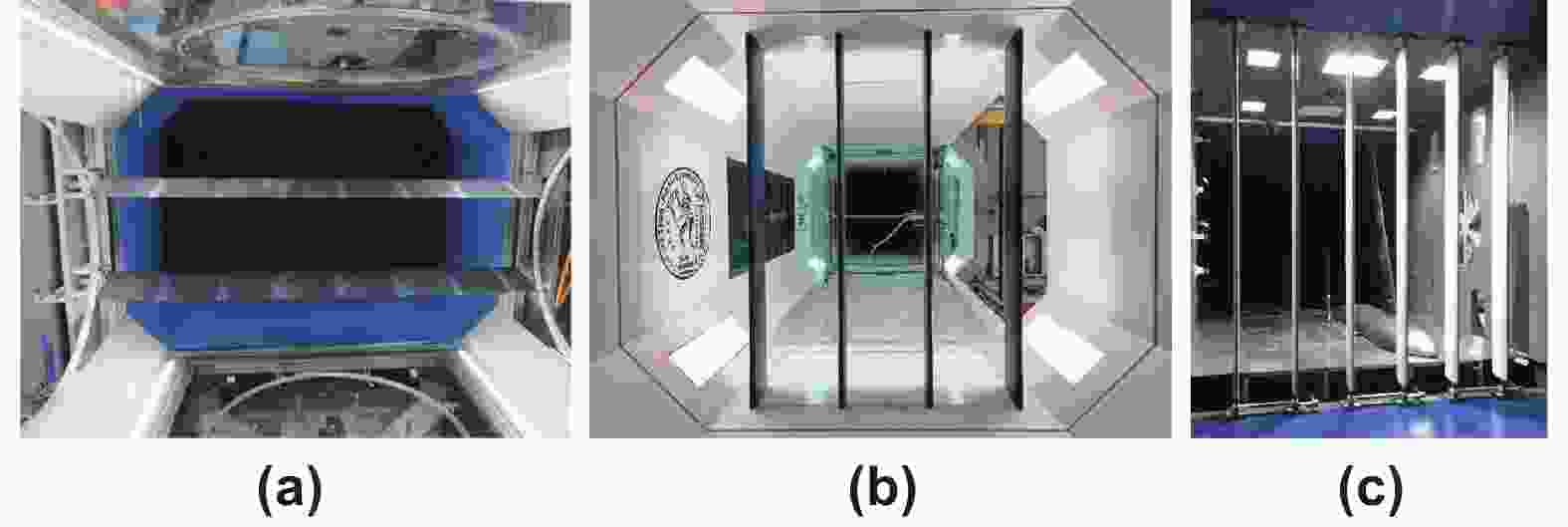
图 7 一些典型的阵风叶栅装置实物图 (a) 英国斯旺西大学风洞(Balatti et al. 2022), (b) 希腊雅典国立技术大学风洞(Manolesos et al. 2026), (c) 意大利米兰理工大学GVPM风洞(Fonte 2017)
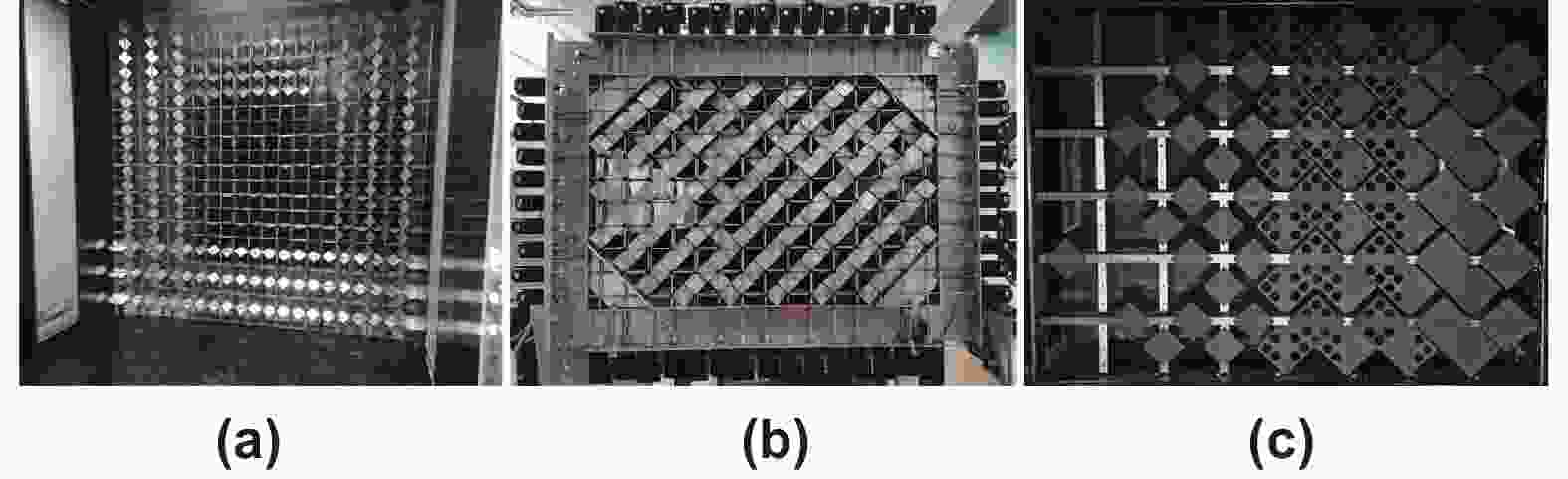
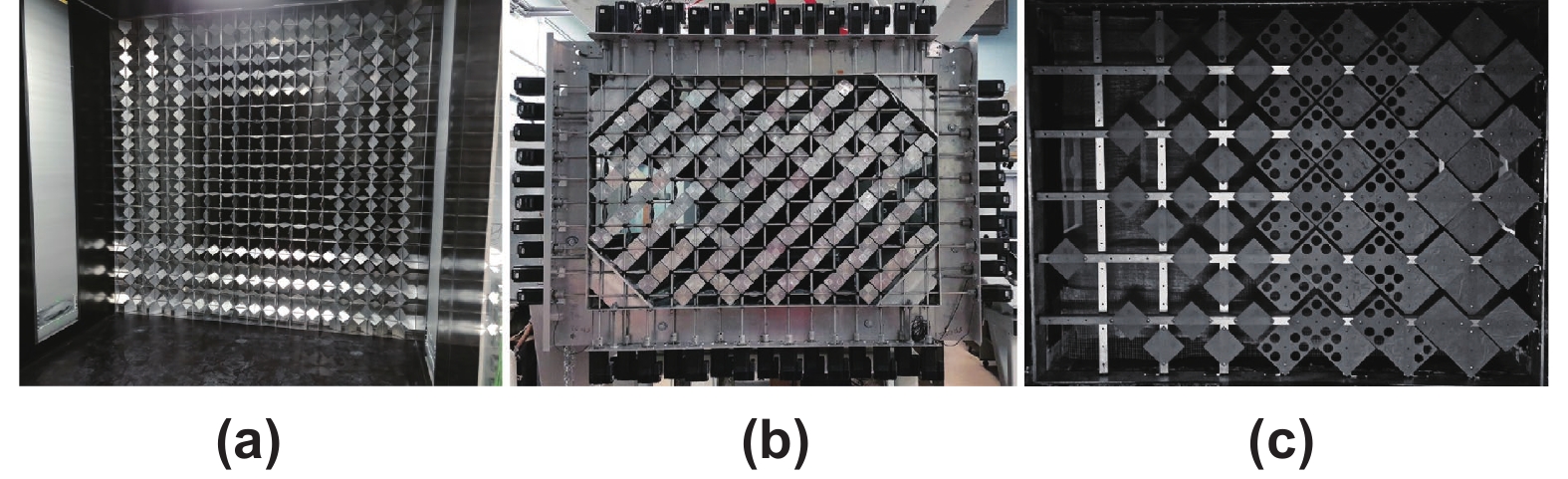
图 8 一些典型的主动湍流格栅装置实物图 (a) 德国欧登堡大学风洞(Neuhaus 2022), (b) 加拿大多伦多大学风洞(Azzam & Lavoie 2023), (c) 美国约翰霍普金斯大学风洞(Rumple 2024)
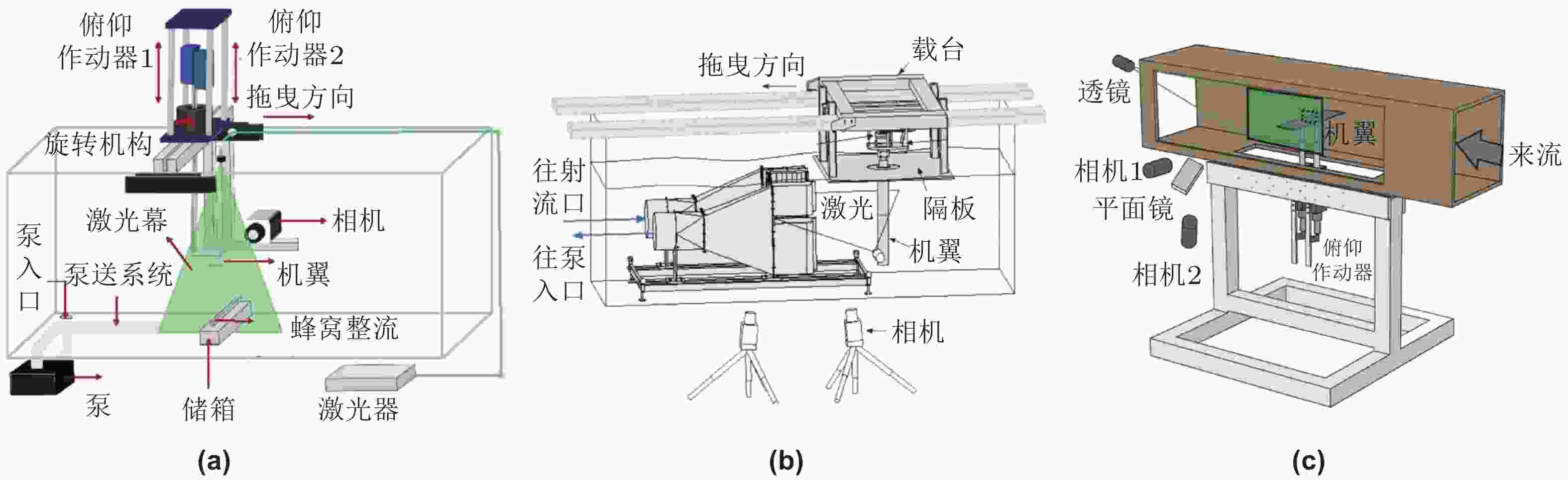
图 9 一些典型的运动机翼装置实物图 (a) 美国马里兰大学水洞 (Biler et al. 2021), (b) 英国剑桥大学水洞 (Gehlert & Babinsky 2019), (c) 德国达姆施塔特工业大学风洞 (Widmann & Tropea 2017)
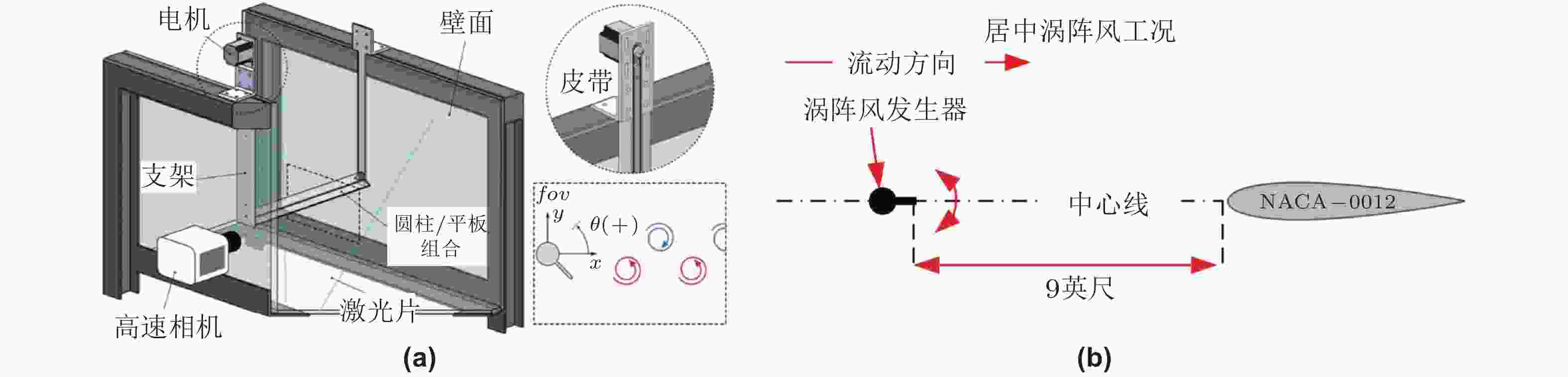
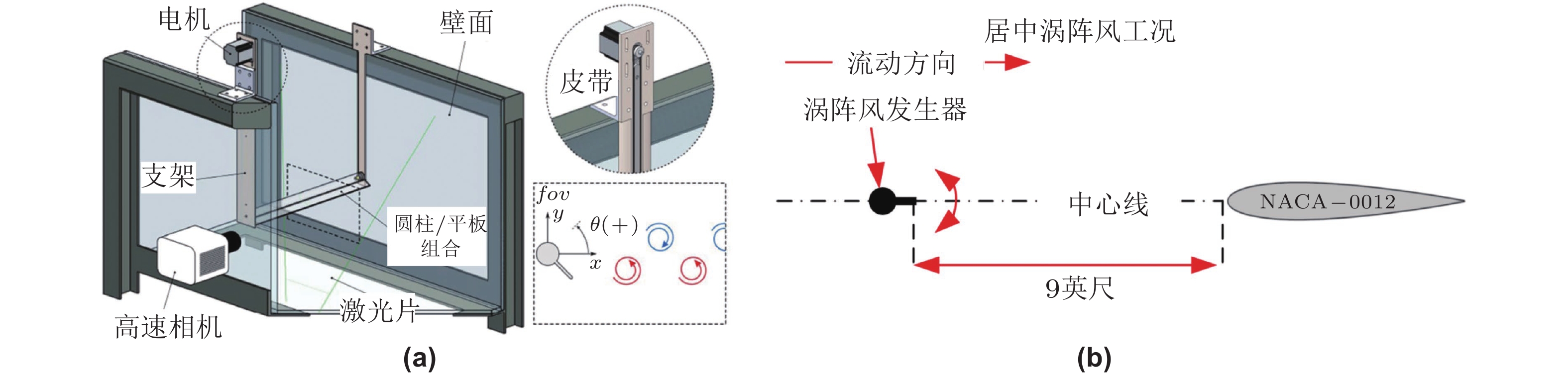
图 10 一些典型的旋转圆柱装置实物图 (a) 美国空军实验室水洞 (Rockwood & Medina 2020), (b) 美国戴顿大学水洞(Durgesh et al. 2026)
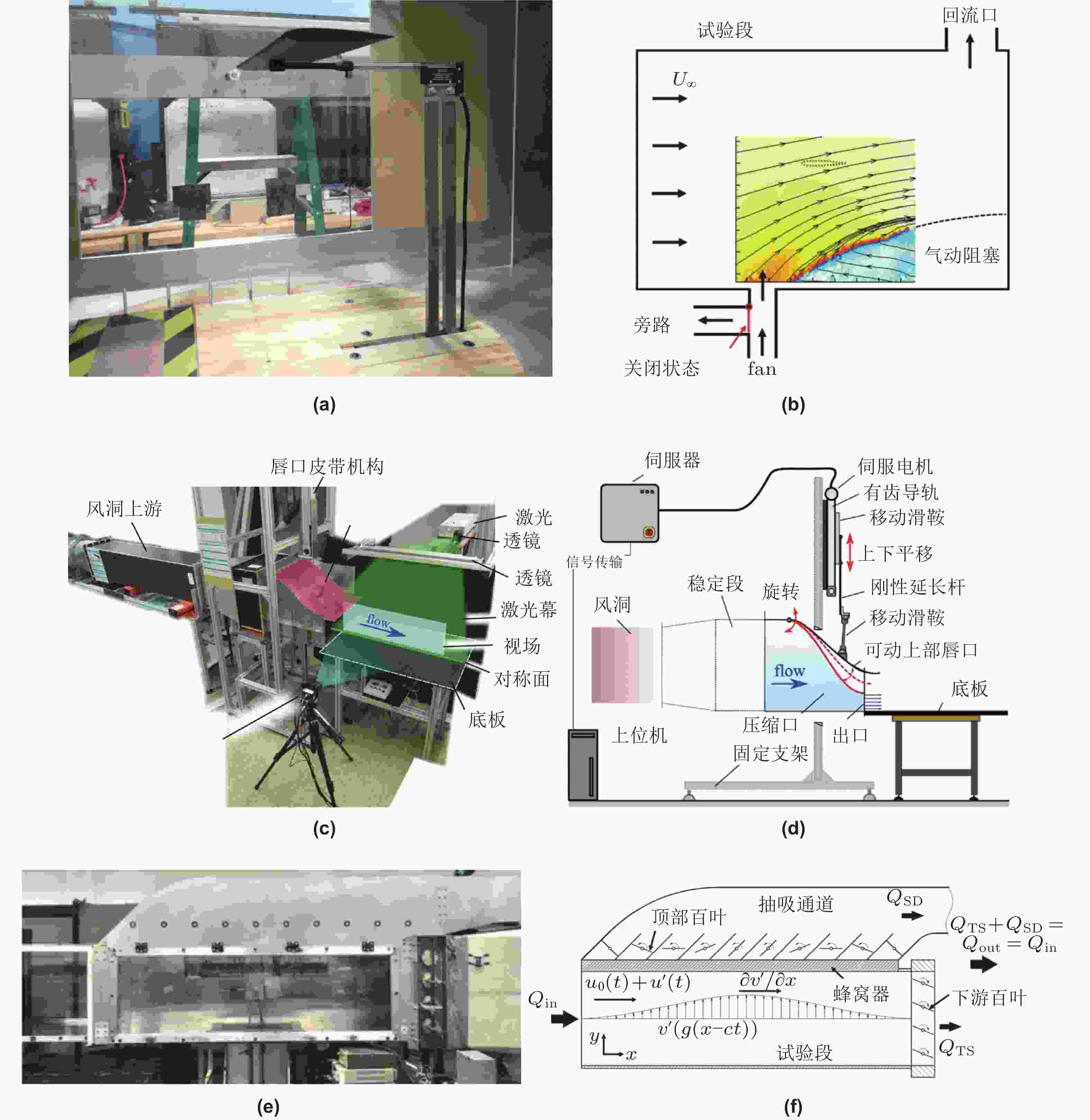
图 11 流动阻塞装置实物与示意图 (a) ~ (b) 美国陆军实验室MAWT风洞ARGGUS阵风发生装置(Stutz et al. 2022b), (c) ~ (d) 德国汉堡国防大学风洞阵风发生装置(Wood & Breuer 2025), (e) ~ (f)美国伊利诺伊大学大学香槟分校AFUWT风洞阵风发生装置(He et al. 2022)
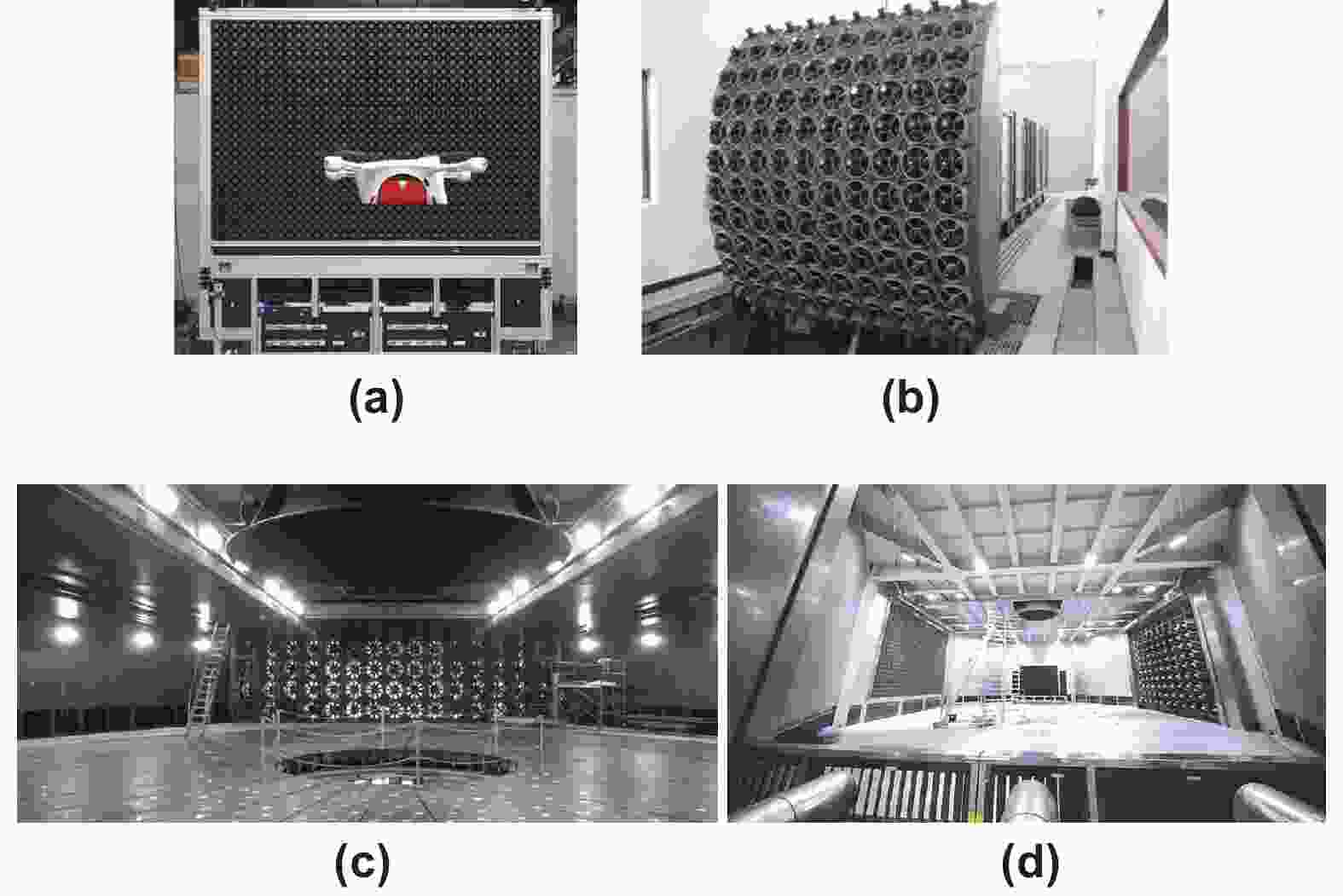
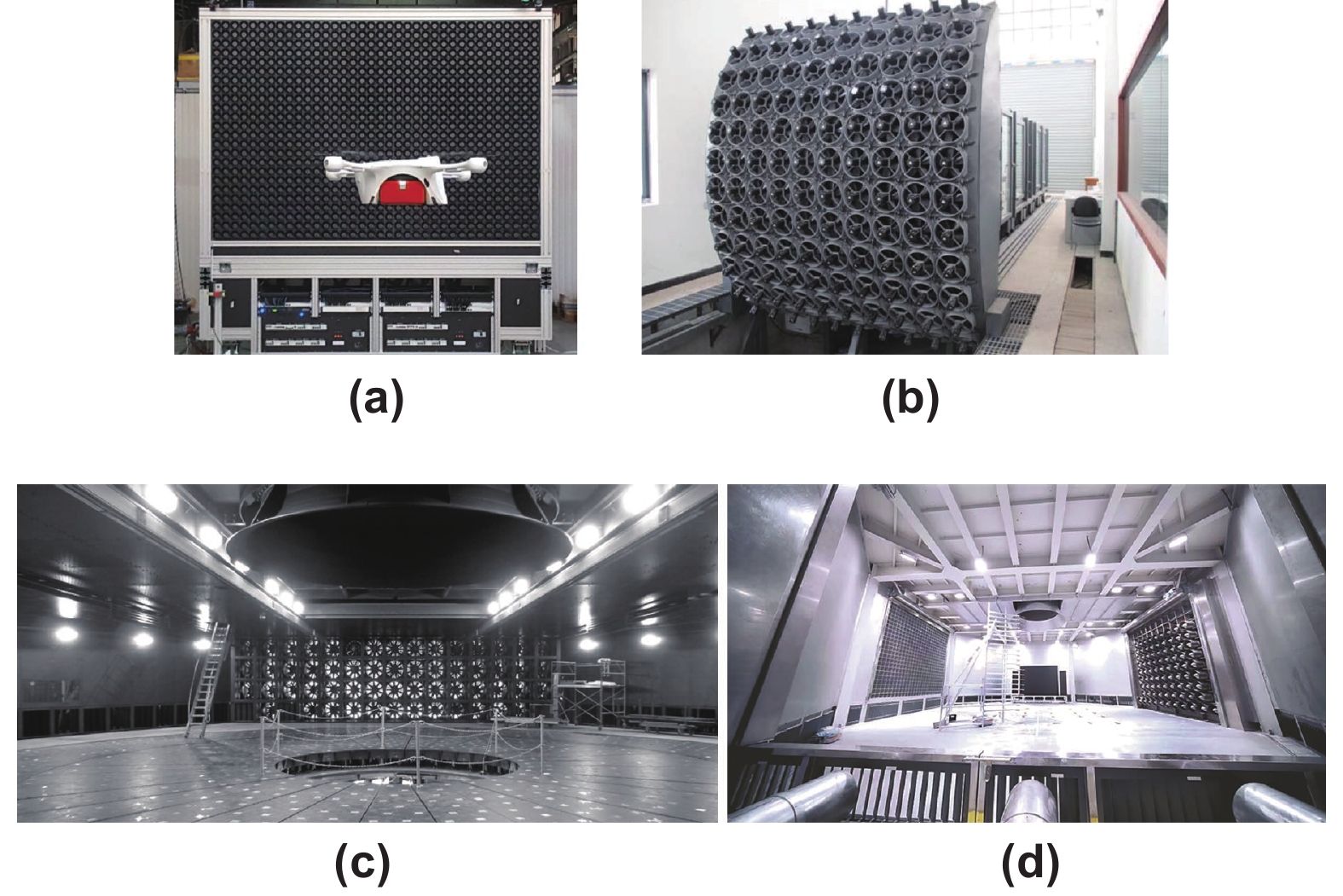
图 12 风机矩阵实物图 (a) 瑞士西部应用科学与艺术大学风墙(Walpen et al. 2024), (b) 中国同济大学多风机阵列风洞(Cao et al. 2017), (c) 加拿大西安大略大学WindEEE风洞, (d) 中国电子科技大学深思实验室三维风洞
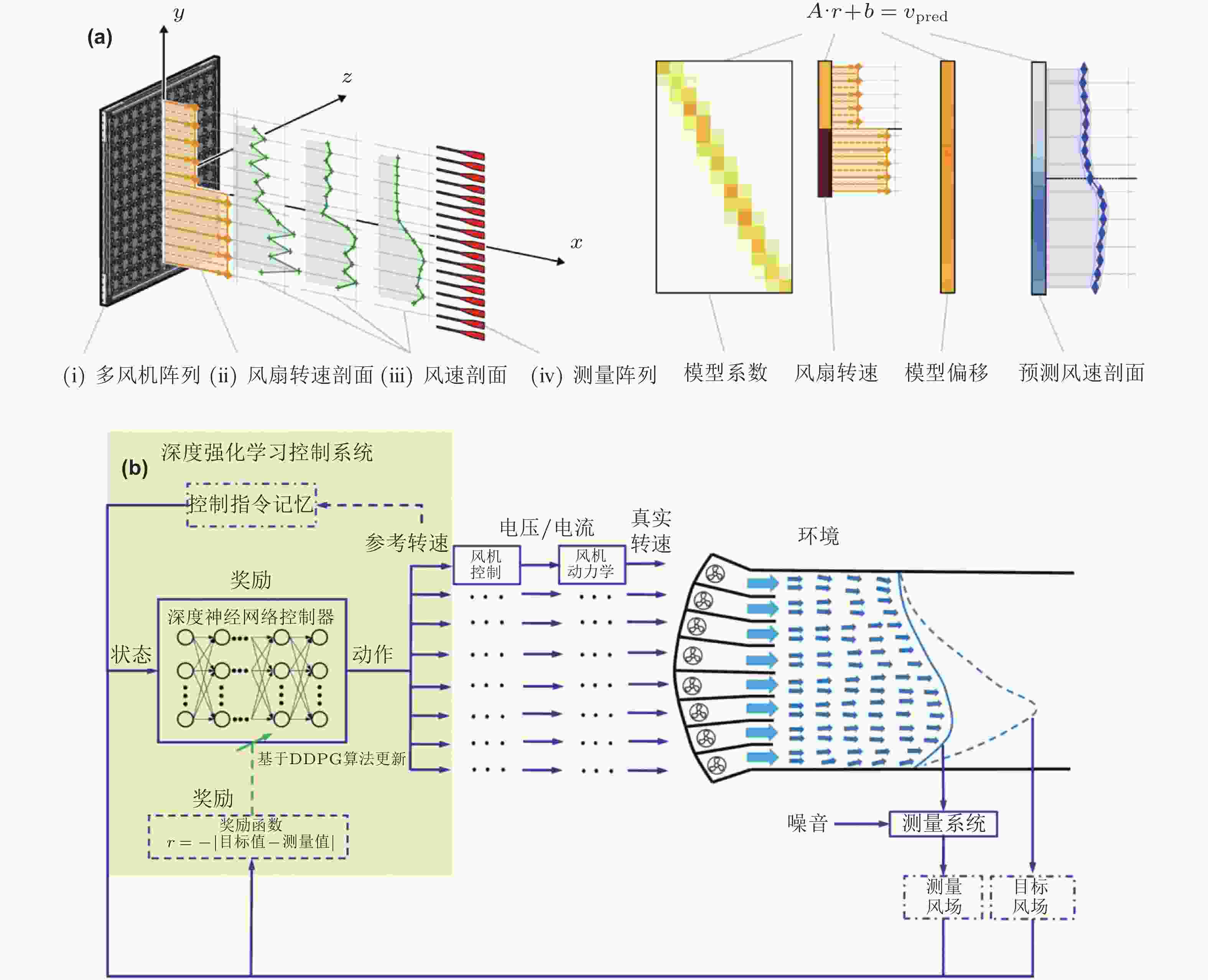
图 13 风机矩阵控制算法示意图 (a) 美国加州理工学院数据驱动建模(Stefan-Zavala et al. 2026), (b) 美国布法罗大学深度学习方法和DDPG方法 (Li et al. 2021)
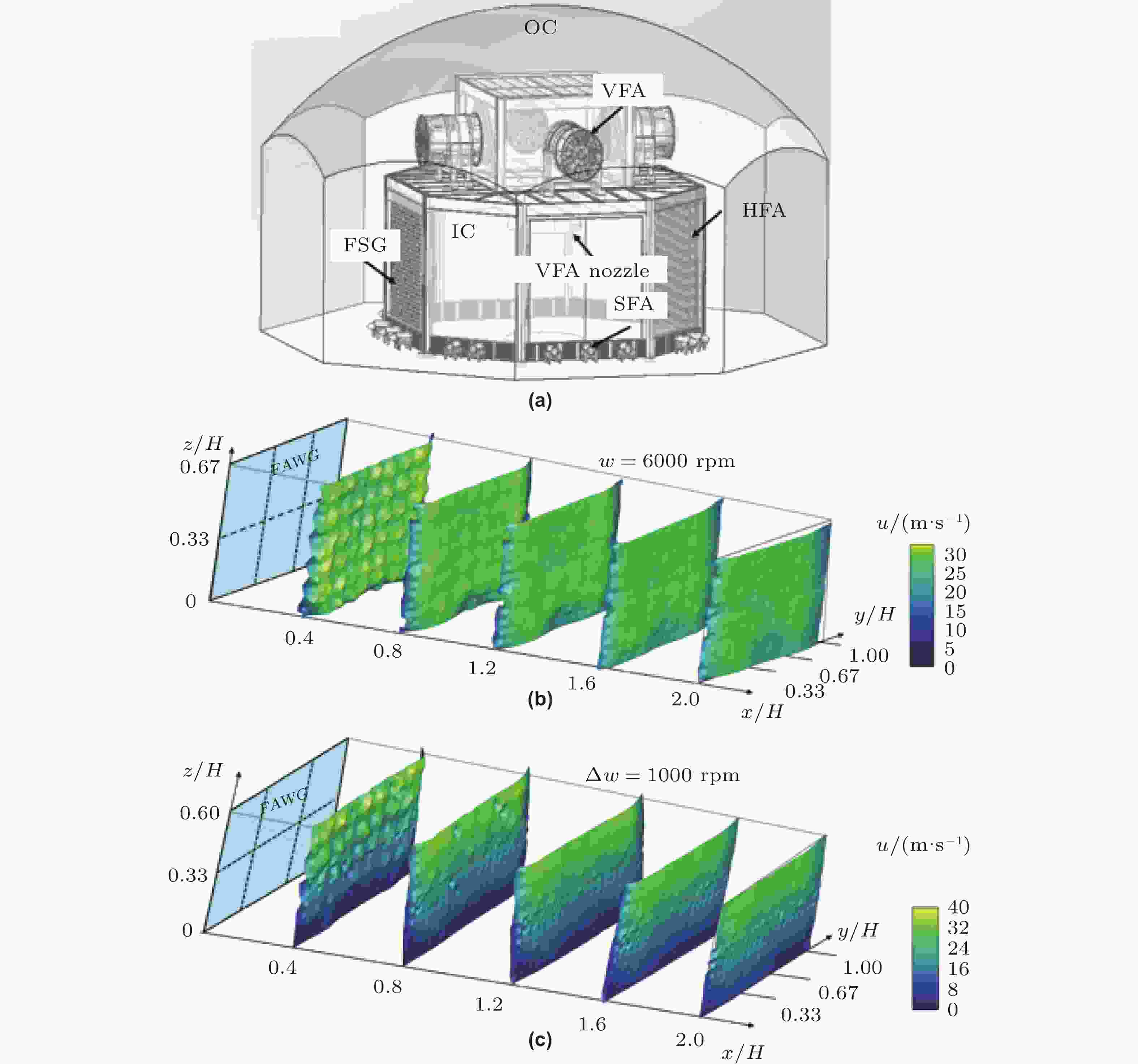
图 14 风矩阵的构造及水平流模拟能力 (a) 风矩阵装置构造HFA 水平风机阵列VFA 垂直风机阵列SFA旋流风机阵列, (b) HFA生成的强湍流沿流向的演化, (c) HFA生成的风切变沿流向的演化(Wang et al. 2026)
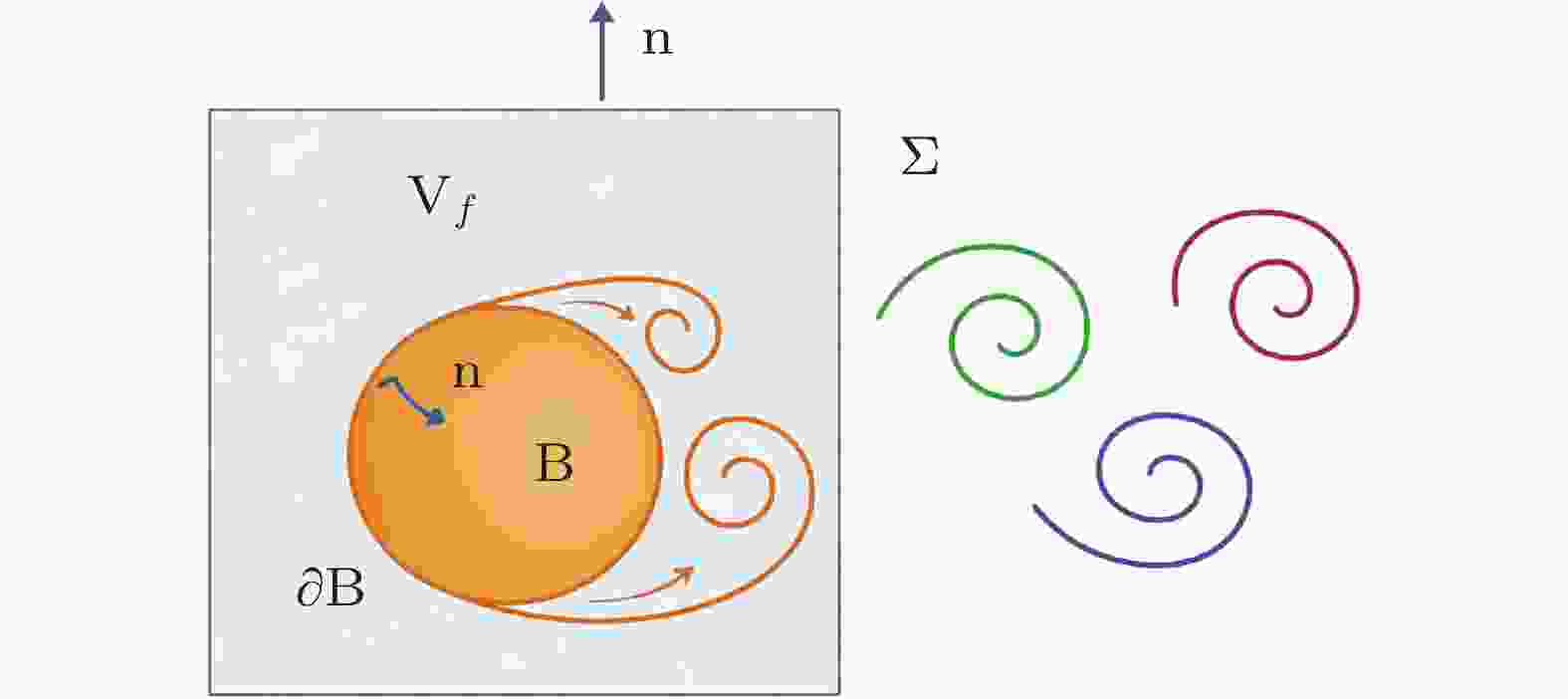
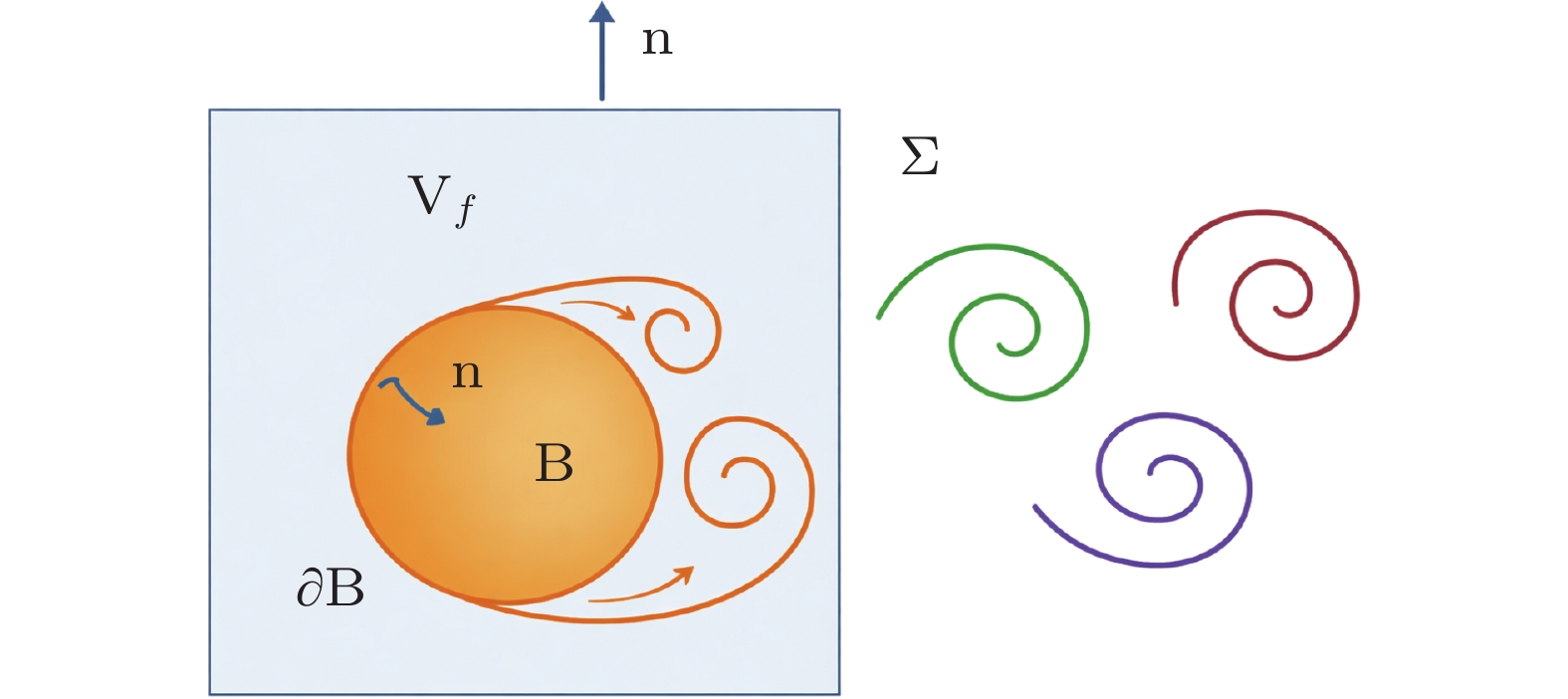
图 15 最小域冲量理论示意图 (改自文献(Kang et al. 2018))
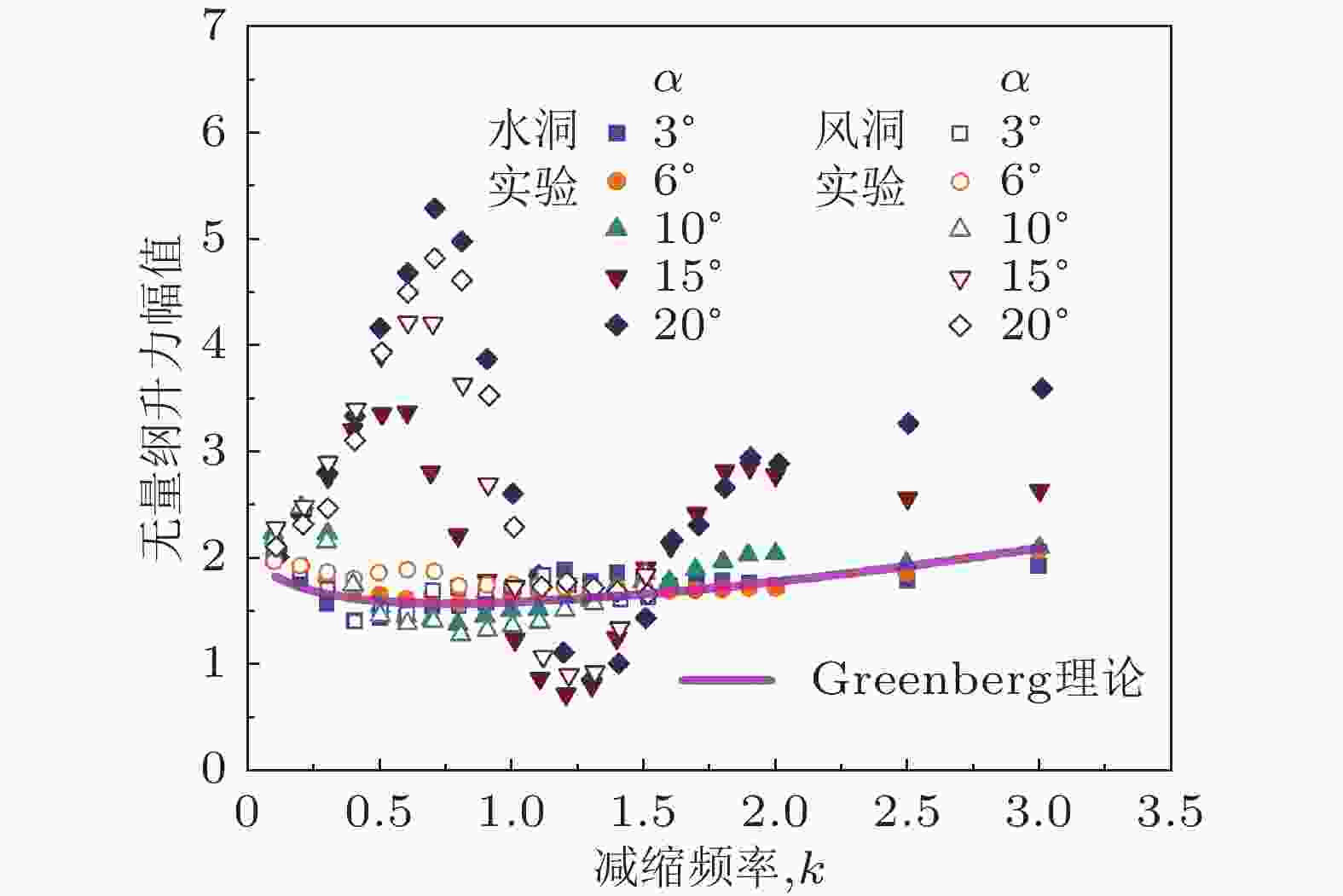
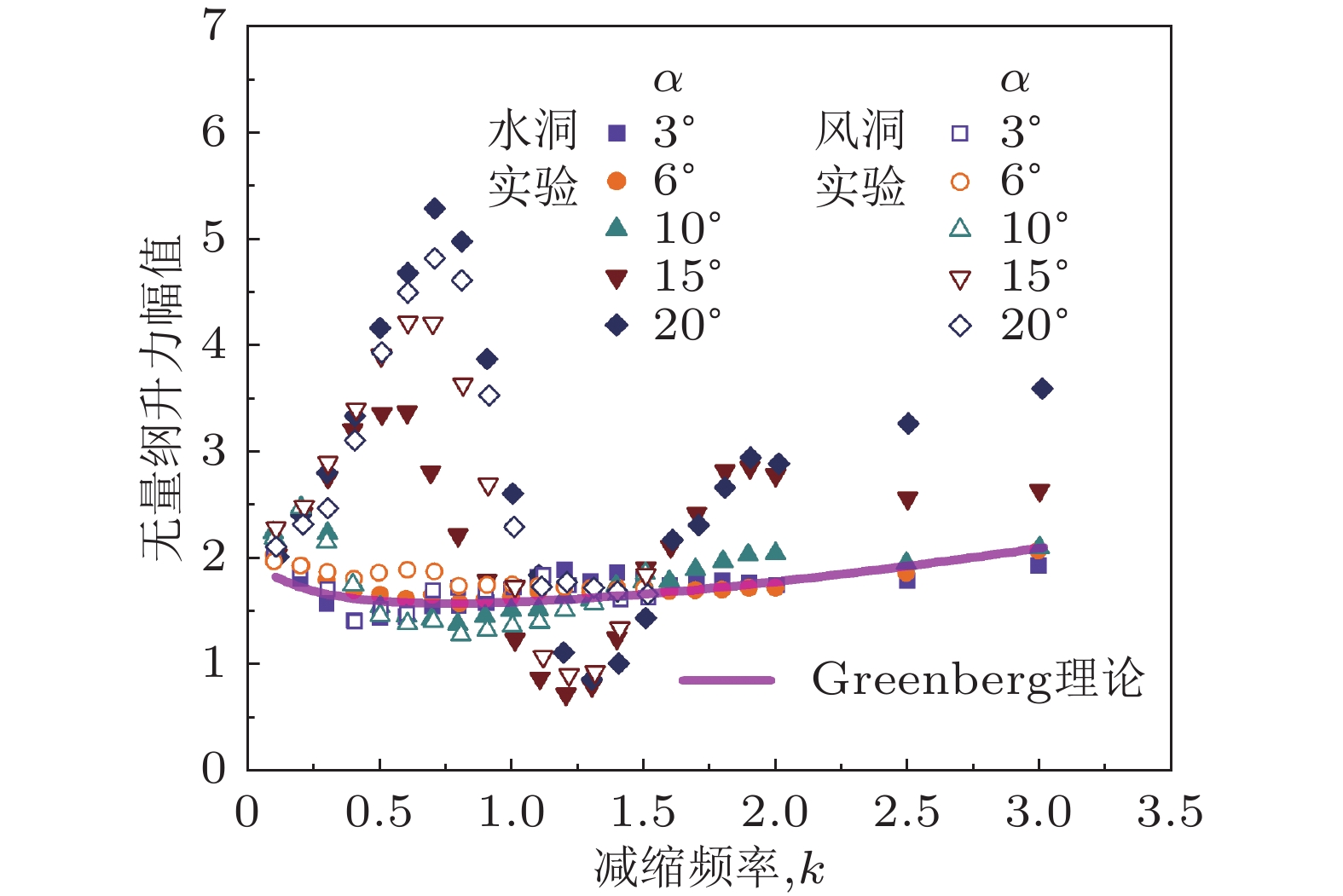
图 16 不同攻角下升力幅值随减缩频率的变化 (数据来自文献(Granlund et al. 2014))
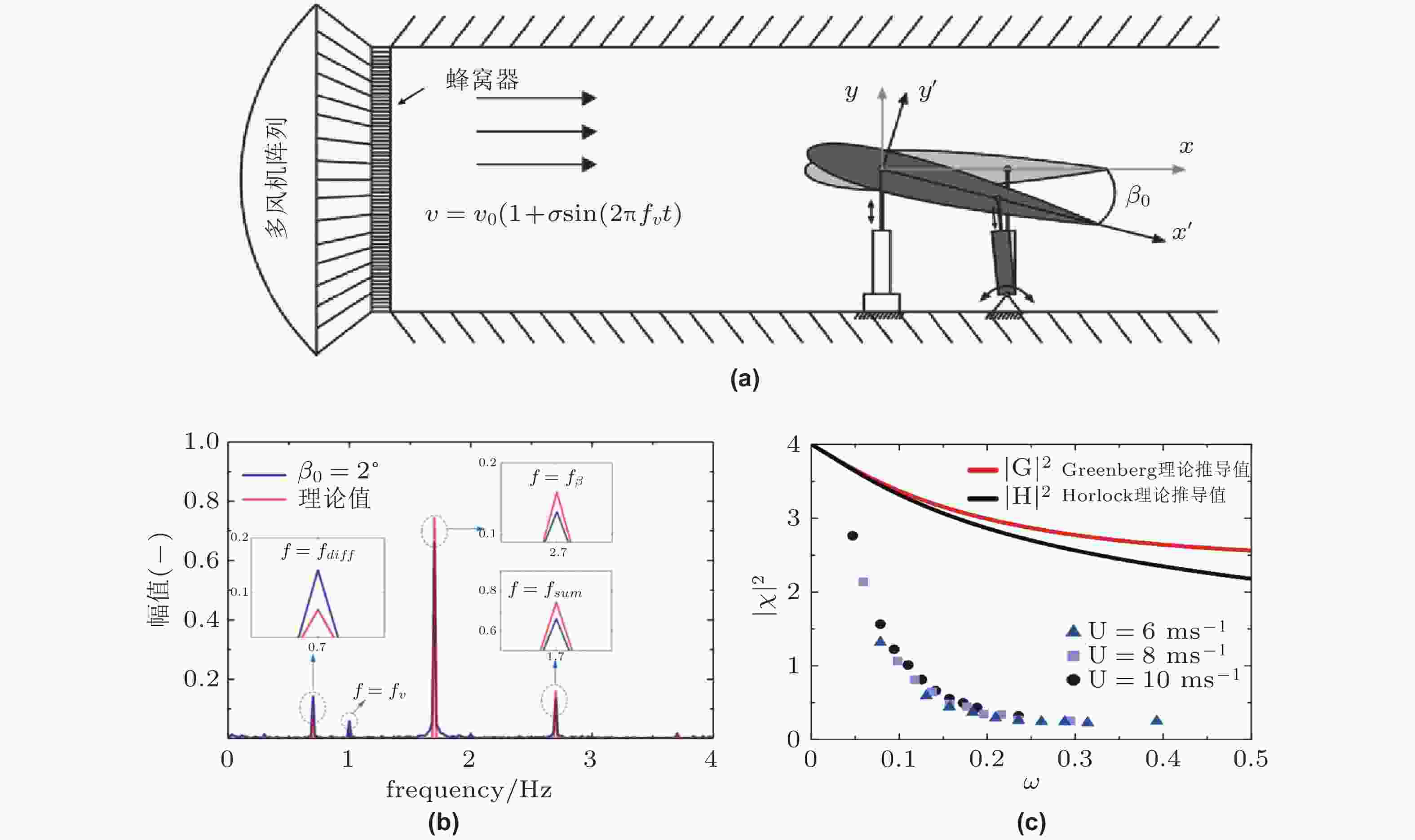
图 17 (a) 实验装置示意图, (b) 定常升力系数傅里叶频谱(Ma et al. 2021), (c) 气动导纳幅值理论与试验对比图(Yang et al. 2017)
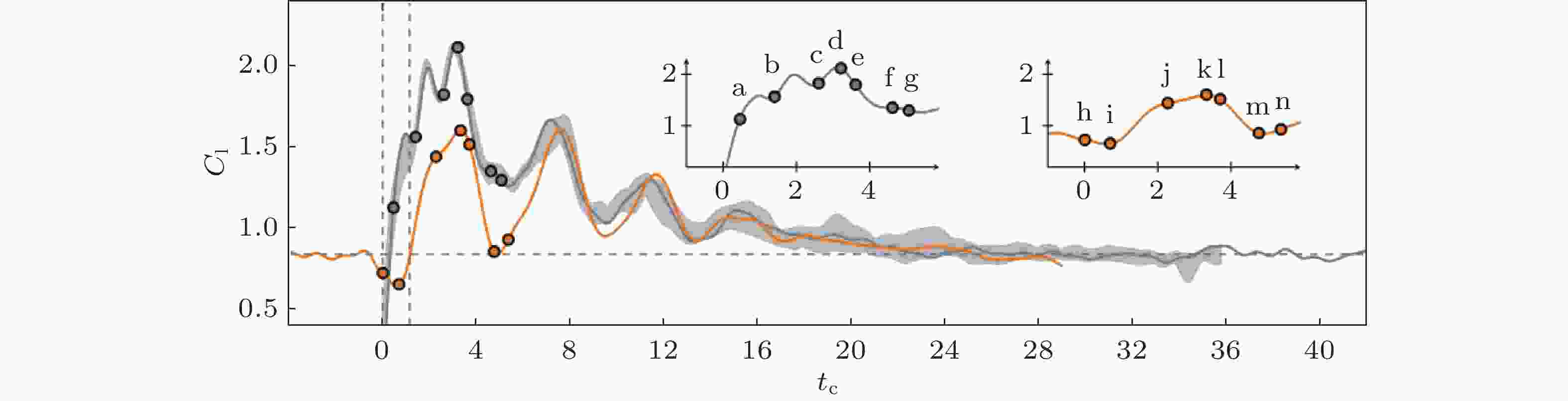
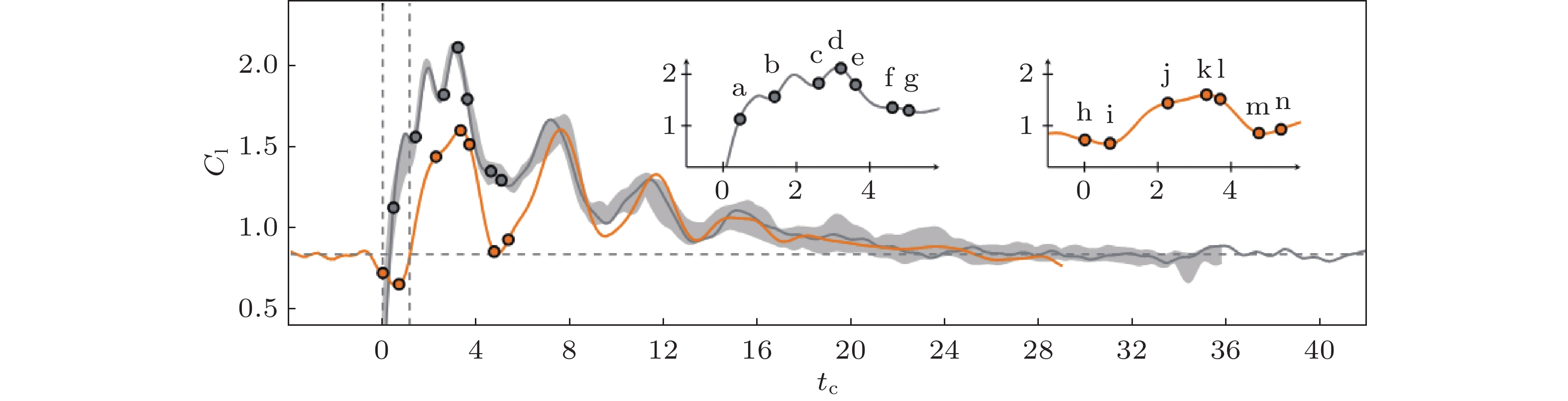
图 18 静止起步 (灰色) 与基准来流U0加速 (橙色) 工况的升力响应(Mulleners et al. 2017)
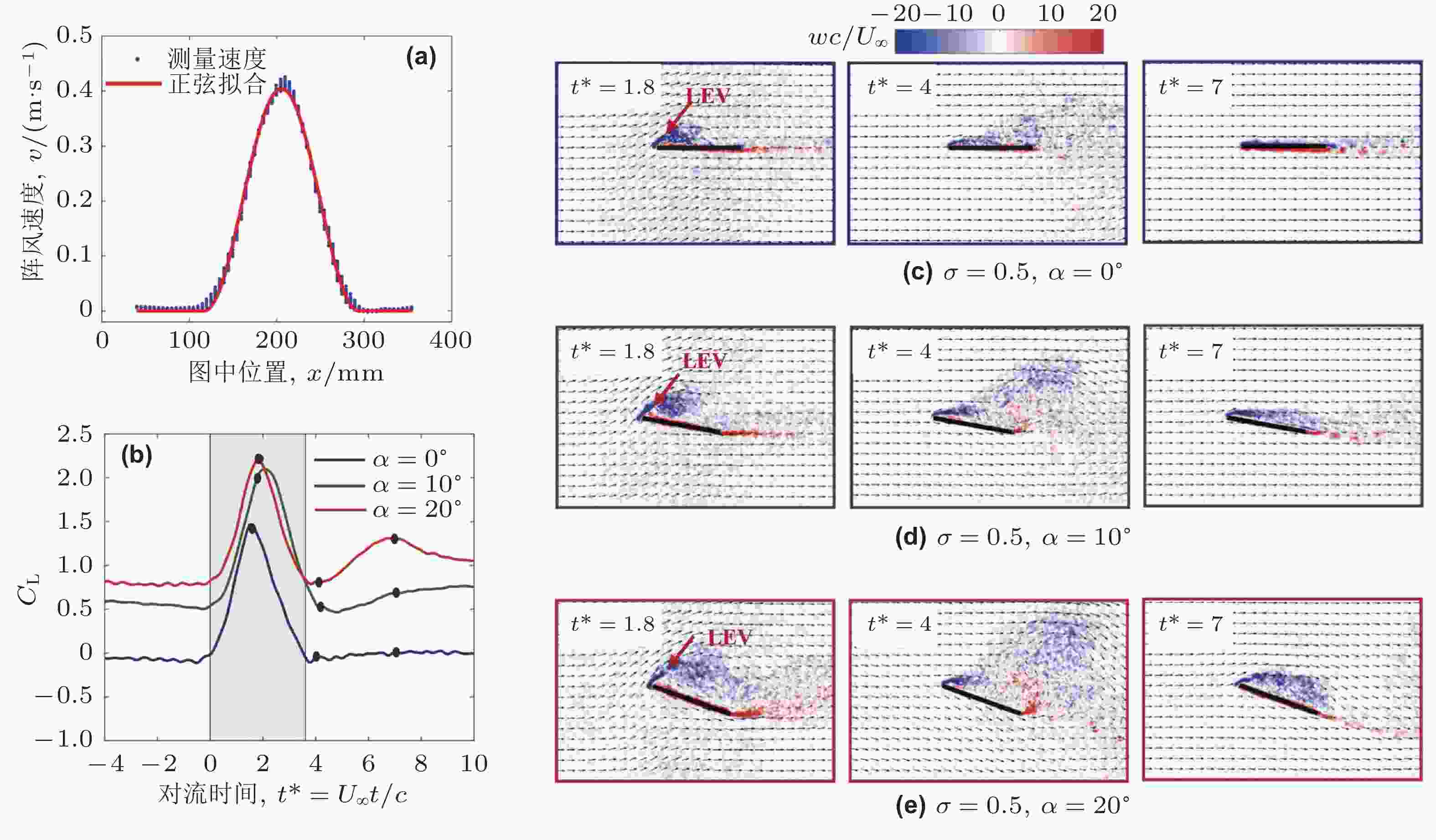
图 19 在UMD拖曳水槽中的“正弦平方阵风”作用下的实验结果, 实验模型为攻角α = 0°、10°和20°的平板机翼, 穿越阵风比$ \sigma $ = 0.5的阵风区域. (a) “正弦平方阵风”速度剖面, (b)升力系数CL随时间变化的历程, (c) ~ (e)对应(b)中标记时刻的流场结构(Biler & Jones 2020)
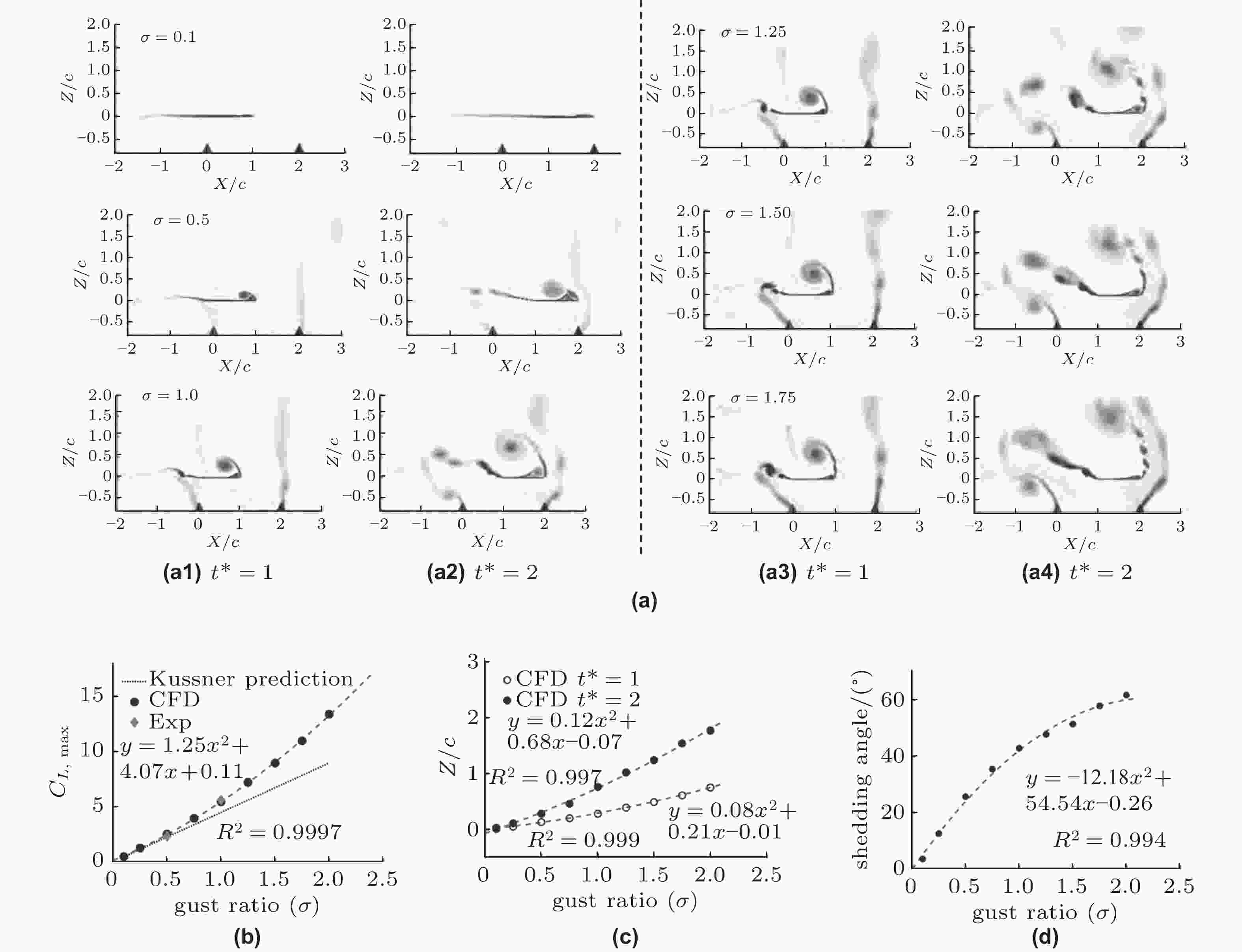
图 20 阵风因子对气动特性的影响 (a) 涡量分布云图, (b) 最大升力系数, (c) LEV垂直于翼面的位置, (d) LEV脱落角(注: t*表示翼型穿过阵风区域的对流时间, Bonnet et al. 2024)
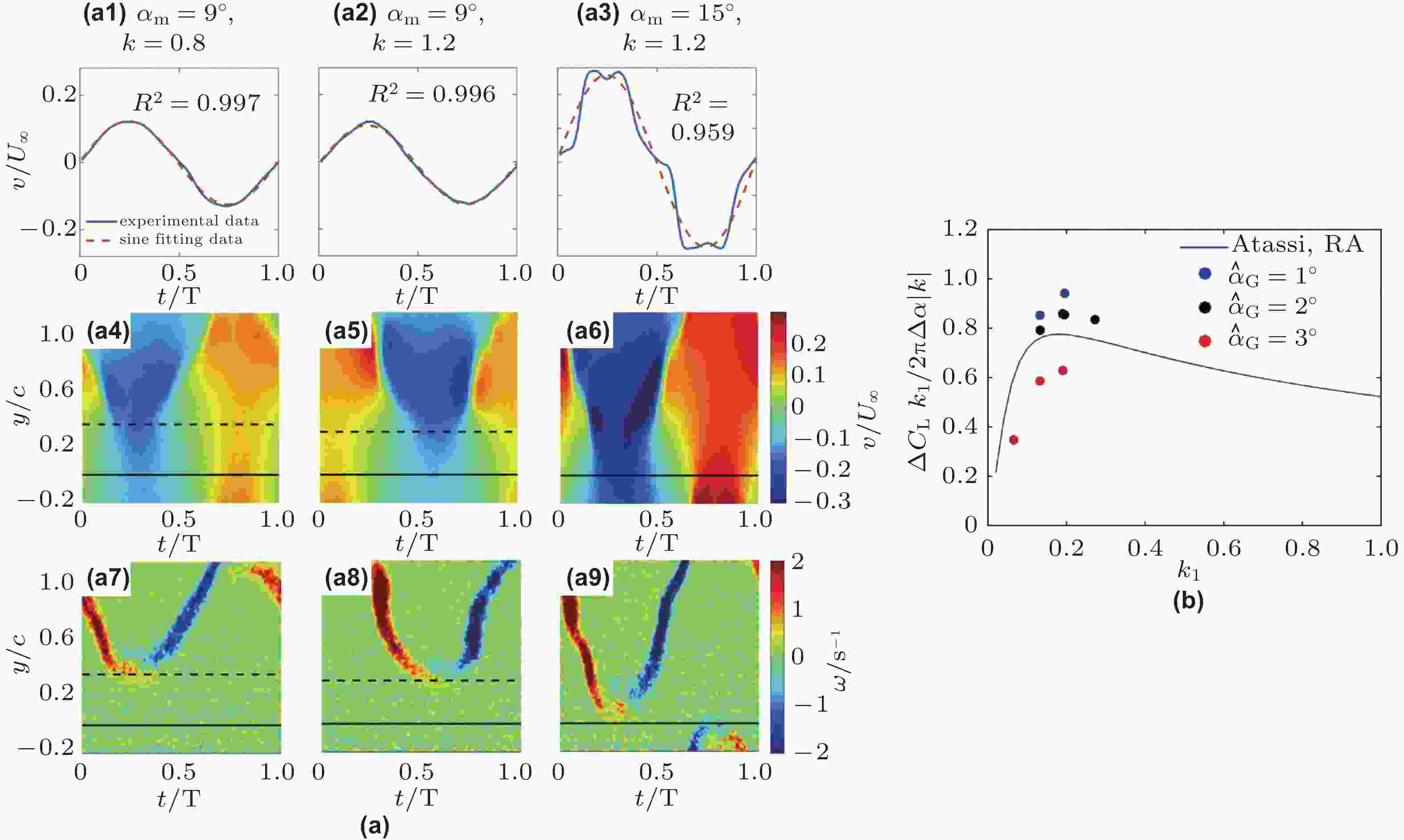
图 22 减缩频率对(a)流场特性(Du et al. 2024)和(b)气动特性的影响(Young & Smyth 2021)
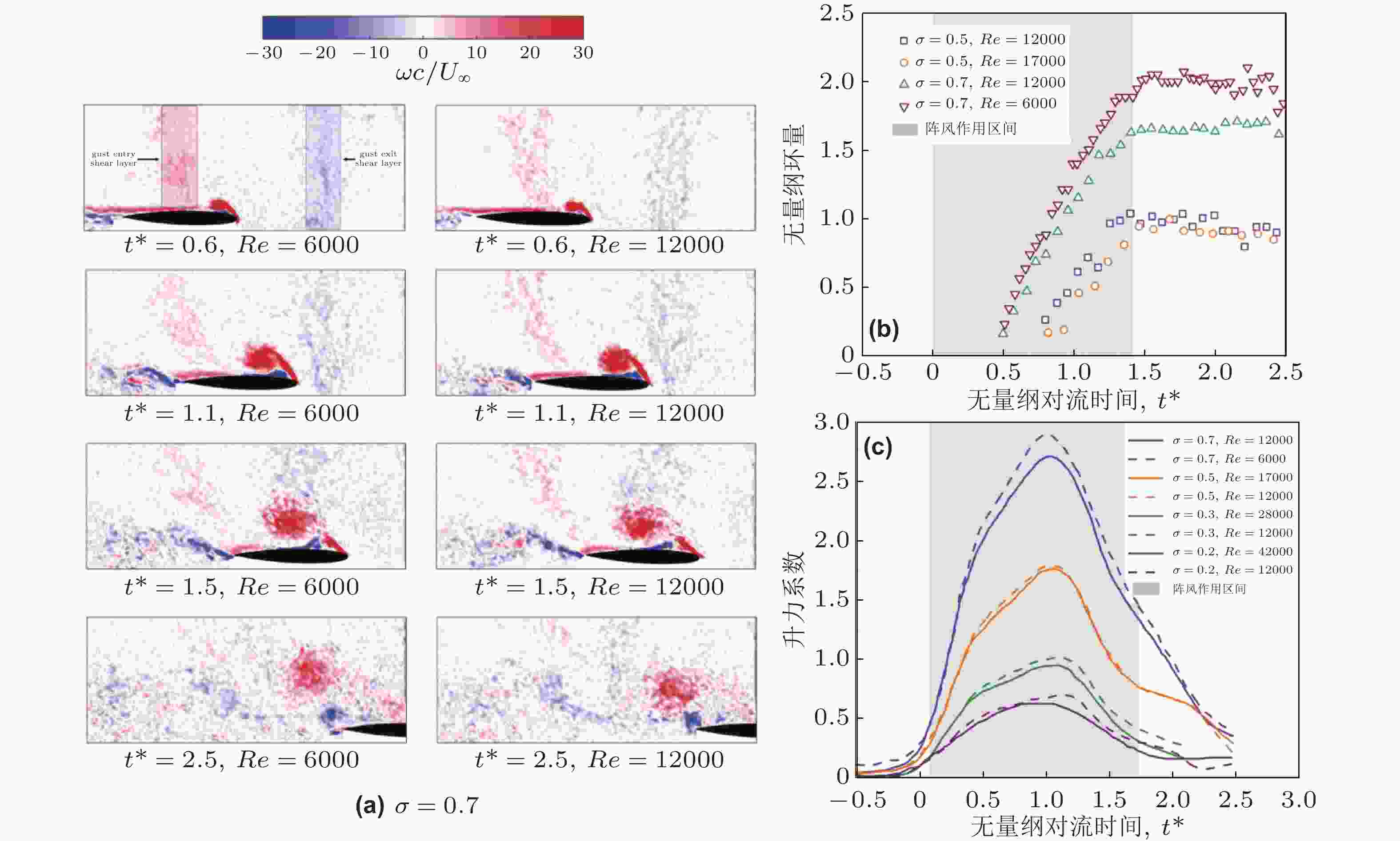
图 21 雷诺数对气动特性的影响, 改编自文献(Gementzopoulos et al. 2022)
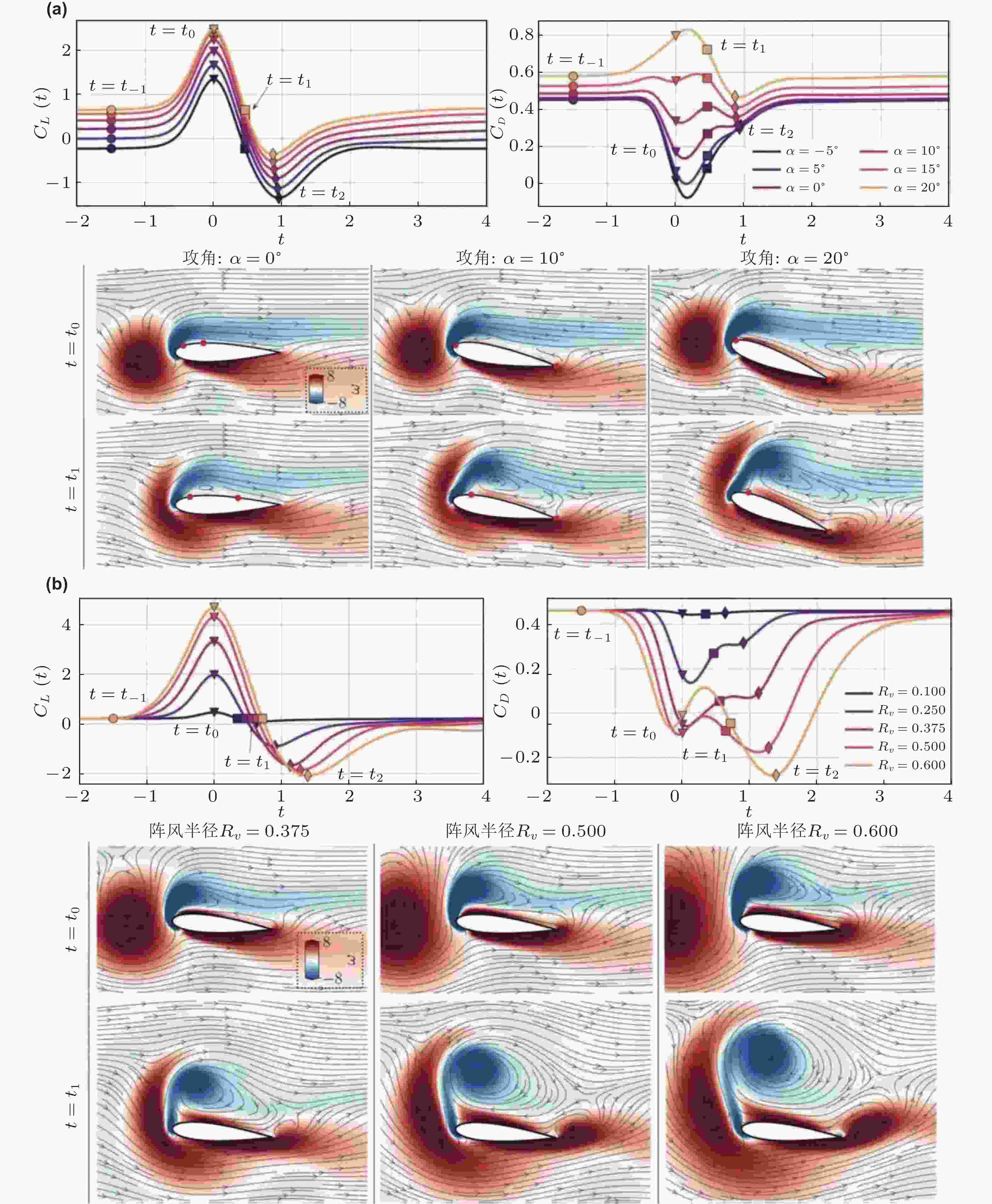
图 25 翼型攻角(a)和涡阵风半径(b)对气动响应及流场结构的影响(Lopez-Doriga et al. 2025)
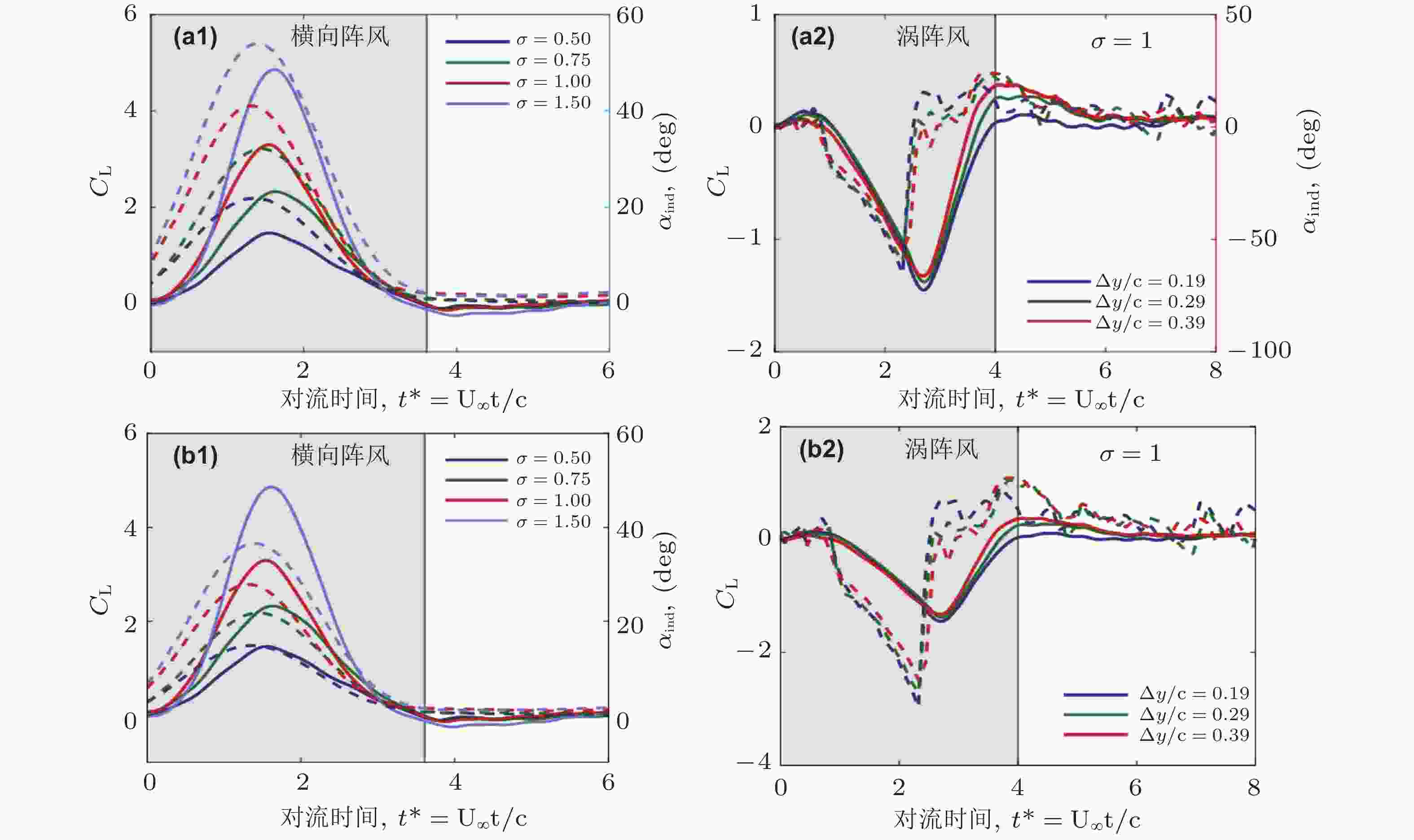
图 24 不同阵风作用下CL及诱导攻角随对流时间的演化对比 (a1) ~ (b1)不同阵风因子横向阵风; (a2) ~ (b2)涡阵风($ \sigma $= 1)在不同横向位置 Δy/c 条件下的响应(Biler et al. 2021)
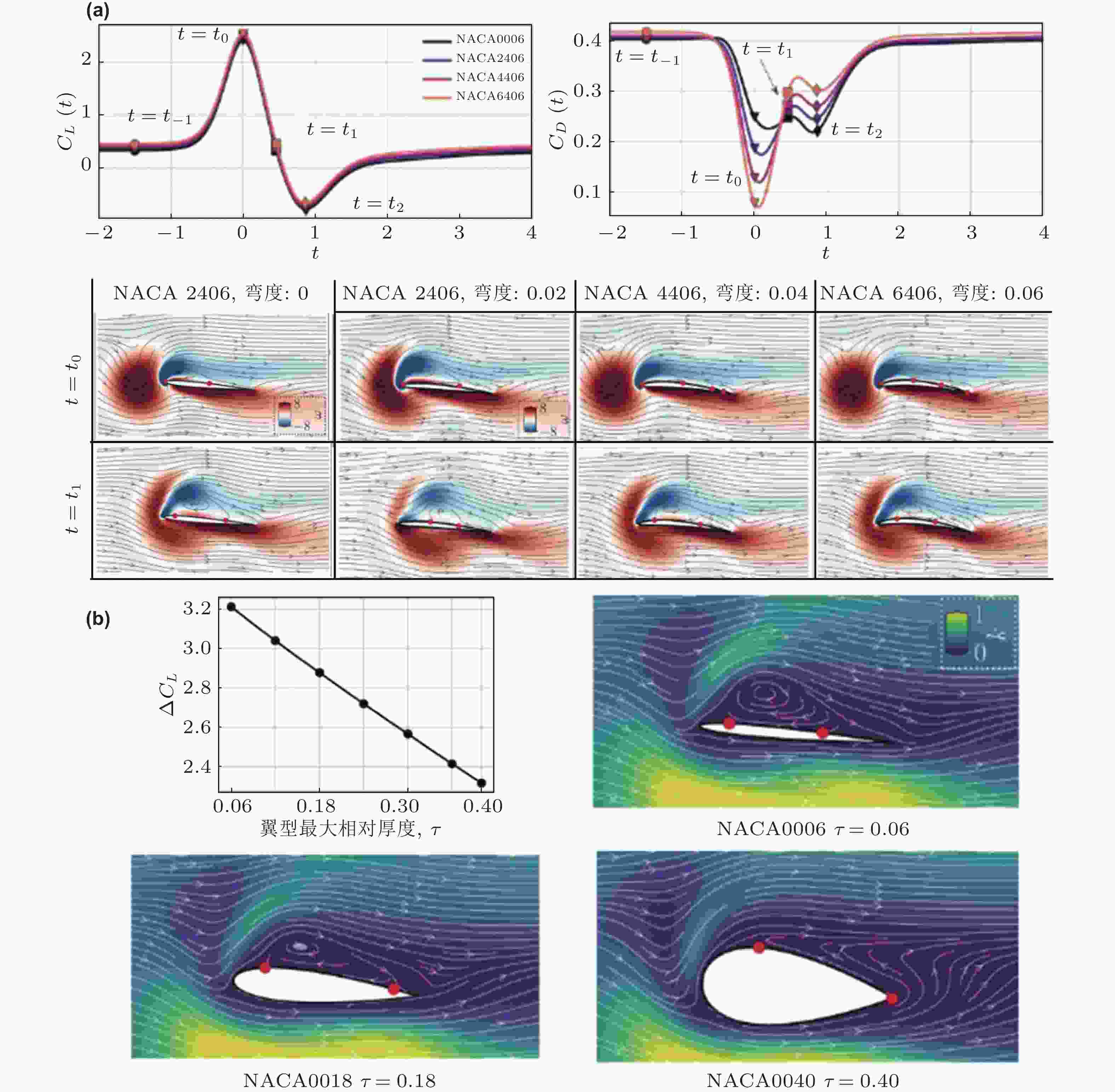
图 26 翼型弯度(a)与厚度(b)对涡阵风气动响应及流场结构的影响(Lopez-Doriga et al. 2025)
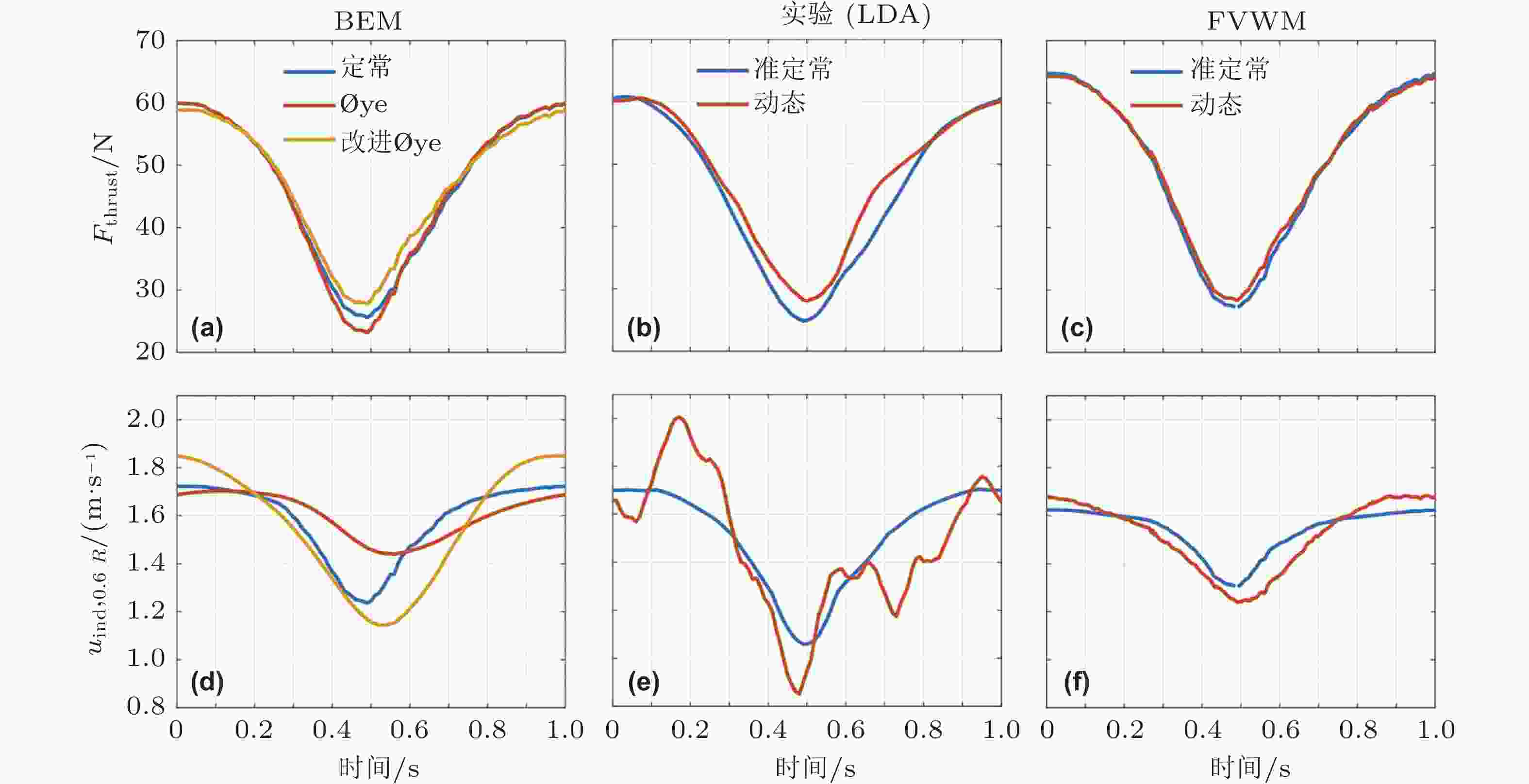
图 27 正弦轴向阵风工况下, 0.6倍桨盘半径位置的(a)稳态与动态推力、(d)诱导速度 (数据来自原始及改进Øye 动态入流模型), (b)、(e)对应试验测量与(c)、(f) FVWM仿真(Berger et al. 2022)
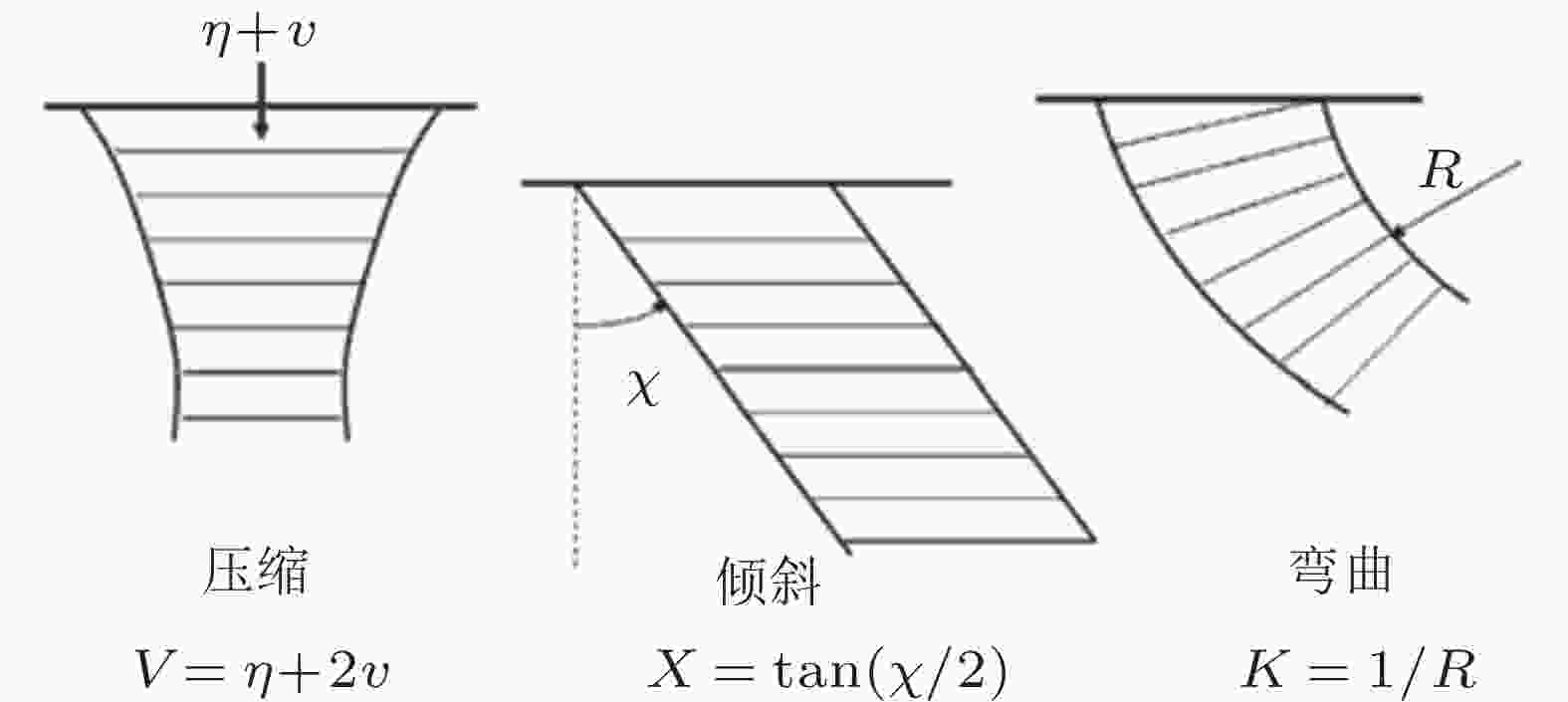
图 28 需要对动态入流模型进行修正的几种尾流形态(Zhao et al. 2004)
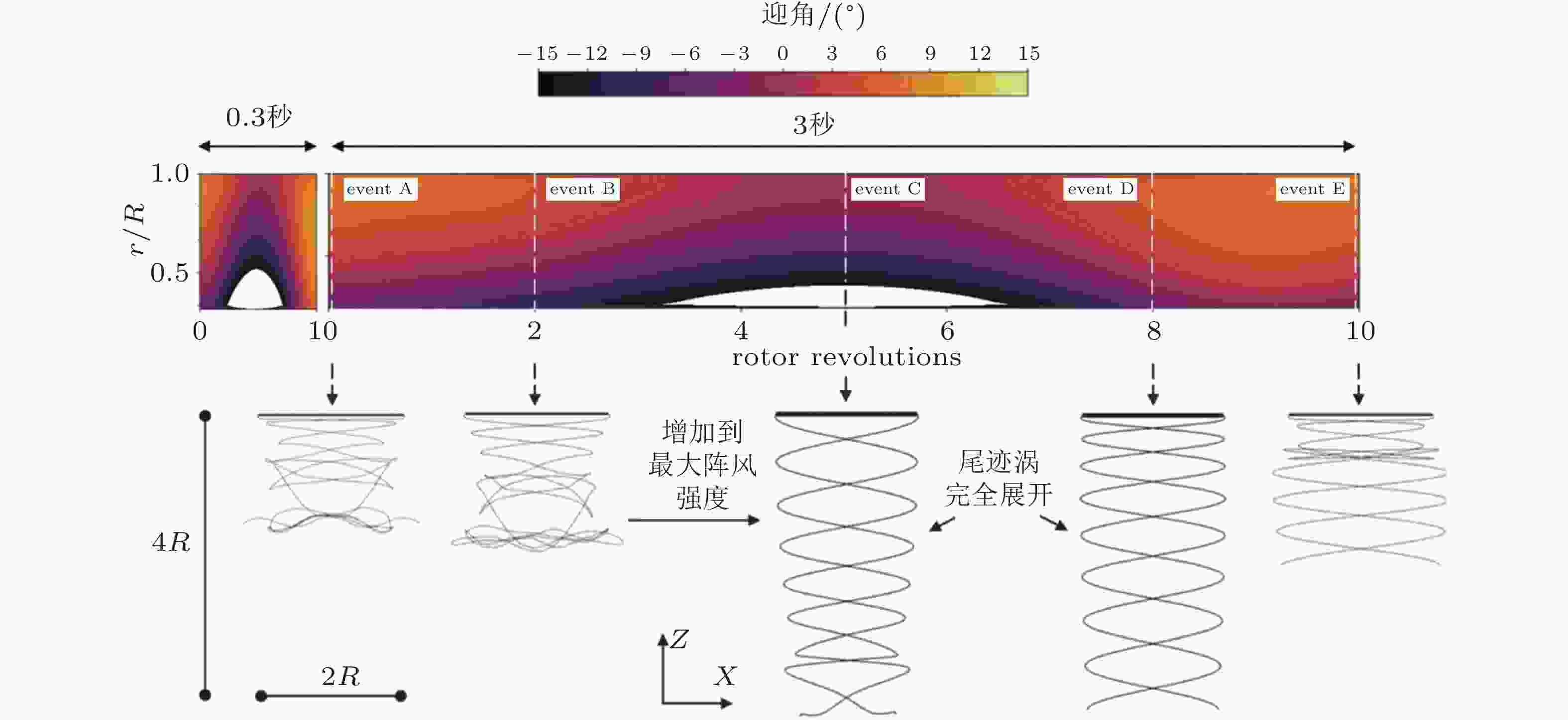
图 29 悬停情况下, Harrington旋翼受轴向阵风影响下旋翼攻角和尾流涡结构的演化过程(Narayanan & Govindarajan 2024)
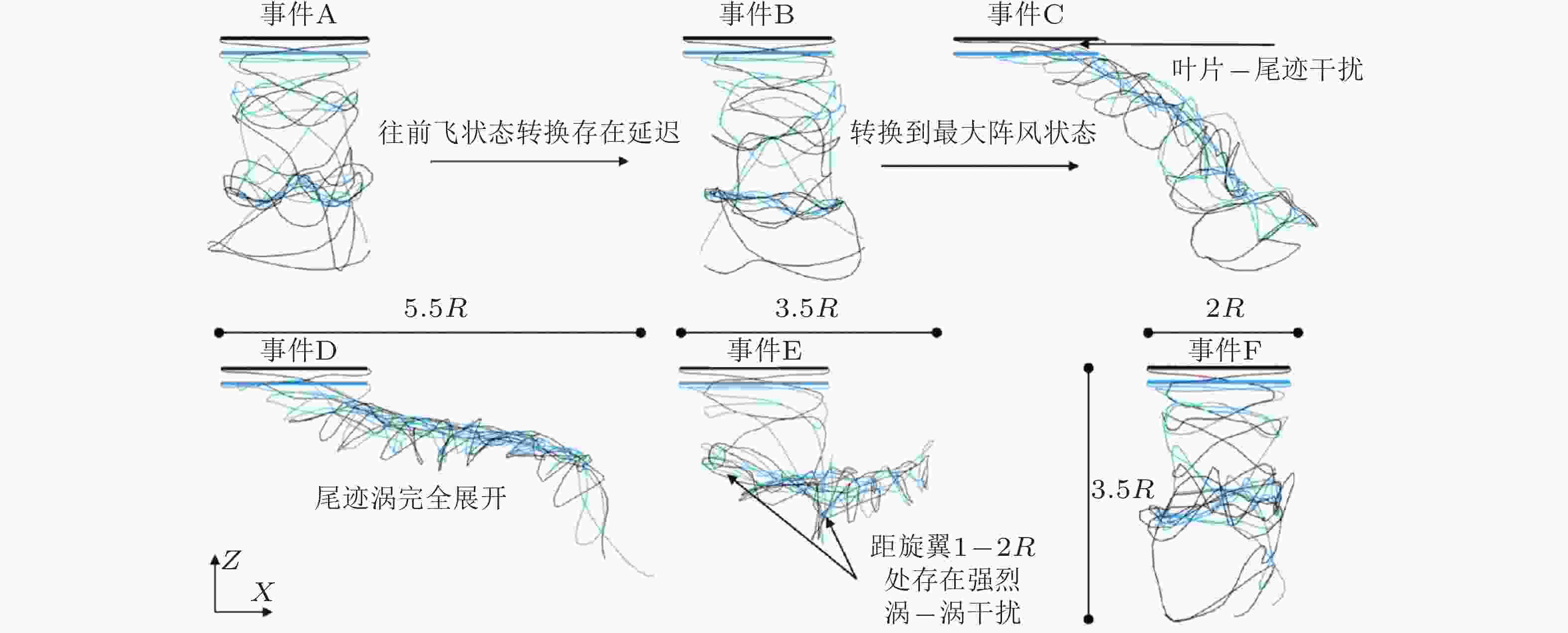
图 30 悬停情况下, Harrington共轴旋翼受离散侧向阵风影响下尾流涡结构的演化过程(Narayanan & Govindarajan 2024)
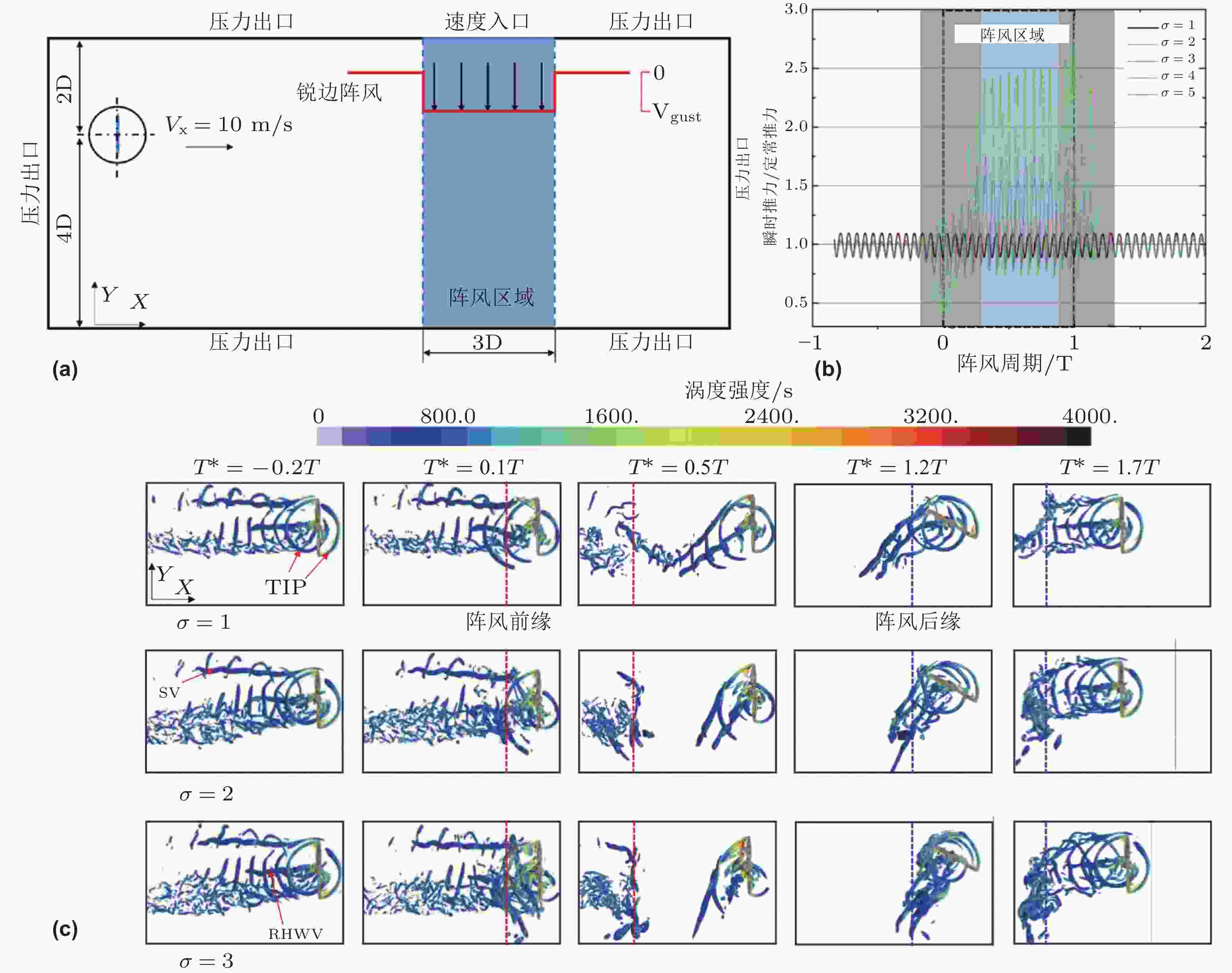
图 31 旋翼遭遇不同强度锐边阵风 (a) 计算模型, (b) 不同阵风因子下全周期拉力响应, (c) 旋翼阵风遭遇全过程涡结构的时间演化(Liu et al. 2026)
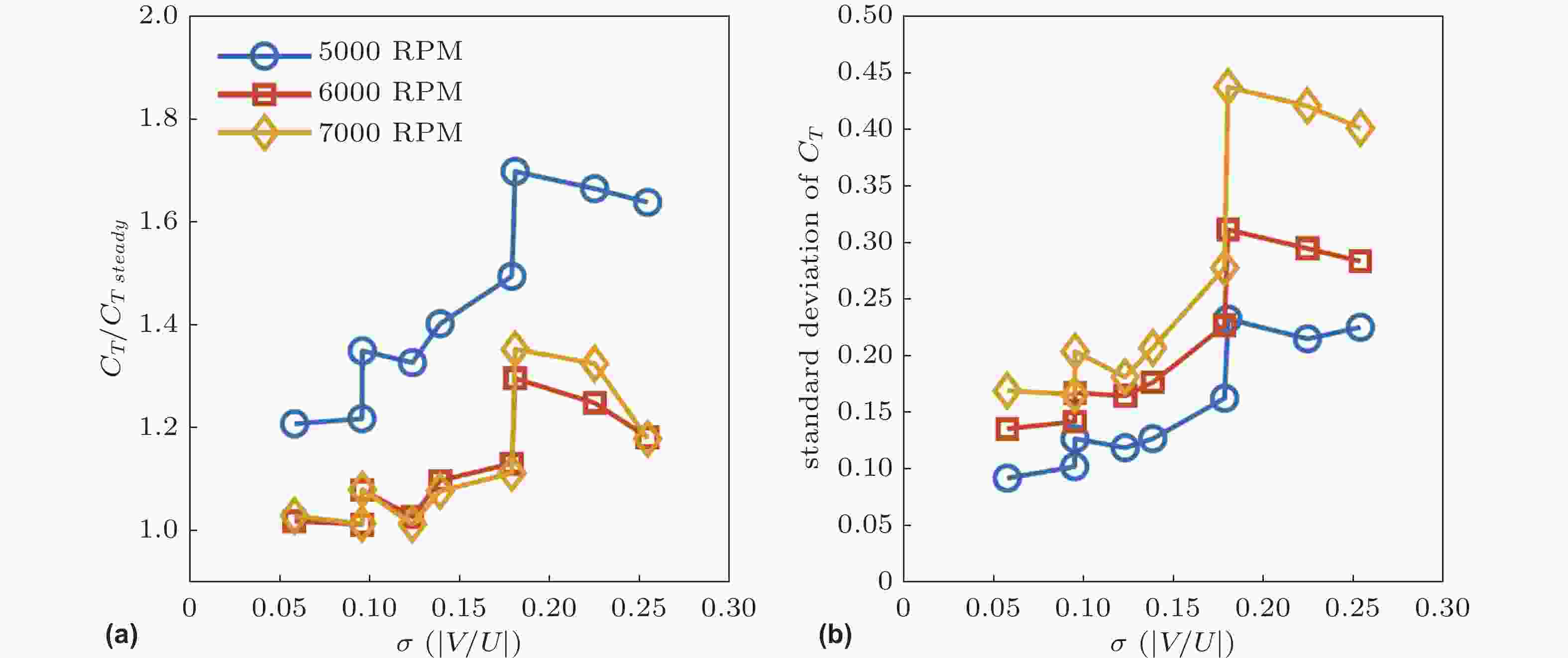
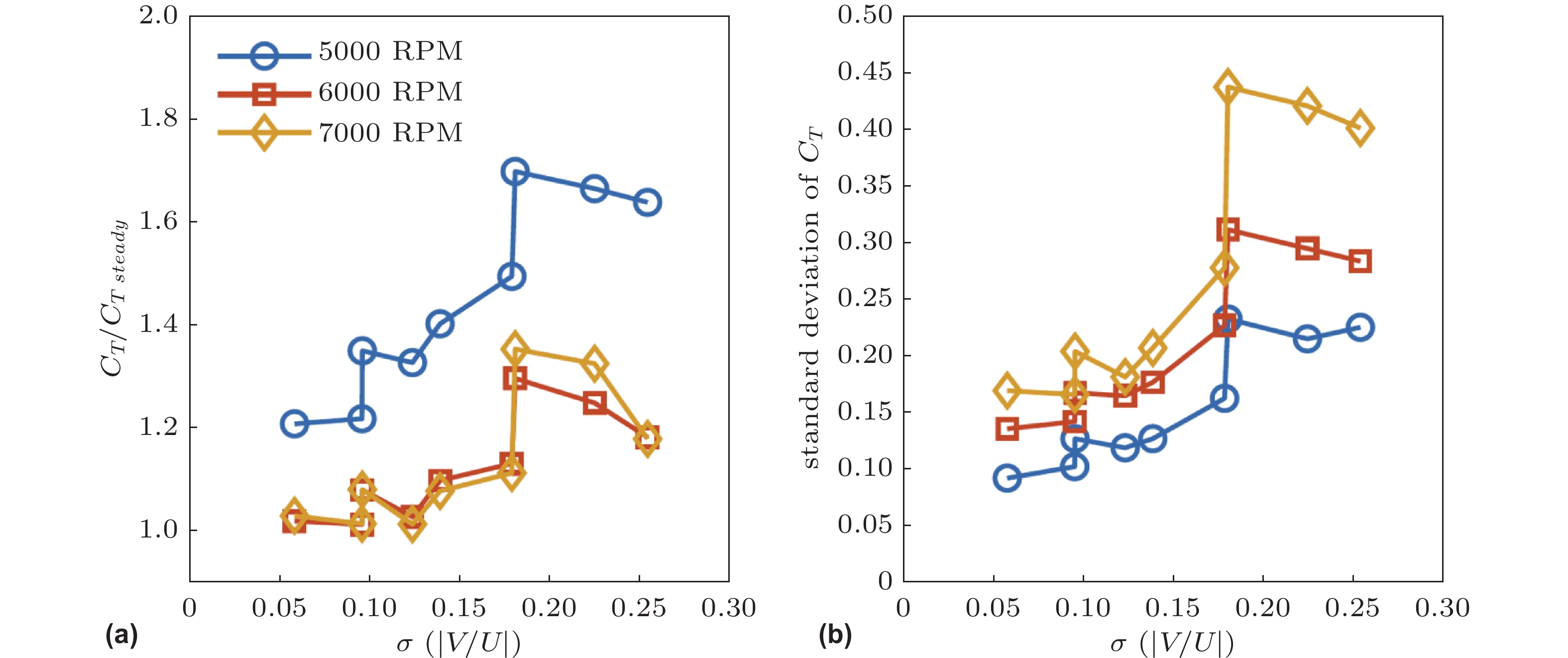
图 32 旋翼气动载荷随阵风因子的变化 (a) 阵风工况与定常来流推力系数之比, (b) 推力系数标准差(Finnemore et al. 2026a)
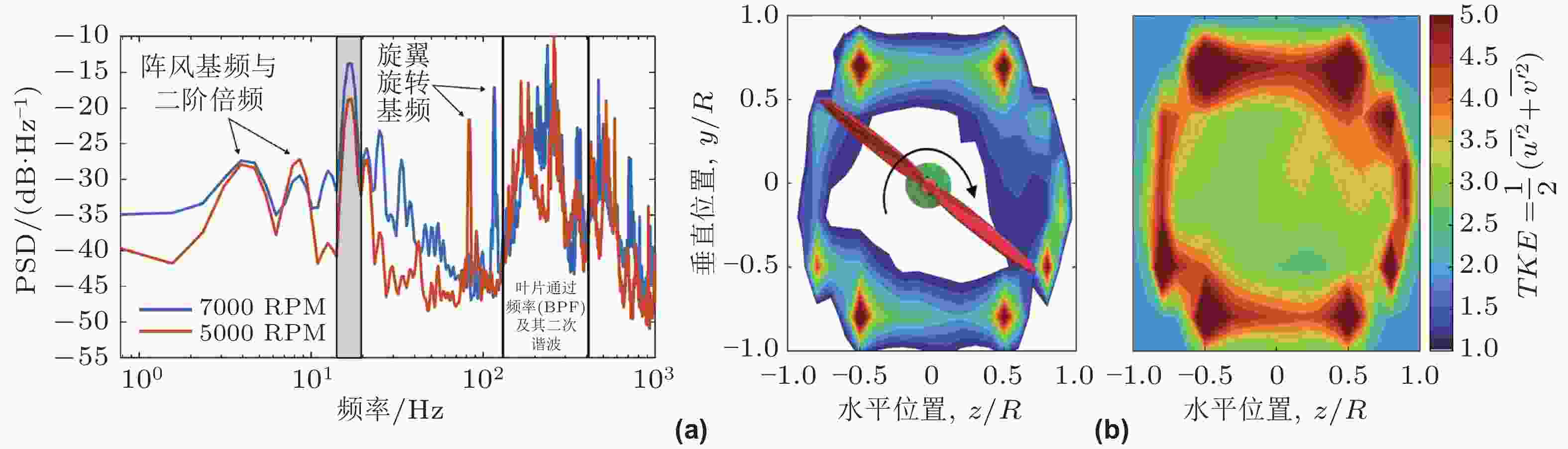
图 33 左: 在4 Hz连续阵风下, 不同旋翼转速的旋翼推力功率谱密度; 右: 旋翼下游0.2倍桨半径处 y-z平面流场湍动能分布: (a) 稳态来流, (b) 连续阵风 (Finnemore et al. 2026a)
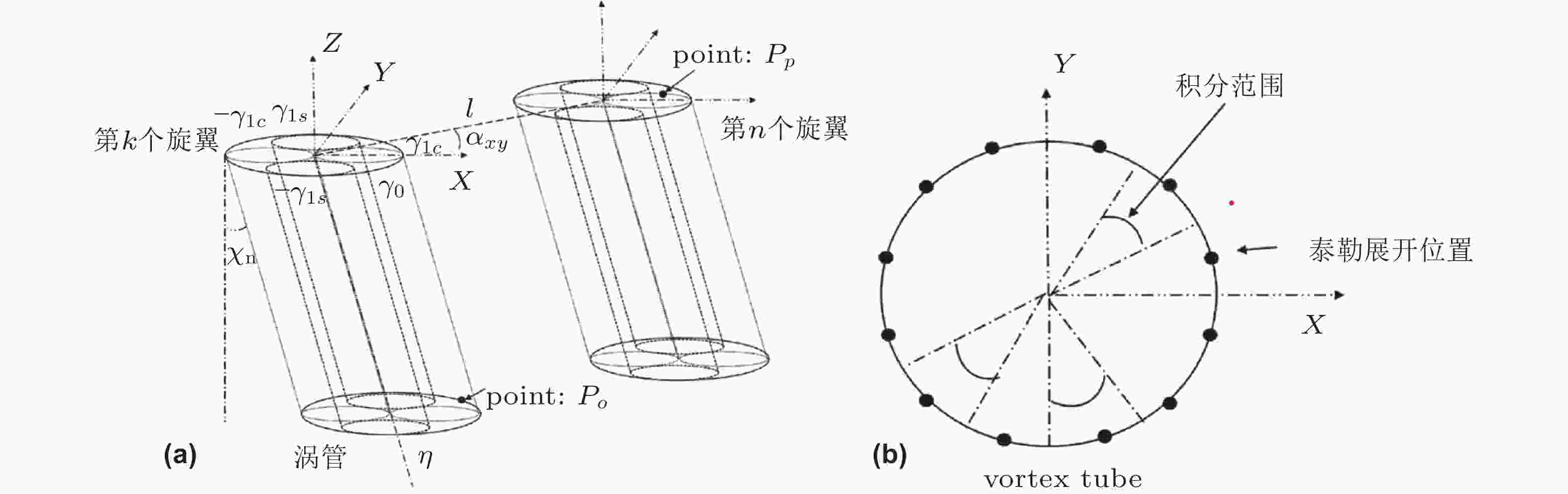
图 34 (a) 基于涡管模型对旋翼机的尾流进行三维建模, (b)涡管12方位基准点(Park et al. 2023a)
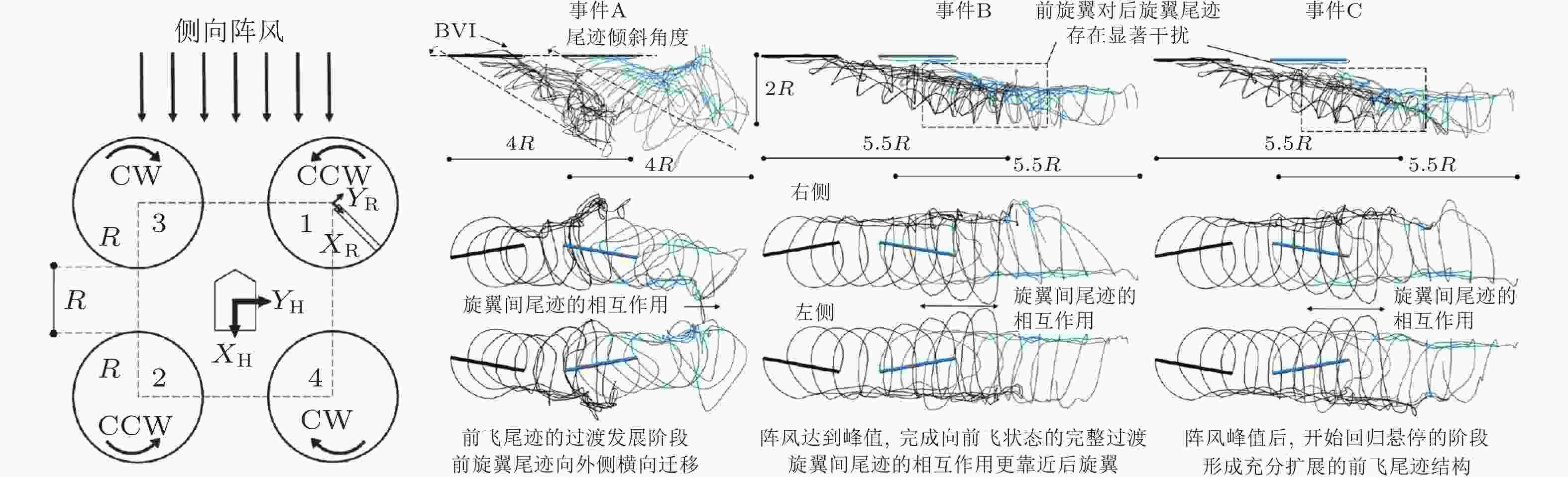
图 35 APC四旋翼无人机遭遇离散侧阵风时尾流涡的演化过程(Narayanan & Govindarajan 2024)
表 1 水平风的垂直切变(崔海洋 等 2024)
强度等级 风切变数值标准/
(海里·hr−1·30 m−1)风切变数值标准/
(m·s−1·30 s−1)风切变数值标准/
(s−1)对飞行的影响 轻度 ≤ 4 0 ~ 2 0 ~ 0.07 飞行航迹和空速稍有变化 中度 5 ~ 8 2.1 ~ 4 0.08 ~ 0.13 对飞机操纵造成很大的困难 强烈 9 ~ 12 4.1 ~ 6 0.14 ~ 0.20 有使飞机失去操纵的危险 严重 > 12 > 6 > 0.20 造成严重的危害  下载: 导出CSV
表 2 被动和主动的风洞模拟方法对比
类别 代表方法 基本实现思路 主要控制能力 可模拟特征 被动方法 尖劈、粗糙元、挡板、
被动格栅通过固定几何构件对来流产生
阻塞, 剪切层发展无主动控制能力 平均速度剖面、湍流强度、
积分尺度、能量谱主动方法 阵风叶栅、主动格栅、运动
翼型、旋转圆柱、风墙等动过电机驱动的随机或周期性
运动, 对流动施加时间变化扰动时间和空间可控 非定常、非均匀流动,
低频大尺度结构
下载: 导出CSV
表 3 近年来的阵风叶栅装置主要结构参数
机构 试验段尺寸
(宽 × 高 × 长, m)流速/
(m·s−1)叶栅参数 摆动角
度/°摆动频
率/Hz阵风类型 典型参数 (范围) 米兰理工大学 (Fonte et al. 2016) 4 × 3.84 × 6 3 ~ 55 NACA 0012, $ N=6 $
$ c=0.4\; \text{m} $, $ AR=8.9 $6 ~ 12 最大5 横向: 离散
(1−cos)、连续
(正弦)$ {U}_{\infty }=35\; \text{m/s} $,
$ GR=0.04 \sim 0.087 $,
$ k=0.025 $代尔夫特大学 (Lancelot
et al. 2017)2.85 × 2.85
(开口)最大 35 NACA 0014, $ N=2 $
$ c=0.3\; \text{m} $, $ AR=9.6 $2.5 ~ 10 0.6 ~ 5 横向: 离散
(1−cos)、连续
(正弦)$ {U}_{\infty }=15 \sim 25\; \text{m/s} $,
$ GR=0.014 \sim 0.017 $,
$ k=0.0377 \sim 0.1884 $布里斯托大学 (Wood et al. 2017) 2.14 × 1.525 × 3.2 最大60 NACA 0015, $ N=2 $
$ c=0.3\; \text{m} $, $ AR=7.1 $最大30 最大20 横向: 离散
(1−cos)、连续
(正弦)、随机$ {U}_{\infty }=8 \sim 24\; \text{m/s} $,
$ GR=0.014 \sim 0.23 $,
$ k=0.0377 \sim 0.1884 $缅因大学 (French et al. 2021) 0.75 ×
0.75 × 2最大约24 NACA 0018, $ N=2 $
$ c=0.15\; \text{m} $, $ AR=5 $15 ~ 45 0.5 ~ 2 流向: 离散、连续 $ {U}_{\infty }=9 \sim 18\; \text{m/s} $,
$ GR=0.083 \sim 0.22 $,
$ k=0.013 \sim 0.105 $北京航空航天大学 (Wang & Feng 2022) 1 × 1.2 × 18
(水洞)最大1 NACA 0015, $ N=2 $
$ c=0.24\; \text{m} $, $ AR=2.5 $4 ~ 6 小于1 横向: 连续
(正弦)
流向: 连续
(正弦)$ {U}_{\infty }=0.5\; \text{m/s} $,
$ {\mathrm{GR}}_{{\mathrm{v}}}=0.02 \sim 0.09 $,
$ {{GR}}_{{\mathrm{u}}}=0.025 \sim 0.1 $,
$ k=0.2 \sim 0.8 $中东科技大学 (Yigili 2022) 0.34 ×
0.34 × 1最大25 NACA 0015, $ N=2 $
$ c=0.08\; \text{m} $, $ AR=4.1 $8 ~ 16 2.5 ~ 10 横向: 离散、连续
流向: 离散、连续$ {U}_{\infty }=5 \sim 15\; \text{m/s} $,
$ {{GR}}_{{\mathrm{v}}}=0.04 \sim 0.14 $,
$ {{GR}}_{{\mathrm{u}}}=0.01 \sim 0.03 $,
$ k=0.06 \sim 0.5 $斯旺西大学 (Balatti 2023) 1.5 × 1 × 2.36 10 ~ 50 NACA 0015, $ N=2 $
$ c=0.2\; \text{m} $, $ AR=7.5 $5 ~ 12 最大14 横向: 离散
(1−cos)、连续
(正弦)、自定义$ {U}_{\infty }=10 \sim 26\; \text{m/s} $,
$ GR=0.01 \sim 0.15 $,
$ k=0.06 \sim 0.88 $亚利桑那大学 (Nietzel 2024) 0.91 × 1.22 × 3.66 最大80 NACA 0015, $ N=2 $
$ c=0.174\; \text{m} $, $ AR=6.9 $5 ~ 20 10 ~ 50 横向: 离散
(1−cos)、连续
(正弦)、随机$ {U}_{\infty }=6 \sim 25\; \text{m/s} $,
$ GR=0.005 \sim 1 $雅典国立技术大学 (Manolesos
et al. 2026)1.8 × 1.4 × 3.2 最大60 NACA 0015, $ N=4 $
$ c=0.2\; \text{m} $, $ AR=7.0 $最大20 最大20 横向: 离散
(1−cos)、
自定义$ {U}_{\infty }=10 \sim 20\; \text{m/s} $,
$ GR=0.014 \sim 0.23 $,
$ k=0.31 \sim 1.26 $
下载: 导出CSV
表 4 近年主动湍流格栅装置主要结构参数
机构 试验段尺寸
(宽 × 高 × 长, m)流速/
(m·s−1)格栅数
(行 × 列)格栅尺寸
M/mm最大雷诺数
$ {{Re}}_{\lambda } $湍流强度 加利福尼亚大学尔湾
分校 (Marti et al. 2017)0.15 × 0.15 × 2 16 8 × 8 30 717 3.92% ~ 25.1% 乔治亚理工
(Fries et al. 2017)0.146 × 0.146 × 1.372 15 ~ 30 5 × 6 24.1 1242 — 新墨西哥州州立大学
(Talavera & Shu 2017)1.2 × 1.2 × 14.6 最大35 6 × 6 190 — 0.5% ~ 8% 斯坦福大学
(Quinn et al. 2017)1 × 0.82 × 1.73 最大50 7 × 8 100 — — 格勒诺布尔阿尔卑斯
大学 (Mora et al. 2019)0.75 × 0.75 × 4 5 ~ 50 8 × 8 100 50 ~ 200
(全开静止)
200 ~ 950
(三重随机)2% ~ 10%
12.5% ~ 15%欧德堡大学
(Neuhaus et al. 2021)3 × 3 × 6 最大42 (闭口),
32 (开口)20 × 20 轴
(80个电机)140 14,000 — 多伦多大学
(Azzam & Lavoie 2023)1.2 × 0.8 × 5 最大 20 × 30
(双层, 每层10 × 15,
间距40 mm)80 486 — 南安普顿大学 (Thompson 2024) 1.2 × 1 × 2.4 最大10 11 × 13 85 760 12.6% ~ 19.6% 怀俄明大学
(Rumple 2024)0.61 × 0.61 × 1.22 最大33 20 × 20
(双层, 每层10 × 10,
间距76 mm)106 — 0.4% ~ 11% 挪威科技大学
(Kidal 2025)2.71 × 1.8 × 11 最大30 18 × 10 101.6 × 71.12 — —
下载: 导出CSV
表 5 近年运动机翼装置主要结构参数
机构和设施 试验段尺寸
(宽 × 长 × 高, m)相对流速/
(m·s−1)机翼尺寸 实验条件 产生流动 研究问题 达姆施塔特工业大学 (Widmann & Tropea 2017) 0.45 ×
0.45 × 2
(风洞)0 ~ 68 平板, 弦长120 mm,
厚度5 mmRe = 10,000 ~ 80,000
k = 0.25
$\alpha $ = $ 0^{\circ } \sim{30}^{\circ } $前缘涡 $ {{Re}} $对俯仰平板前缘涡生成
的影响剑桥大学 (Corkery
et al. 2018)1 × 1 × 9
(水槽)0.4 平板, 弦长120 mm, 展长480 mm, 厚度
4 mmRe = 20,000
GR = 1
$ \alpha $ = ${0}^{\circ } $阶跃型
横阵风Küssner
模型修正伊斯坦布尔科技大学 (Zaloglu et al. 2020) 1.01 × 0.79
(水洞)0.1 NACA 0012 弦长100 mm, 展长
300 mm
平板, 弦长100 mm, 展长400 mm,
厚度5 mmRe = 10,000
GR = 0.3 ~ 1
f = 0.25 ~ 0.5 Hz连续涡阵风或瞬态
涡阵风涡阵风气
动响应马里兰大学 (Biler et al. 2021) 1.5 × 1 × 7
(水槽)0.8 平板, 弦长76.2 mm, 展长304.8 mm,
厚度3.28 mmGR = 0.5 ~ 1.5
$\alpha $ = $ {0}^{\circ }\sim{45}^{\circ } $离散正弦型
横阵风大阵风因子横阵风和涡阵风对气动影响的对比 北京航空航天大学 (Feng & Wang 2014) 1 × 1.2 × 18
(水洞)0.2 NACA 0012, 弦长120 mm, 展长
600 mm$ {f}_{{\mathrm{g}}}=0.11\;\text{Hz} $ (阵风频率);
$ {f}_{{\mathrm{m}}} $ = 0.055 ~ 0.22 Hz
(俯仰频率), $ {\alpha }_{{\mathrm{m}}}={4}^{\circ } $
(最大迎角); $ {f}_{{\mathrm{m}}}=0.11 \; \text{Hz} $
(俯仰频率), $ {\alpha }_{{\mathrm{m}}}={24}^{\circ } $连续正弦型
横阵风Theodorsen和Sears模型
下载: 导出CSV
表 6 近年多风机阵列装置主要结构参数
机构 风扇大
小/mm阵列规模 成风尺寸
(宽 × 高)/m最大速度/
(m·s−1)应用方向 流场/阵风能力 控制策略/
算法西安大略大学 (Hangan 2014) 800 15 × 4 14 × 5
(内舱直径25 m)16 (龙卷风) 35 (下击暴流) 31 (直流) 复杂风场生成, 城市风场表征, 风力发电机优化 龙卷风、下击暴流、直流、剪切流 复杂开环控制 布法罗大学 (Li et al. 2021) 250 8 × 8 1 × 1.2 20 下击暴流风
场模拟风墙响应频率最大
12 Hz; 流向阵风6 Hz, 阵风因子0.14深度强化学习, 全理解
深层网络瑞士西部应用科学与艺术大学 (Walpen et al. 2023) 80 36 ×
24 × 22.88 × 1.92 16 模拟大气扰动生成, 无人机抗风研究 均匀、水平/垂直剪切、点阵; 连续阵风 (正弦0.2 Hz, 左右同向/异相); 随机 五孔探针
测量反馈同济大学 (Cao et al. 2024) 270 10 × 12 1.5 × 1.8 18 (有阻尼段) 24 (无阻尼段) 大气边界层模拟, 剪切、速度突变流动 剪切流动; 瞬态加/减速流动 (12 ~ 17 m/s用时0.3 ~ 0.6 s; 连续 (简谐) 阵风, 动态范围 < 3 Hz 开环控制, 预先设定输
入信号哈尔滨工业大学深圳 (Li
et al. 2024)40 10 × 10 0.4 × 0.4 12 风墙流场表征 均匀流动 开环控制, 均匀占空比 深圳技术大学 (Liu et al. 2024) 80 40 × 40 3.25 × 3.25 12.5 无人机抗风
性测试均匀流动; 脉冲流动: 静止−全速响应2 s; 全速−静止响应10 s 开路脉冲宽度调制 加州理工学院 (Stefan-Zavala et al. 2026) 120 10 × 10 1.2 × 1.2 11 火星无人机测试, 风墙控制算法 均匀、单行、缺行、自由剪切、间行、随机 数据驱动建模 (LASSO线性回归) 电子科技大学深圳高等研究院 (Wang
et al. 2026)300 9 × 9 3 × 3
(舱体直径10 m)50 无人机抗风
性测试三维多物理场风、龙卷风、下击暴流 分布式控制
下载: 导出CSV
表 7 典型线性气动模型的理论基础及适用性对比
模型类别 代表模型 理论假设与建模基础 来流/激励类型 适用范围 局限性 线性定常模型 Kutta-Joukowski/
薄翼理论二维薄翼、无黏势流、小攻角 定常均匀流 基础升力估计 无法描述非定常与分离 线性非定常模型 Theodorsen 1935 二维薄翼、无黏势流、小扰动、频域函数 均匀流+翼型
简谐运动颤振、气动弹性分析 不考虑阵风输入 线性非定常模型 von Kármán &
Sears 1938二维薄翼、势流、涡系分解、连续尾流 任意加速运动 一般非定常升力问题 尾流积分复杂 横向阵风模型 Sears 1941 二维薄翼、势流、小扰动、正弦阵风输入 横向阵风 阵风升力响应
分析仅适用于二维理想阵风 流向阵风模型 Isaacs 1945/ Greenberg 1947 二维薄翼、小攻角、附加质量、尾流耦合 流向阵风 来流脉动主导
问题物理机理较复杂 三维非定常模型 Graham 1971 薄升力面理论、双波数展开、小扰动 三维湍流阵风 三维机翼气动
响应数学形式复杂 三维导纳模型 Massaro & Graham 2015 频谱分析、统计湍流假设、展弦比效应 三维湍流场 气动导纳分析 依赖湍流统计
模型高阶非定常模型 Atassi 1984/ Goldstein &
Atassi 1976薄翼、二阶摄动、阵风畸变、弱非线性 周期阵风 高精度非定常气动分析 仍基于小扰动
假设
下载: 导出CSV
-
[1] 崔海洋, 王彦丰, 张秀明. 2024. 航空气象学基础. 天津: 中国民航出版社. [2] 金长江, 肖业伦. 1992. 大气扰动中的飞行原理. 北京: 国防工业出版社. [3] 李道春, 刘奕良, 阚梓, 等. 2026. 低空气动环境及其对无人机气动影响研究综述. 国防科技大学学报, 48(2): 1-28. [4] 徐浩军, 李颖晖, 李哲. 2017. 飞行安全理论与分析. 北京: 科学出版社. [5] 中国民用航空局. 2016. CCAR-25-R4 中国民用航空规章第25部: 运输类飞机适航标准. 北京: 中国民用航空局. [6] Abd-elaal E S, Mills J E, Ma X. 2013. An analytical model for simulating steady state flowsof downburst. J. Wind Eng. Ind. Aerodyn., 115: 53-64. doi: 10.1016/j.jweia.2013.01.005 [7] Agarwal D, Lu L, Padfield G D, et al. 2022. The use of augmented rotor inflow to predict rotorcraft responses in hover and low-speed manoeuvres. The Aeronautical Journal, 126(1301): 1168-1186. [8] Aldereguía Sánchez C, Tubino F, Bagnara A, et al. 2023. Experimental simulation of thunderstorm profiles in an atmospheric boundary layer wind tunnel. Appl. Sci., 13(14): 8064. doi: 10.3390/app13148064 [9] Anderson J D. 2016. Fundamentals of aerodynamics. 6th Edition. New York, USA: McGraw-Hill Education. [10] Atassi H M. 1984. The Sears problem for a lifting airfoil revisited-new results. J. Fluid Mechanics, 141: 109-122. doi: 10.1017/S0022112084000768 [11] Azzam A, Lavoie P. 2023. Unsteady flow generation in a wind tunnel using an active grid. Exp. Fluids, 64(2): 29. doi: 10.1007/s00348-023-03571-5 [12] Balatti D. 2023. Numerical and experimental studies of aeroelastic hinged wingtips. Swansea: Swansea University. [13] Balatti D, Haddad Khodaparast H, Friswell M I, et al. 2022. Improving wind tunnel “1−cos” gust profiles. Journal of Aircraft, 59(6): 1514-1528. doi: 10.2514/1.C036772. [14] Bansal S, Lavoie P. 2022. Effect of periodic longitudinal gusts on airfoil performance under separated-flow conditions. AIAA AVIATION 2022 Forum. Chicago, IL & Virtual: American Institute of Aeronautics and Astronautics. [15] Barnes C J, Visbal M R. 2018. Clockwise vortical-gust/airfoil interactions at a transitional Reynolds number. AIAA J., 56(10): 3863-3874. doi: 10.2514/1.J057262 [16] Berger F, Neuhaus L, Onnen D, et al. 2022. Experimental analysis of the dynamic inflow effect due to coherent gusts. Wind Energy Sci, 7(5): 1827-1846. [17] Biler H, Badrya C, Jones A R. 2019. Experimental and computational investigation of transverse gust encounters. AIAA J., 57(11): 4608-4622. doi: 10.2514/1.J057646 [18] Biler H, Jones A R. 2020. Force prediction during transverse and vortex gust encounters. AIAA Scitech 2020 Forum. Orlando, FL: American Institute of Aeronautics and Astronautics. [19] Biler H, Sedky G, Jones A R, et al. 2021. Experimental investigation of transverse and vortex gust encounters at low Reynolds numbers. AIAA J., 59(3): 786-799. doi: 10.2514/1.J059658 [20] Bonnet C, Grubb K A, Smith M J. 2024. Computational validation and assessment of large amplitude transverse gust physics. J. Am. Helicopter Soc., 69(2): 1-14. doi: 10.4050/jahs.69.020011 [21] Buell D A. 1969. An experimental investigation of the velocity fluctuations behind oscillating vanes: NASA TN D-5543. Moffett Field, California: NASA Allies Research Center. [22] CAA. 1994. Joint airworthiness requirements, JAR-25: Large aeroplanes. Cheltenham: Civil Aviation Authorities. [23] Cao G, Shaqarin T, Jiang Z, et al. 2025. Turbulence enhancement of a fan array wind generator using geometric texturing and optimization-based control. arXiv[2026-04-27]. [24] Cao J, Cao S, Ge Y. 2017. Characteristics and performances of a newly-built actively-controlled multiple-fan wind tunnel//Proceedings of the 9th Asia-Pacific Conference on Wind Engineering. Auckland: APCWE Organizing Committee. [25] Carr L W. 1988. Progress in analysis and prediction of dynamic stall. Journal of Aircraft, 25(1): 6-17. doi: 10.2514/3.45534 [26] Cekli H E, van de Water W. 2010. Tailoring turbulence with an active grid. Exp. Fluids, 49: 409-416. doi: 10.1007/s00348-009-0812-5 [27] Cermak J E. 1971. Laboratory simulation of the atmospheric boundary layer. AIAA J., 9(9): 1746-1754. doi: 10.2514/3.49977 [28] Comte B G, Corrsin S. 1966. The use of a contraction to improve the isotropy of grid-generated turbulence. J. Fluid Mechanics, 25(4): 657-682. doi: 10.1017/S0022112066000338 [29] Cook N J. 1978. Wind-tunnel simulation of the adiabatic atmospheric boundary layer by roughness, barrier and mixing-device methods. J. Wind Eng. Ind. Aerodyn., 3(2-3): 157-176. doi: 10.1016/0167-6105(78)90007-7 [30] Corkery S J, Babinsky H, Harvey J K. 2018. On the development and early observations from a towing tank-based transverse wing–gust encounter test rig. Exp. Fluids, 59(9): 135. doi: 10.1007/s00348-018-2586-0 [31] Counihan J. 1969. An improved method of simulating an atmospheric boundary layer in a wind tunnel. Atmos. Environ, 3(2): 197-214. doi: 10.1016/0004-6981(69)90008-0 [32] Counihan J. 1973. Simulation of an adiabatic urban boundary layer in a wind tunnel. Atmos. Environ, 7(7): 673-689. doi: 10.1016/0004-6981(73)90150-9 [33] Counihan J. 1975. Adiabatic atmospheric boundary layers: A review and analysis of data from the period 1880–1972. Atmos. Environ, 9(10): 871-905. doi: 10.1016/0004-6981(75)90088-8 [34] Conlisk A T. 2001. Modern helicopter rotor aerodynamics. Prog Aerosp Sci, 37(5): 419-476. [35] Davenport A G. 1961. The spectrum of horizontal gustiness near the ground in high winds. Q. J. R. Meteorol. Soc., 87(372): 194-211. doi: 10.1002/qj.49708737208 [36] Di L M, Leipold M, Noca F. 2024a. On the generation of plane compound shear flows with fan-array wind tunnels. AIAA SCITECH 2024 Forum. Orlando, FL: American Institute of Aeronautics and Astronautics [37] Di L M, Leipold M, Noca F. 2024b. Design, implementation and validation of a flow management device for fan-array wind tunnels. 2024 AIAA SciTech Forum. Orlando, Florida. [38] Du Z R, Feng L H, Wang T. 2024. Characteristics of gusts with different velocity profiles and control parameters. Phy. Fluids, 36(10): 107124. doi: 10.1063/5.0223931 [39] Durgesh V, Medina A, Mongin M P, et al. 2026. Impact of gusts on performance of NACA-0012 airfoil at low-Re. 2026 AIAA SciTech Forum. Orlando, Florida. [40] EASA. 2009. Certification specifications for large aeroplanes: CS-25. Europe: EASA. [41] Eldredge J D, Jones A R. 2019. Leading-edge vortices: Mechanics and modeling. Annu. Rev. Fluid Mech., 51(1): 75-104. doi: 10.1146/annurev-fluid-010518-040334 [42] FAA. 1996. Federal aviation regulations, Part 25: Airworthiness standards: Transport category airplanes, Section 341: Gust and turbulence loads. Washington, D. C.: Department of Transportation, Federal Aviation Administration. [43] Farell C, Iyengar A K S. 1999. Experiments on the wind tunnel simulation of atmospheric boundary layers. J. Wind Eng. Ind. Aerodyn., 79(1-2): 11-35. doi: 10.1016/S0167-6105(98)00117-2 [44] Favier D, Agnes A, Barbi C, et al. 1988. Combined translation/pitch motion—A new airfoil dynamic stall simulation. J. Aircraft, 25(9): 805-814. doi: 10.2514/3.45663 [45] Feng L H, Wang T. 2024. Combined Theodorsen and Sears theory: Experimental validation and modification. J. Fluid Mech., 986: A1. doi: 10.1017/jfm.2024.139 [46] Finnemore A, Lobb M, Modrzynski J, et al, 2026a. Unsteady aerodynamic response of single and side-by-side propellers in continuous gusts//AIAA AVIATION 2026 Forum. San Diego, CA: American Institute of Aeronautics and Astronautics. [47] Finnemore A, Lobb M, Modrzynski J, et al, 2026b. Experimental study of discrete gust interaction with a single and side-by-side propeller//AIAA AVIATION 2026 Forum. San Diego, CA: American Institute of Aeronautics and Astronautics. [48] Fonte F. 2017. Design and validation of active gust load alleviation systems for aircraft. Poltechico Di Milano. [49] Fonte F, Riccobene L, Ricci S, et al. 2016. Design, manufacturing and validation of a gust generator for wind tunnel test of a large scale aeroelastic model. 30th Congress of the International Council of the Aeronautical Science, Daejeon, South Korea: International Council of the Aeronautical Science (ICAS), 25-30. [50] French A, Friess W, Goupee A, et al. 2021. Design, construction and evaluation of an oscillating vane gust generator for atmospheric flow simulation. Wind, 1(1): 63-76. doi: 10.3390/wind1010004 [51] Fries D, Ochs B A, Ranjan D, et al. 2017. Hot-wire and PIV characterisation of a novel small-scale turbulent channel flow facility developed to study premixed expanding flames. J. Turbul., 18(11): 1081-1103. doi: 10.1080/14685248.2017.1356466 [52] Fukami K, Taira K. 2023. Grasping extreme aerodynamics on a low-dimensional manifold. Nat. Commun., 14(1): 6480. doi: 10.1038/s41467-023-42213-6 [53] Fuller J R. 1995. Evolution of airplane gust loads design requirements. J. Aircraft, 32(2): 235-246. doi: 10.2514/3.46709 [54] Gao Z X, Gu H B. 2011. Safety analysis of aircraft flying through low altitude wind shear. Appl. Mech. Mater, 97-98: 817-820. [55] Gehlert P. 2021. Unsteady flow and force development in the case of a circular cylinder. Cambridge: University of Cambridge. [56] Gehlert P, Babinsky H. 2019. Linking the unsteady force generation to vorticity for a translating and rotating cylinder. AIAA Scitech Proceedings, 1-18. [57] Gementzopoulos A, Sedky G, Jones A. 2022. Lift and vortex development during transverse wing-gust encounters for a blunt-edge airfoil. 2022 AIAA SciTech Forum, San Diego, California. [58] Gerz T, Holzäpfel F, Darracq D. 2002. Commercial aircraft wake vortices. Prog. Aerosp. Sci., 38(3): 181-208. doi: 10.1016/S0376-0421(02)00004-0 [59] Gladfelter M, He C, Chang C, et al, 2020. Enhancement and validation of VPM-derived state-space inflow models for multi-rotor simulation//Proceedings of the Vertical Flight Society 76th Annual Forum. Virtual: The Vertical Flight Society: 1-22. [60] Gloutak D, Jansen K E, Farnsworth J A. 2022. Impact of streamwise gusts on the aerodynamic performance of a finite-span wing. 2022 AIAA SciTech Forum, San Diego, California. [61] Goldstein M E, Atassi H. 1976. A complete second-order theory for the unsteady flow about an airfoil due to a periodic gust. J. Fluid Mech., 74(4): 741-765. doi: 10.1017/S0022112076002036 [62] Good G H, Warhaft Z. 2011. On the probability distribution function of the velocity field and its derivative in multi-scale turbulence. Phys. Fluids, 23(9): 095106. doi: 10.1063/1.3632090 [63] Graham J M R. 1971. A lifting-surface theory for the rectangular wing in non-stationary flow. Aeronaut. Quart., 22(1): 83-100. doi: 10.1017/S0001925900005667 [64] Granlund K, Monnier B, Ol M, et al. 2014. Airfoil longitudinal gust response in separated vs. attached flows. Phys. Fluids, 26(2): 027103. doi: 10.1063/1.4864338 [65] Greenberg J M. 1947. Airfoil in sinusoidal motion in a pulsating stream: TN1326. National Advisory Committee for Aeronautics. [66] Grissom D, Devenport W. 2004. Development and testing of a deterministic disturbance generator. 10th AIAA/CEAS Aeroacoustics Conference, Manchester, Great Britain: American Institute of Aeronautics and Astronautics. [67] Hallock J N, Holzapfel F. 2018. A review of recent wake vortex research for increasing airport capacity. Progress Aerosp. Sci., 98: 27-36. doi: 10.1016/j.paerosci.2018.03.003 [68] Hancock P E, Hayden P. 2021. Wind-Tunnel simulation of approximately horizontally homogeneous stable atmospheric boundary layers. Boundary-Layer Meteorology, 180(1): 5-26. doi: 10.1007/s10546-021-00611-7 [69] Hangan H. 2014. The wind engineering energy and environment (WindEEE) dome at Western University, Canada. Wind Eng., JAWE, 39(4): 350-351. doi: 10.5359/jawe.39.350 [70] He C, Syal M, Tischler M, et al. 2017. State-space inflow model identification from viscous vortex particle method for advanced rotorcraft configurations//Proceedings of the Vertical Flight Society 73rd Annual Forum and Technology Display. Fort Worth, Texas: The Vertical Flight Society: 1-30[2026-06-29]. [71] He C, Zhao J. 2009. Modeling rotor wake dynamics with viscous vortex particle method. AIAA Journal, 47(4): 902-915. [72] He X, Williams D R. 2023. Pressure feedback control of aerodynamic loads on a delta wing in transverse gusts. AIAA J., 61(4): 1659-1674. doi: 10.2514/1.J062442 [73] He X, Williams D R, Dawson S T M. 2022. Transverse gust generation in a wind tunnel: A suction-driven approach. Exp. Fluids, 63(8): 125. doi: 10.1007/s00348-022-03484-9 [74] Hearst R J. 2015. Fractal, classical, and active grid turbulence: From production to decay. University of Toronto. [75] Ho J C, Yeo H. 2021a. Evaluation of finite-state dynamic inflow for rotors. J. Aircraft, 58(5): 1068-1082. [76] Ho J C, Yeo H. 2021b. Considerations in the selection of inflow states with finite-state dynamic inflow. AIAA Journal, 59(7): 2800-2805. [77] Hughes M T, Gopalarathnam A, Bryant M. 2023. Modulation and annihilation of aeroelastic limit-cycle sscillations using a variable-frequency disturbance generator. AIAA J., 61(4): 1447-1461. doi: 10.2514/1.J062295 [78] Hurst D, Vassilicos J C. 2007. Scalings and decay of fractal-generated turbulence. Phys. Fluids, 19(3): 035103. doi: 10.1063/1.2676448 [79] Ilyas M, Noack B R, Hu G, et al. 2025. Drone anemometry of atmospheric winds—A review. Phys. Fluids, 37(6): 061302. doi: 10.1063/5.0259355 [80] Irwin H P A H. 1981. The design of spires for wind simulation. J. Wind Eng. Ind. Aerodyn., 7(3): 361-366. [81] Isaacs R. 1945. Airfoil theory for flows of variable velocity. J. Wind Eng. Ind. Aerodyn., 12(1): 113-117. doi: 10.2514/8.11202 [82] Jia H, Lin C, Iwabuchi M, et al. 2026. Ten questions concerning urban wind environments for the safe utilization of urban air mobility. Build. Environ., 290: 114136. doi: 10.1016/j.buildenv.2025.114136 [83] Jones A R, Cetiner O. 2020. Overview of NATO AVT-282: Unsteady aerodynamic response of rigid wings in gust encounters. 2020 AIAA SciTech Forum, Orlando, Florida. [84] Jones A R, Cetiner O, Smith M J. 2022. Physics and modeling of large flow disturbances: Discrete gust encounters for modern air vehicles. Annu. Rev. Fluid Mech., 54(1): 469-493. doi: 10.1146/annurev-fluid-031621-085520 [85] Kaimal J C, Wyngaard J C, Izumi Y, et al. 1972. Spectral characteristics of surface-layer turbulence. Q. J. R. Meteorol. Soc, 98(417): 563-589. [86] Kang L L, Liu L Q, Su W D, et al. 2018. Minimum-domain impulse theory for unsteady aerodynamic force. Phys. Fluids, 30(1): 016107. doi: 10.1063/1.5010008 [87] Keller J D. 1996. An investigation of helicopter dynamic coupling using an analytical model. J. Am. Helicopter Soc, 41(4): 322-330. [88] Kildal O. 2025. Using an active turbulence grid in wind tunnel testing of bridges: An experimental study. Norwegian University of Science and Technology. [89] Killian A, Gunasekaran S, Mongin M P, et al. 2023. Periodic vortical gust encounter and mitigation using closed loop control. 2023 AIAA SciTech Forum, 23-27 January, National Harbor, Maryand. [90] Klehr J. 1984. Simulation of hazardous flight conditions. In 22nd AIAA Aerospace Sciences Meeting, Reno, NV, USA. https://doi.org/10.2514/6.1984-278. [91] Komerath N M, Smith M J, Tung C. 2011. A review of rotor wake physics and modeling. J. Am. Helicopter Soc, 56(2): 22006. [92] Küssner H G. 1936. Zusammenfassender Bericht über den instationären Auftrieb von Flügeln. Luftfahrtforschung, 13(12): 410-424. [93] Lancelot P M G J, Sodja J, Werteer N P M, et al. 2017. Design and testing of a low subsonic wind tunnel gust generator. Adv. Aircr. Spacecr. Sci., 4(2): 125-144. doi: 10.12989/aas.2017.4.2.125 [94] Larssen J V, Devenport W J. 2011. On the generation of large-scale homogeneous turbulence. Exp. in Fluids, 50(5): 1207-1223. doi: 10.1007/s00348-010-0974-1 [95] Lee H, Sengupta B, Araghizadeh M S, et al. 2022. Review of vortex methods for rotor aerodynamics and wake dynamics. Adv. Aerodyn., 4(1): 20. [96] Li G J, Lu X Y. 2012. Force and power of flapping plates in a fluid. J. Fluid Mech., 712: 598-613. doi: 10.1017/jfm.2012.443 [97] Li M, Yu J, Lin Z, et al. 2024. Theoretical and experimental study of the spanwise effect of turbulence on the aerodynamic lift on a wing with different aspect ratios. Phys. Fluids, 36(4): 045104. doi: 10.1063/5.0190734 [98] Li S, Li M. 2017. Spectral analysis and coherence of aerodynamic lift on rectangular cylinders in turbulent flow. J. Fluid Mech., 830: 408-438. doi: 10.1017/jfm.2017.593 [99] Li S, Liu Y, Jiang Z, et al. 2024. Aerodynamic characterization of a fan-array wind generator. AIAA J., 62(1): 291-301. doi: 10.2514/1.J063114 [100] Li S, Snaiki R, Wu T. 2021. Active simulation of transient wind field in a multiple-fan wind tunnel via deep reinforcement learning. J. Eng. Mech., 147(9): 04021056. [101] Liu L, Hu X, Xin L, et al. 2026. Aerodynamic response and vortex structures evolution in an isolated rotor during gust encounters. Aerosp. Sci. Technol., 170: 111567. [102] Liu Y, Noack B R, Hu G, et al. 2025. Aerodynamic characterization of a wind generator with 40 × 40 individually controllable fans. Phys. Fluids, 37(2): 025117. doi: 10.1063/5.0243991 [103] Lone M, Dussart G. 2019. Impact of spanwise non-uniform discrete gusts on civil aircraft loads. Aeronaut. J., 123(1259): 93-120. doi: 10.1017/aer.2018.148 [104] Lopez-Doriga B, Jones A R M, Taira K. 2025. On the effect of airfoil geometry on extreme vortex-gust encounters. J. Fluid Mech., 1037: A61. doi: 10.1017/jfm.2026.11711 [105] Ludena L, Moravej M, Mooneghi M A, et al. 2017. Wind loads on buildings with balcony glass handrails//9th Asia-Pacific Conference on Wind Engineering. Auckland, New Zealand. [106] Ma R, Yang Y, Li M, et al. 2021. The unsteady lift of an oscillating airfoil encountering a sinusoidal streamwise gust. J. Fluid Mech., 908: A22. doi: 10.1017/jfm.2020.873 [107] Makita H. 1991. Realization of a large-scale turbulence field in a small wind tunnel. Fluid Dyn. Res., 8(1-4): 53-64. doi: 10.1016/0169-5983(91)90030-M [108] Manolesos M, Ampatis C, Gkiolas D, et al. 2026. Design, testing and numerical modelling of a low-speed wind tunnel gust generator. Fluids, 11(3): 71. doi: 10.3390/fluids11030071 [109] Marti F, Martinez O, Mazo D, et al. 2017. Evaporation of a droplet larger than the Kolmogorov length scale immersed in a relative mean flow. Int. J. Multiph. Flow., 88: 63-68. doi: 10.1016/j.ijmultiphaseflow.2016.09.019 [110] Marzanek M F, Rival D E. 2019. Separation mechanics of non-slender delta wings during streamwise gusts. J. Fluids Struct., 90: 286-296. doi: 10.1016/j.jfluidstructs.2019.07.001 [111] Massaro M, Graham J M R. 2015. The effect of three-dimensionality on the aerodynamic admittance of thin sections in free stream turbulence. J. Fluids Struct, 57: 81-90. doi: 10.1016/j.jfluidstructs.2015.05.012 [112] Mccroskey W J. 1981. The phenomenon of dynamic stall: NASA-TM-81264. Moffett Field: NASA Ames Research Center. [113] Mccroskey W J. 1982. Unsteady airfoils. Annu. Rev. Fluid Mech., 14(1): 285-311. doi: 10.1146/annurev.fl.14.010182.001441 [114] McKercher R G, Khouli F, Wall A S, et al. 2024. Modelling and control of an urban air mobility vehicle subject to empirically-developed urban airflow disturbances. Aerospace, 11(3): 220. doi: 10.3390/aerospace11030220 [115] Mctavish S, Barber H, Wall A. 2024. Validation of urban airflow measurements through a combined field test and wind tunnel study. J. Wind Eng. Ind. Aerodyn, 265: 106155. doi: 10.2139/ssrn.4937577 [116] Moeini M, Romanic D. 2023. An analytical solution to the perturbation analysis of the interaction between downburst outflows and atmospheric boundary layer winds. J. Atmos. Sci., 80(1): 301-319. doi: 10.1175/JAS-D-22-0123.1 [117] Mohamed M S, Larue J C. 1990. The decay power law in grid-generated turbulence. Journal of Fluid Mechanics, 219: 195-214. doi: 10.1017/S0022112090002919 [118] Mohamed A, Marino M, Watkins S, et al. 2022. Gusts encountered by flying vehicles in proximity to buildings. Drones, 7(1): 22. doi: 10.3390/drones7010022 [119] Mora D O, Muñiz Pladellorens E, Riera Turró P, et al. 2019. Energy cascades in active-grid-generated turbulent flows. Phys. Rev. Fluids, 4(10): 104601. doi: 10.1103/PhysRevFluids.4.104601 [120] Mulleners K, Mancini P, Jones A R. 2017. Flow development on a flat-plate wing subjected to a streamwise acceleration. AIAA J., 55(6): 2118-2122. doi: 10.2514/1.J055497 [121] Mydlarski L. 2017. A turbulent quarter century of active grids: From Makita (1991) to the present. Fluid Dyn. Res., 49(6): 061401. doi: 10.1088/1873-7005/aa7786 [122] Narayanan S, Govindarajan B. 2024. Effects of gust on the aerodynamics of multi-rotors. Phys. Fluids, 36(12): 127169. [123] Neuhaus L, Berger F, Peinke J, et al. 2021. Exploring the capabilities of active grids. Exp. Fluids, 62(6): 130. doi: 10.1007/s00348-021-03224-5 [124] Neuhaus L K. 2022. Generation of turbulence by means of active grids for wind turbine investigations. Universität Oldenburg. [125] Nietzel K, 2024. Designing, manufacturing, and testing a wind gust generator. University of Arizona. [126] Nithya D S, Quaranta G, Muscarello V, et al. 2024. Review of wind flow modelling in urban environments to support the development of urban air mobility. Drones, 8(4): 147. doi: 10.3390/drones8040147 [127] Noca F, Reymond J, Walpen A, et al. 2024. Large-scale vortex generation (and bursting) using windshapers. 2024 AIAA SciTech Forum, 8-12 January, Orlando, Florida. [128] Ozono S, Miyagi H, Wada K. 2007. Turbulence generated in active grid mode using a multi-fan wind tunnel. J. Fluid Sci. Technol., 2(3): 643-654. doi: 10.1299/jfst.2.643 [129] Park S, Im B, Lee D, et al. 2023a. Aerodynamic interference analysis for a nonoverlapping multirotor UAV based on dynamic vortex tube. J. Am. Helicopter Soc., 68(4): 42010-42030. [130] Park S, Lee S, Im B, et al. 2023b. Improvement of a multi-rotor UAV flight response simulation influenced by gust. Aerosp. Sci. Technol, 134: 108156. [131] Park S, Yoo J, Lee S, et al. 2021. Real-time flight simulation for multirotor UAV integrated with the dynamic inflow aerodynamics. J. Am. Helicopter Soc, 66(4): 1-14. [132] Park S, Yoo J, Shin S. 2020. Improved aerodynamic analysis for multirotor-type uas flight simulation using dynamic inflow and rigid blade flapping. J. Aerosp. Eng, 33(4): 04020021. [133] Peng D, Gregory J W. 2015. Vortex dynamics during blade-vortex interactions. Phys. Fluids, 27(5): 053104. doi: 10.1063/1.4921449 [134] Perrotta G, Jones A R. 2017. Unsteady forcing on a flat-plate wing in large transverse gusts. Exp. Fluids, 58(8): 101. doi: 10.1007/s00348-017-2385-z [135] Peters D A. 2009. How dynamic inflow survives in the competitive world of rotorcraft aerodynamics. J. Am. Helicopter Soc, 54(1): 11001. [136] Peters D A, He C J. 1995. Finite state induced flow models. II—Three-dimensional rotor disk. J. Aircr, 32(2): 323-333. [137] Pitt D M, Peters D A. 1980. Teoretical prediction of dynamic-inflow derivatives//Sixth European Rotorcraft and Powered Lift Aircraft Forum. [138] Poorte R E G, Biesheuvel A. 2002. Experiments on the motion of gas bubbles in turbulence generated by an active grid. J. Fluid Mech., 461: 127-154. doi: 10.1017/s0022112002008273 [139] Quinn D B, Watts A, Nagle T, et al. 2017. A new low-turbulence wind tunnel for animal and small vehicle flight experiments. R. Soc. Open Sci., 4(3): 160960. doi: 10.1098/rsos.160960 [140] Rockwood M, Medina A. 2020. Controlled generation of periodic vortical gusts by the rotational oscillation of a circular cylinder and attached plate. Exp. Fluids, 61(2): 65. doi: 10.1007/s00348-020-2882-3 [141] Rumple C. 2024. Development, characterization, and experimental application of an active grid installed upstream of a wind tunnel contraction. University of Wyoming. [142] Sears W R. 1941. Some aspects of non-stationary airfoil theory and its practical application. J. Aeronaut Sci., 8(3): 104-108. doi: 10.2514/8.10655 [143] Sedky G, Jones A R, Lagor F D. 2020. Lift regulation during transverse gust encounters using a modified Goman–Khrabrov model. AIAA J., 58(9): 3788-3798. doi: 10.2514/1.J059127 [144] Saetti U. 2024. Real-time simulation of a shipborne rotor via linearized state-space free-vortex wake models. J. Aircr., 61(3): 1025-1033. [145] Seoud R E, Vassilicos J C. 2007. Dissipation and decay of fractal-generated turbulence. Phys. Fluids, 19(10): 105108. doi: 10.1063/1.2795211 [146] Shaqarin T, Liu Y, Wang K, et al. 2025. Kernel-based distributed-input distributed-output control for fan array wind generators. Phys. Fluids, 37(8): 085192. doi: 10.1063/5.0282895 [147] Smith Z F, Jones A R, Hrynuk J T. 2018. Micro air vehicle scale gust-wing interaction in a wind tunnel. 2018 AIAA Aerospace Sciences Meeting, Kissimmee, Florida: American Institute of Aeronautics and Astronautics [148] Stefan-Zavala A, Scherl I, Mandralis I, et al. 2026. Data-driven modelling for on-demand flow prescription in fan-array wind tunnels. Flow, 6: E3. doi: 10.1017/flo.2025.10034 [149] Strangfeld C, Müller-vahl H, Nayeri C N, et al. 2016. Airfoil in a high amplitude oscillating stream. J. Fluid Mech., 793: 79-108. doi: 10.1017/jfm.2016.126 [150] Stutz C, Bohl D G, Hrynuk J T. 2022a. Investigation of lift forces during long gust interactions at low Reynolds number. AIAA SCITECH 2022 Forum, San Diego, CA & Virtual: American Institute of Aeronautics and Astronautics. [151] Stutz C, Hrynuk J, Bohl D. 2022b. Investigation of static wings interacting with vertical gusts of indefinite length at low Reynolds numbers. Exp. Fluids, 63(5): 82. doi: 10.1007/s00348-022-03432-7 [152] Theodorsen T. 1935. General theory of aerodynamic instability and the mechanism of flutter. Langley Field: National Advisory Committee for Aeronautics, NACA-TR-496. [153] Taira K. 2026. Extreme aerodynamics: A data-driven perspective. Phys. Rev. Fluids, 11(1): 014702. doi: 10.1103/8pr4-txmt [154] Talavera M, Shu F. 2017. Experimental study of turbulence intensity influence on wind turbine performance and wake recovery in a low-speed wind tunnel. Renew. Energ., 109: 363-371. doi: 10.1016/j.renene.2017.03.034 [155] Tan J F, Wang H W. 2013. Simulating unsteady aerodynamics of helicopter rotor with panel/viscous vortex particle method. Aerosp. Sci. Technol, 30(1): 255-268. [156] Telli K, Kraa O, Himeur Y, et al. 2023. A comprehensive review of recent research trends on unmanned aerial vehicles (UAVs). Systems, 11(8): 400. doi: 10.3390/systems11080400 [157] Thompson C. 2024. A comprehension and prediction of wings in unsteady conditions. University of Southampton. [158] Toparlar Y, Blocken B, Maiheu B, et al. 2017. A review on the CFD analysis of urban microclimate. Renew. Sust. Energ. Rev., 80: 1613-1640. doi: 10.1016/j.rser.2017.05.248 [159] Hahn K U. 1989. Effect of wind shear on flight safety. Prog. Aerosp. Sci., 26(3): 225-259. doi: 10.1016/0376-0421(89)90004-3 [160] Valente P C, Vassilicos J C. 2011. The decay of turbulence generated by a class of multiscale grids. J. Fluid Mech., 687: 300-340. doi: 10.1017/jfm.2011.353 [161] van der Wall B G. 1992. The influence of variable flow velocity on unsteady airfoil behavior. University of Maryland, USA. [162] van der Wall B G, Leishman J G. 1994. On the influence of time-varying flow velocity on unsteady aerodynamics. J. Am. Helicopter Soc., 39(4): 25-36. doi: 10.4050/JAHS.39.25 [163] Van Dyke M D. 1953. Supersonic flow past oscillating airfoils including nonlinear thickness effects: NACA TN 2982. Washington: National Advisory Committee for Aeronautics (NACA), 1-43. [164] Van hoydonck W, Haverdings H, Pavel M, 2009. A review of rotorcraft wake modeling methods for flight dynamics applications//Proceedings of the 35th European Rotorcraft Forum. [165] von Kármán T, Sears W R. 1938. Airfoil theory for non-uniform motion. Journal of the Aeronautical Sciences, 5(10): 379-390. doi: 10.2514/8.674. [166] Walpen A, Catry G, Noca F. 2023. Real-scale atmospheric wind and turbulence replication using a fan-array for environmental testing and UAV/AAM validation. 2023 AIAA SciTech Forum, 23-27 January, National Harbor, Maryand. [167] Walpen A, Govoni T, Stirnemann J, et al. 2024. Automated control of complex aerodynamic flows generated by Windshaper fan arrays. 2024 AIAA SciTech Forum, 8-12 January, Orlando, Florida. [168] Wang M, Luiz S O D, Zhang S, et al. 2023. Electric flight in extreme and uncertain urban environments. Sustainability, 15(16): 12590. doi: 10.3390/su151612590 [169] Wang Q, Wang W, Suzuki S. 2024a. UAV trajectory tracking under wind disturbance based on novel antidisturbance sliding mode control. Aerosp. Sci. Technol., 149: 109138. doi: 10.1016/j.ast.2024.109138 [170] Wang T, Feng L H. 2022. Characterization of vertical and longitudinal gusts generated by twin pitching airfoils. Phys. Fluids, 34(9): 097116. doi: 10.1063/5.0105137 [171] Wang T, Feng L H, Cao Y T, et al. 2024b. Airfoil response to periodic vertical and longitudinal gusts. J. Fluid Mech., 979: A35. doi: 10.1017/jfm.2023.1000 [172] Wang X, Tang X, Li H, et al. 2026. A three-dimensional wind matrix to generate horizontal unsteady non-uniform incoming flow. Aerospace Science and Technology, 113327. [173] Watkins S, Burry J, Mohamed A, et al. 2020. Ten questions concerning the use of drones in urban environments. Build. Environ., 167: 106458. doi: 10.1016/j.buildenv.2019.106458 [174] Wei N J, Kissing J, Tropea C. 2019. Generation of periodic gusts with a pitching and plunging airfoil. Exp. Fluids, 60(11): 166. doi: 10.1007/s00348-019-2815-1 [175] Weitemeyer S, Reinke N, Peinke J, et al. 2013. Multi-scale generation of turbulence with fractal grids and an active grid. Fluid Dyn. Res., 45(6): 061407. doi: 10.1088/0169-5983/45/6/061407 [176] Widmann A, Tropea C. 2017. Reynolds number influence on the formation of vortical structures on a pitching flat plate. Interface Focus, 7. [177] Wood J N, Breuer M. 2025. Experimental study on a novel wind gust generator based on an adaptive nozzle design. J. Wind Eng. Ind. Aerodyn., 261: 106080. doi: 10.1016/j.jweia.2025.106080 [178] Wood K T, Cheung R C, Richardson T S, et al. 2017. A new gust generator for a low speed wind tunnel: Design and commissioning. 55th AIAA Aerospace Sciences Meeting, 9-13 January, Grapevine, Texas. [179] Wu T Y. 2007. A nonlinear theory for a flexible unsteady wing. J. Eng. Math., 58(1-4): 279-287. [180] Yang Y, Zhao Y, Wang P, et al. 2024. Harmonically pitching airfoil in a periodic streamwise superimposed flow. Phys. Fluids, 36(8): 083620. [181] Yang Y, Li M, Ma C, et al. 2017. Experimental investigation on the unsteady lift of an airfoil in a sinusoidal streamwise gust. Phys. Fluids, 29(5): 051703. doi: 10.1063/1.4984243 [182] Yang Y, Yang C, Wu Z. 2020. Aeroelastic dynamic response of elastic aircraft with consideration of two-dimensional discrete gust excitation. Chin. J. Aeronaut., 33(4): 1228-1241. doi: 10.1016/j.cja.2019.09.008 [183] Yigili I. 2022. Design and experimental investigation of a wind tunnel gust generator. Middle East Technical University. [184] Young A M, Smyth A S M. 2021. Gust–airfoil coupling with a loaded airfoil. AIAA J., 59(3): 773-785. doi: 10.2514/1.J059688 [185] Zaloglu B, Saritas M, Cetiner O, et al. 2020. On the effects of discrete and continuous vortex-gust encounters. AIAA Scitech 2020 Forum, Orlando, FL: American Institute of Aeronautics and Astronautics. [186] Zhao J, Prasad J V R, Peters D A. 2004. Rotor dynamic wake distortion model for helicopter maneuvering flight. J. Am. Helicopter Soc, 49(4): 414-424. [187] Zhao Y, Li M, Yang Y. 2025a. Insights into the aerodynamic response of a harmonic oscillating airfoil in various turbulent flows. Commun. Eng., 4(1): 170. doi: 10.1038/s44172-025-00503-5 [188] Zhao Y, Yang Y, Li M. 2025b. The lift on an airfoil at various angles of attack in turbulent flow. J. Fluid Mech, 1010: A45. [189] Zhao Y, Zhang J, Pei B, et al. 2026. Evolution of turbulent diffusivity in heterogeneous surface boundary layers. Phys. Fluids, 38(1): 015102. doi: 10.1063/5.0301234 [190] Zheng S, Bruce P J K, Graham J M R, et al. 2018. Weakly sheared turbulent flows generated by multiscale inhomogeneous grids. J. Fluid Mech., 848: 788-820. doi: 10.1017/jfm.2018.387 [191] Zhukovskii N. 2001. On annexed vortices early developments of modern aerodynamics. Oxford: Elsevier Science & Technology: 88-106. -

 下载:
下载:
















计量
- 文章访问数: 560
- HTML全文浏览量: 136
- PDF下载量: 199
- 被引次数: 0