


Spinodoid non-periodic architected materials: Mechanical performance prediction, design, and applications
-
摘要: 结构化材料(architected materials)通过结构设计实现可控的超常性能, 在生物医学、航空航天、能源环境等多领域得到广泛应用. 通过在结构设计过程中引入随机非周期性, 可以解决传统周期性材料局部化失效导致的高脆性问题, 提高材料的韧性、损伤容限与缺陷不敏感性, 实现优异的综合性能. 但是, 这同时使结构整体复杂度增加, 研究、设计成本大幅提升, 亟需发展新的理论和方法. 旋节线拓扑构成的材料(spinodoid/spinodal-like metamaterials)是一种具有代表性的非周期结构化材料, 其研究范式可以推广至多种复杂非周期结构的力学性能预测、拓扑结构设计. 本文以旋节线拓扑为代表, 介绍非周期结构化材料的建模原理、等效力学性能、设计和制造方法及典型应用, 对现有研究进行总结并提出未来的发展方向.Abstract: Through structural design, architected materials can achieve extraordinary properties and therefore have found broad applications across biomedical, aerospace, energy, and environmental domains. Incorporating non-periodicity into structural design helps mitigate the brittleness arising from localized failure in conventional periodic materials, leading to improved toughness, damage tolerance, and defect insensitivity. However, the added complexity imposes computational and manufacturing challenges, calling for the development of new theoretical frameworks and design methodologies. Spinodoid materials/spinodal-like materials, characterized by spinodal topology, represent a class of non-periodic architected materials, and the research paradigm established for these materials can be generalized to predict mechanical performance and guide structural design of various complex non-periodic architectures. This review focuses on spinodoid structures as a representative example, introducing their modeling principles, effective mechanical properties, design and manufacturing methods, and typical applications. We summarize the current research and propose future research directions, with the aim of charting a roadmap for non-periodic architected materials based on the advanced methods across the integrated “modeling–design–manufacturing–application" pipeline.
-
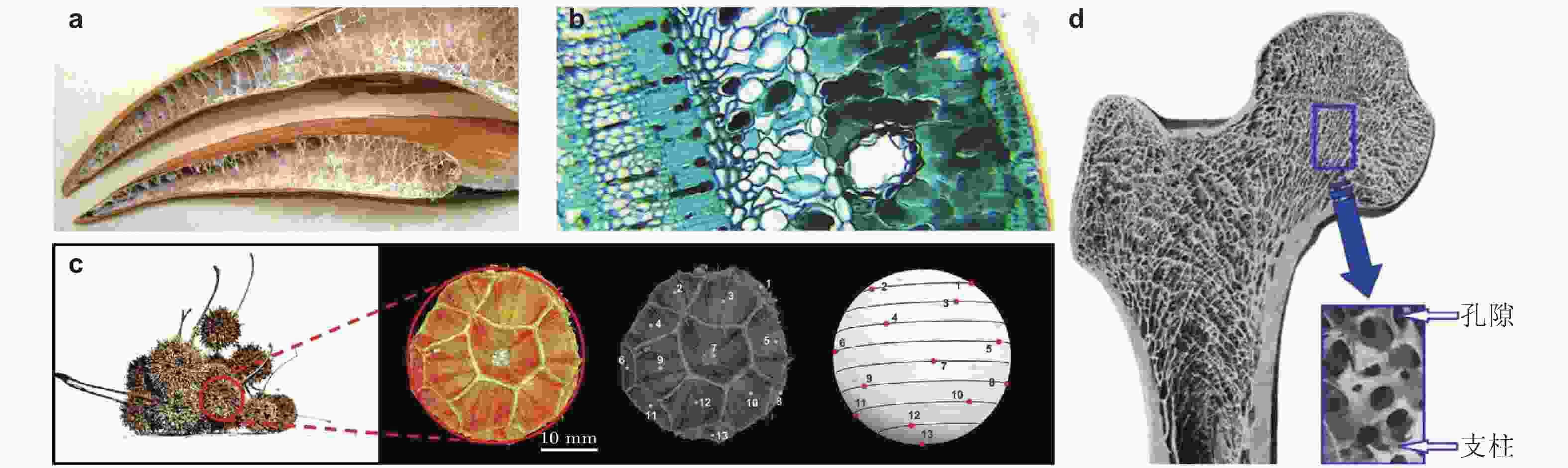
图 1 自然界的随机非周期拓扑结构. (a)犀鸟鸟喙(Schaedler & Carter 2016), (b)松叶横截面(Bhate 2019), (c)枫香树果实(Chiang et al. 2021), (d)人体股骨内部骨小梁(Musthafa & Walker 2024)
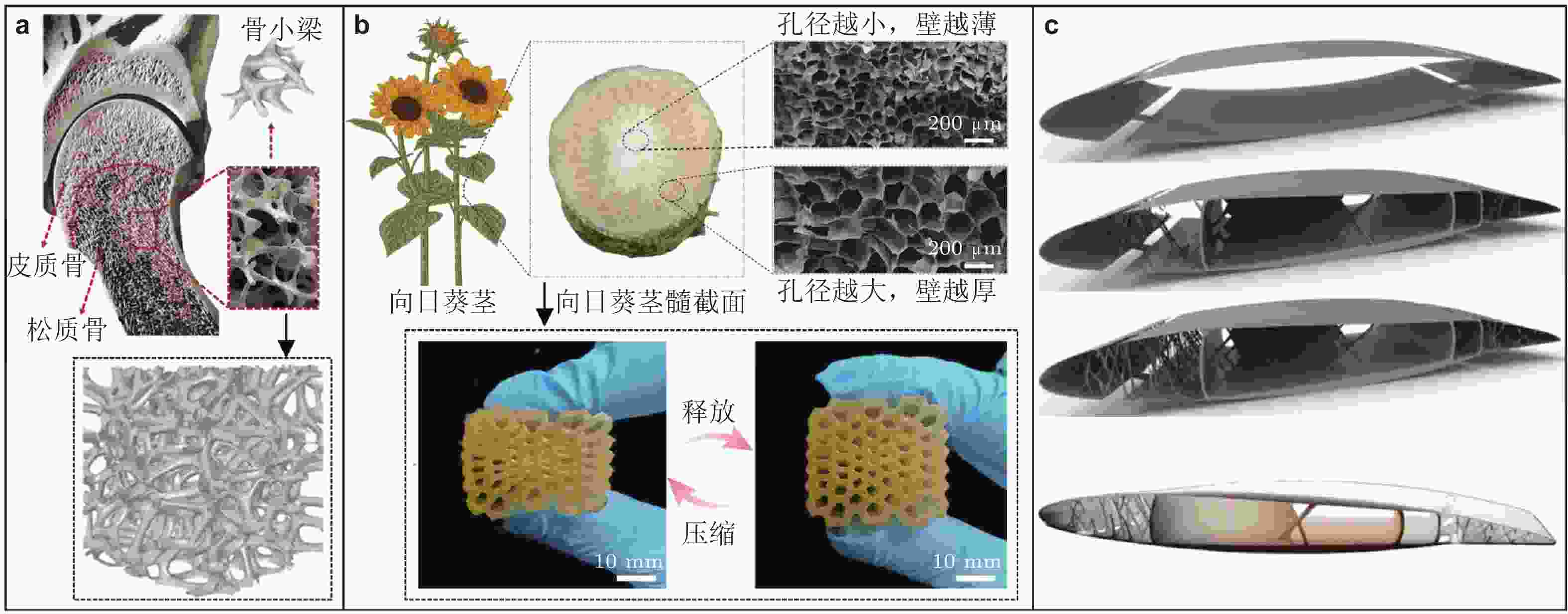
图 2 非周期仿生材料. (a)仿骨小梁的随机Voronoi杆状材料(Jiao et al. 2022), (b)仿向日葵髓部截面的双重梯度结构(Bai et al. 2024), (c)与犀鸟鸟喙内部结构高度相似的拓扑优化结构(Aage et al. 2017)
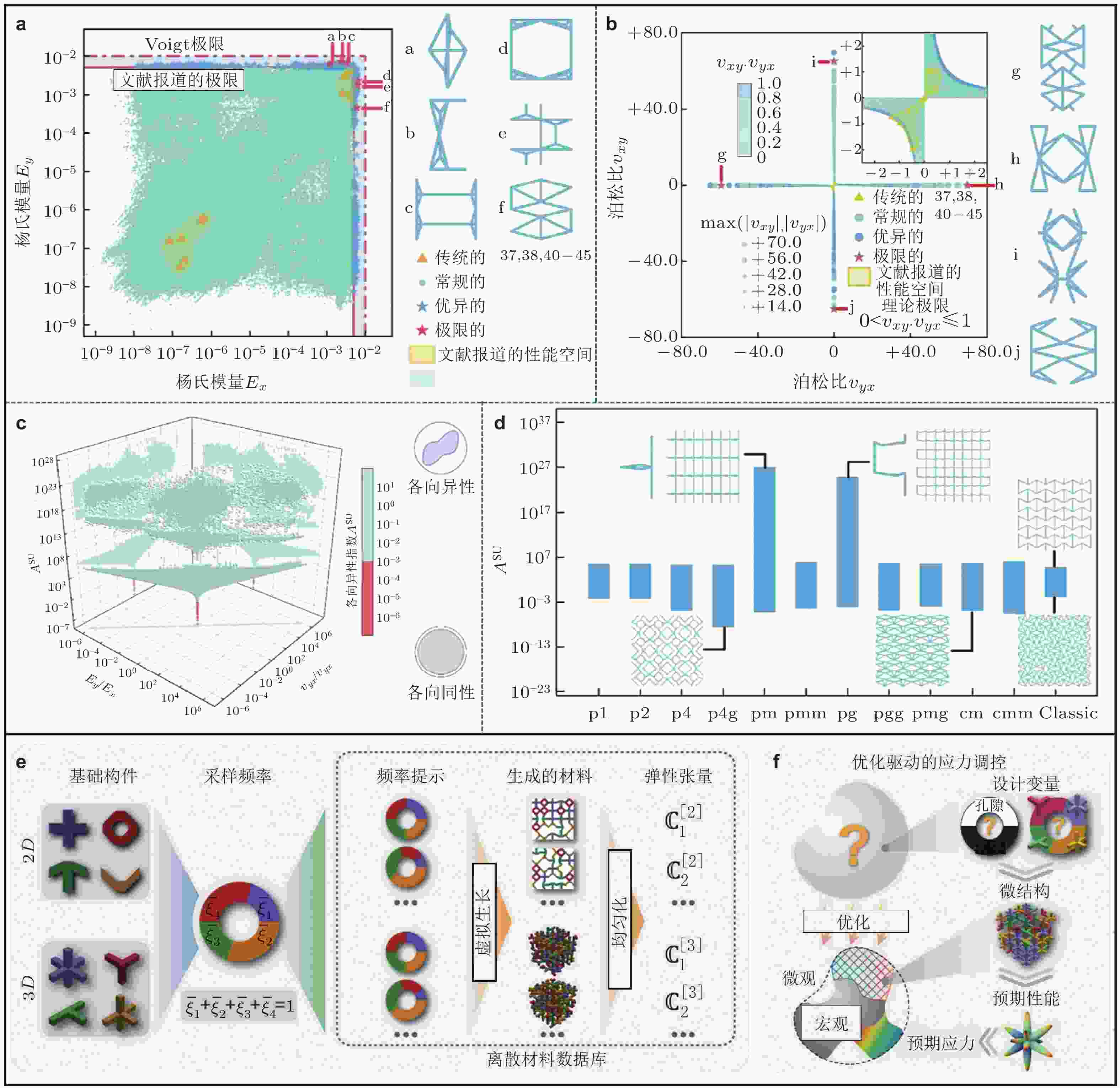
图 3 材料数据库的构建及非周期结构的代表性优化设计流程. (a) ~ (d)材料数据库的力学性能分布范围, 包括(a)沿水平和竖直方向的等效杨氏模量(星形代表2939种超越经典超材料的新型材料类型)、(b)泊松比与(c) ~ (d)各向异性, 其中(c)展示了各向异性指数ASU与Ex/Ey及νyx/νxy的关系图及投影, (d)展示了11组新型材料和经典超材料ASU范围的浮动柱状图(Chen et al. 2025); (e) ~ (f)基于“频率提示 + 拓扑优化”的不规则微结构虚拟生长方法, 其中圆环颜色占比反映了不同基础单元的频率; 均匀化计算后, 设计参数与力学性能通过神经网络建立映射关系, 进而在迭代中向力学目标优化(Jia et al. 2024b)
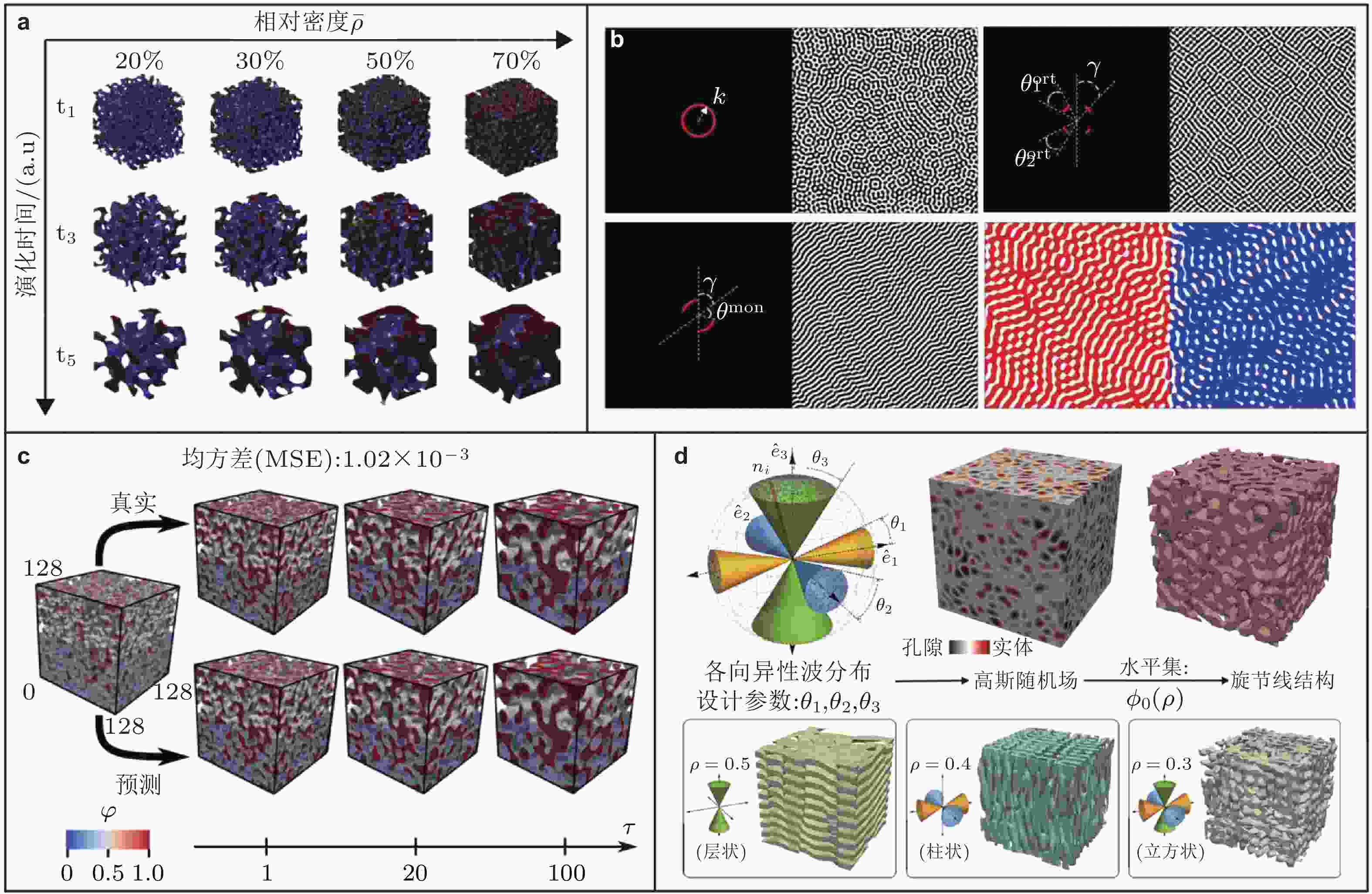
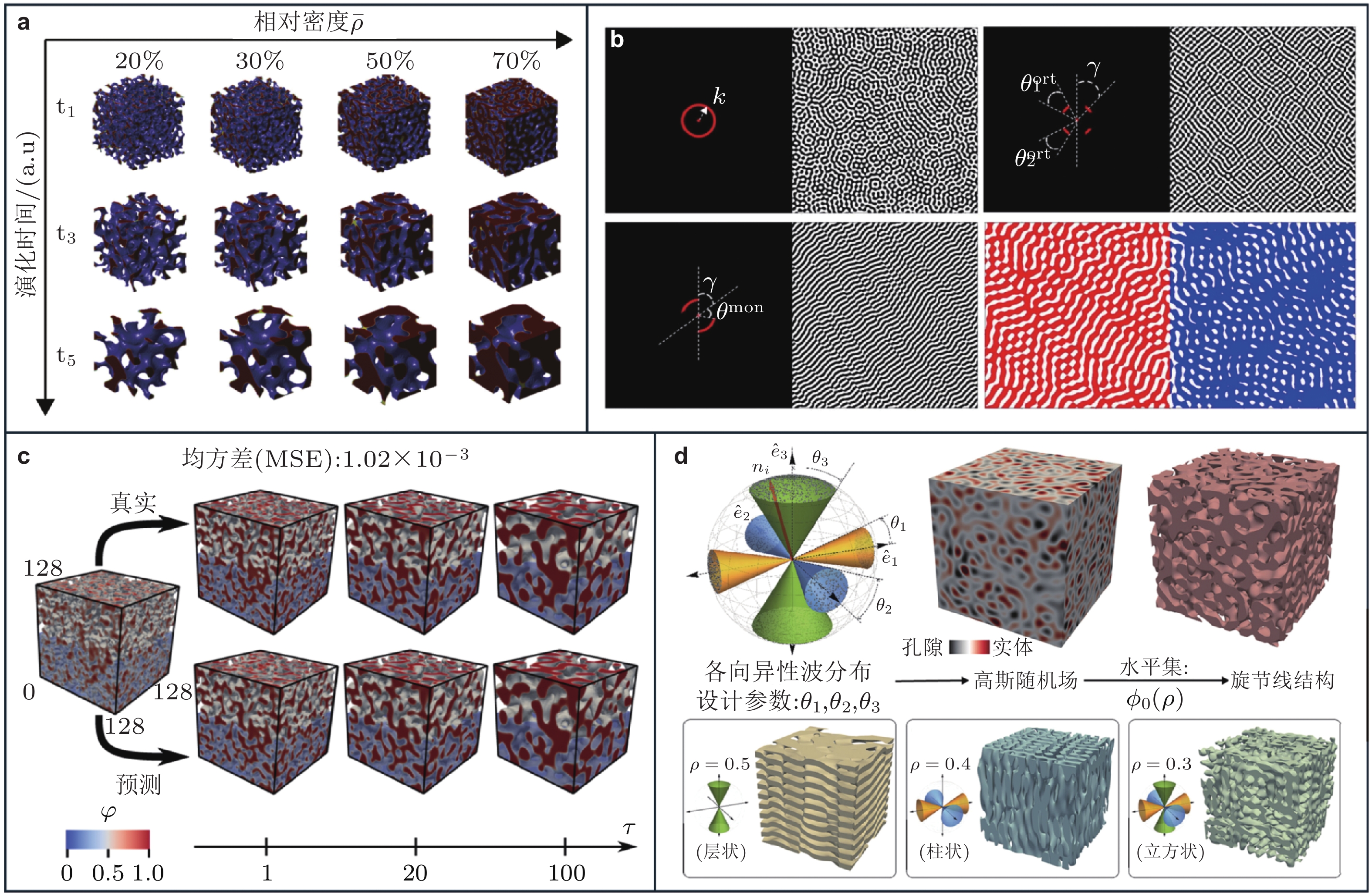
图 4 四种旋节线结构的建模方法. (a)不同相对密度和演化时间下, 相场演化法产生的三维实体结构(Hsieh et al. 2019), (b)不同参数模式下, 谱密度函数法获得的二维结构(Deng et al. 2026), (c) 3D-CRNN预测的三维实体结构, 其展现了良好的空间泛化效果(Lanzoni et al. 2024), (d)高斯随机场方法+水平集方法所得的4种旋节线典型构型(Deng et al. 2024)
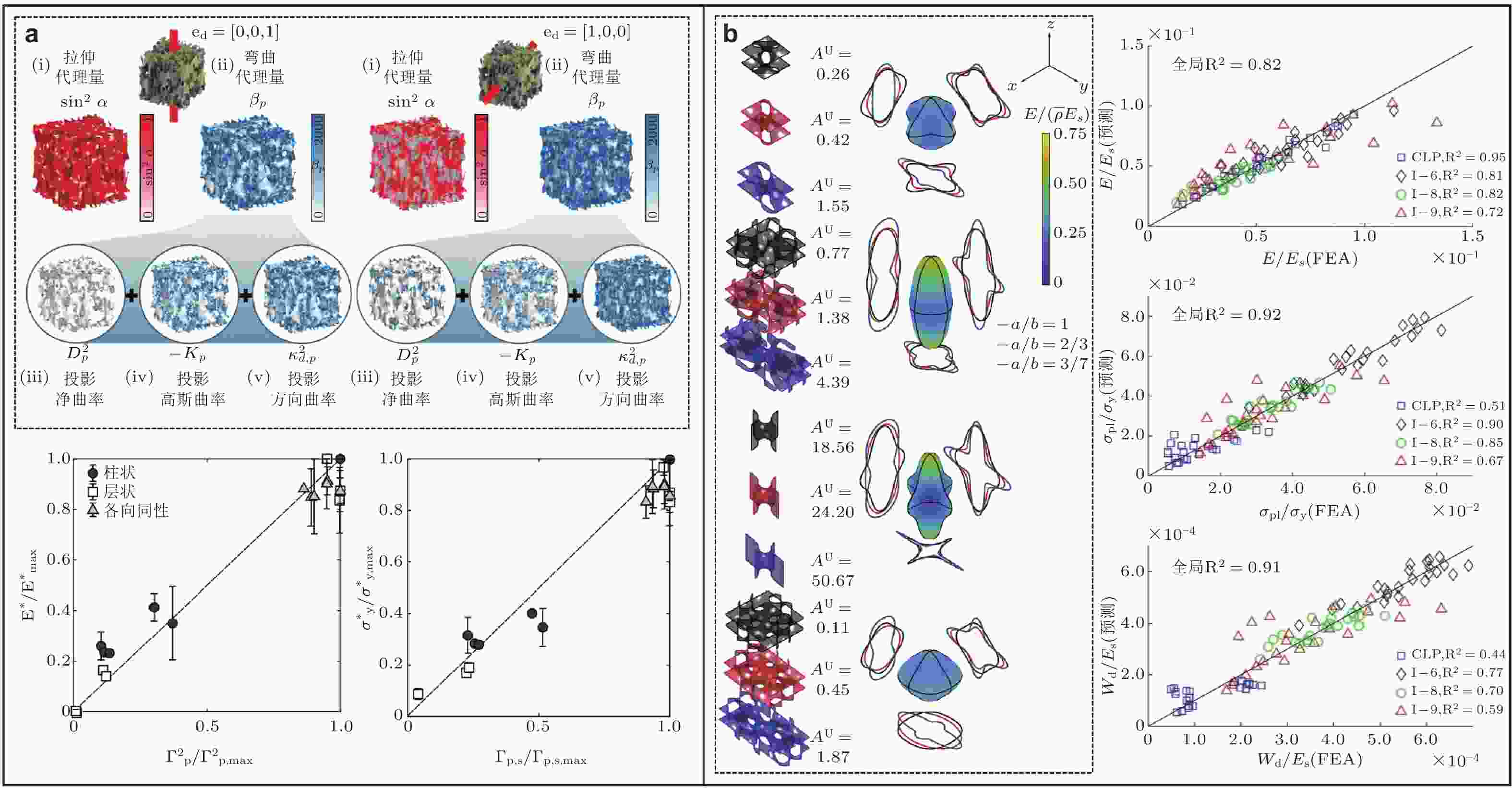
图 5 由细观角度建立宏观统计量的方法. (a)上方为旋节线元胞变形过程的拉伸能代理量(红)分布与弯曲能代理量(蓝)分布, 材料分布对两种能量的分布影响较大; 下方为实验所得(归一化)力学性能与响应代理量间的对比(Dhulipala & Portela 2025). (b)左侧为具有各向异性的正交对称TPMS结构及其弹性面, 右侧为引入边结构张量后理论预测值与数值计算值的对比(Daynes 2026)
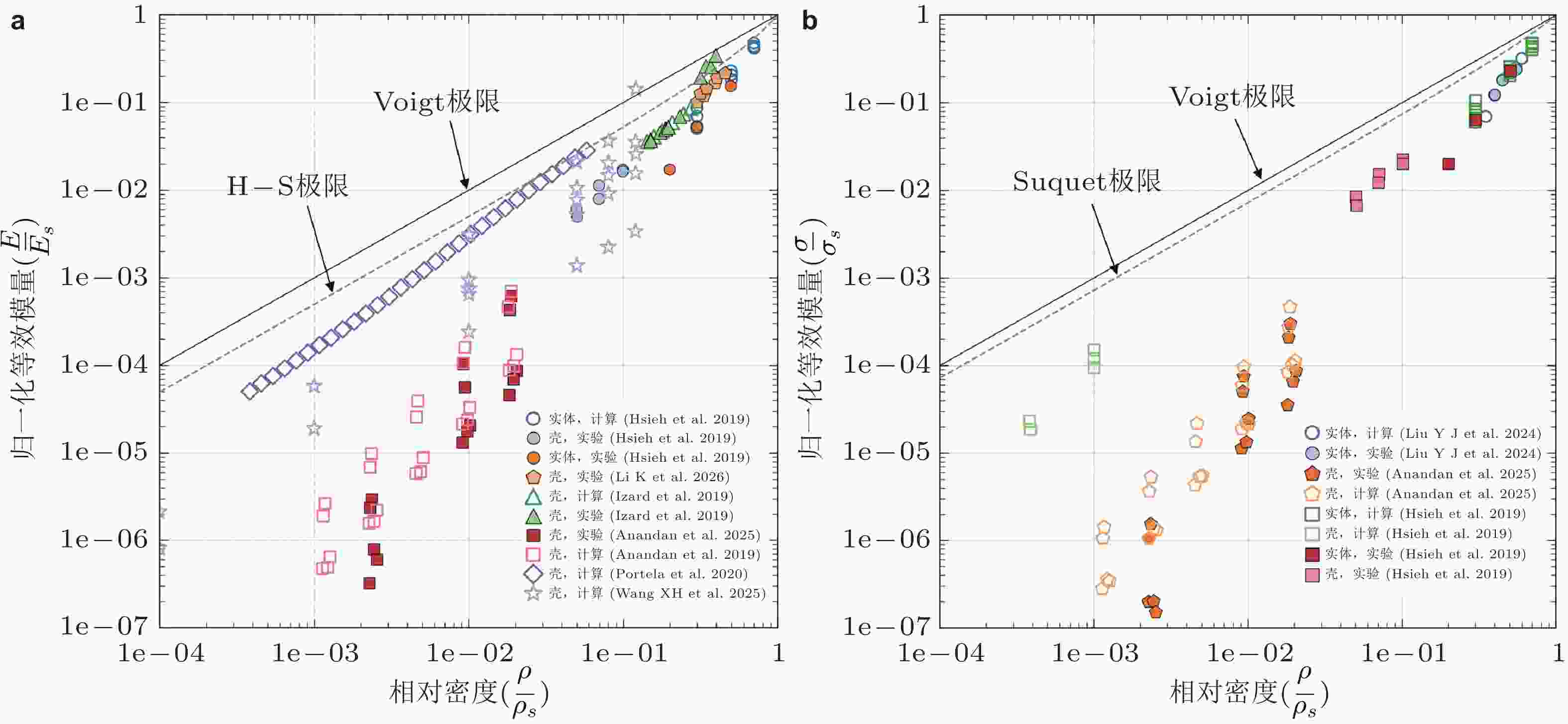
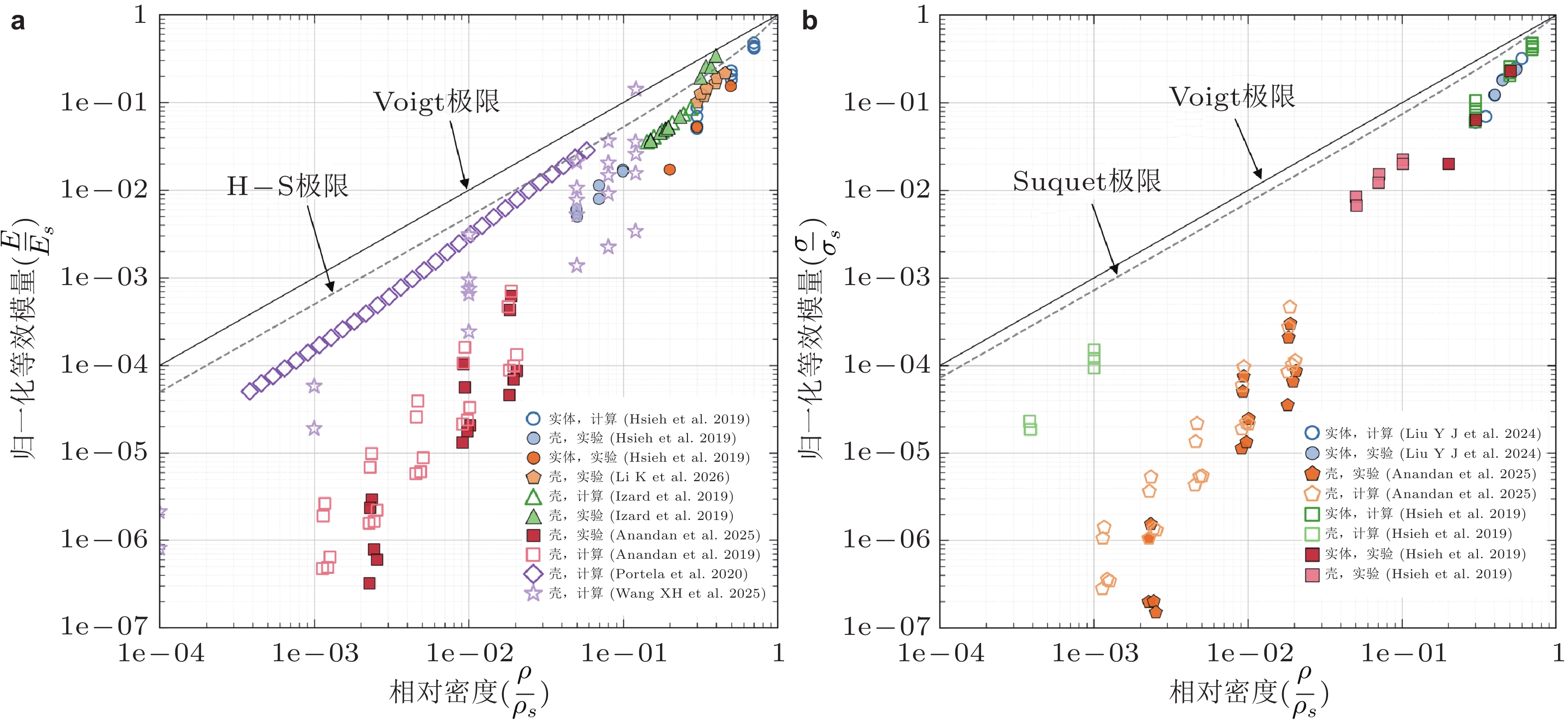
图 6 汇总现有代表性研究的Ashby图. (a)归一化等效模量(Hsieh et al. 2019, Izard et al. 2019, Portela et al. 2020, Anandan et al. 2025, Li et al. 2026, Wang X H et al. 2025), (b)归一化等效强度(Hsieh et al. 2019, Liu Y J et al. 2024, Anandan et al. 2025)
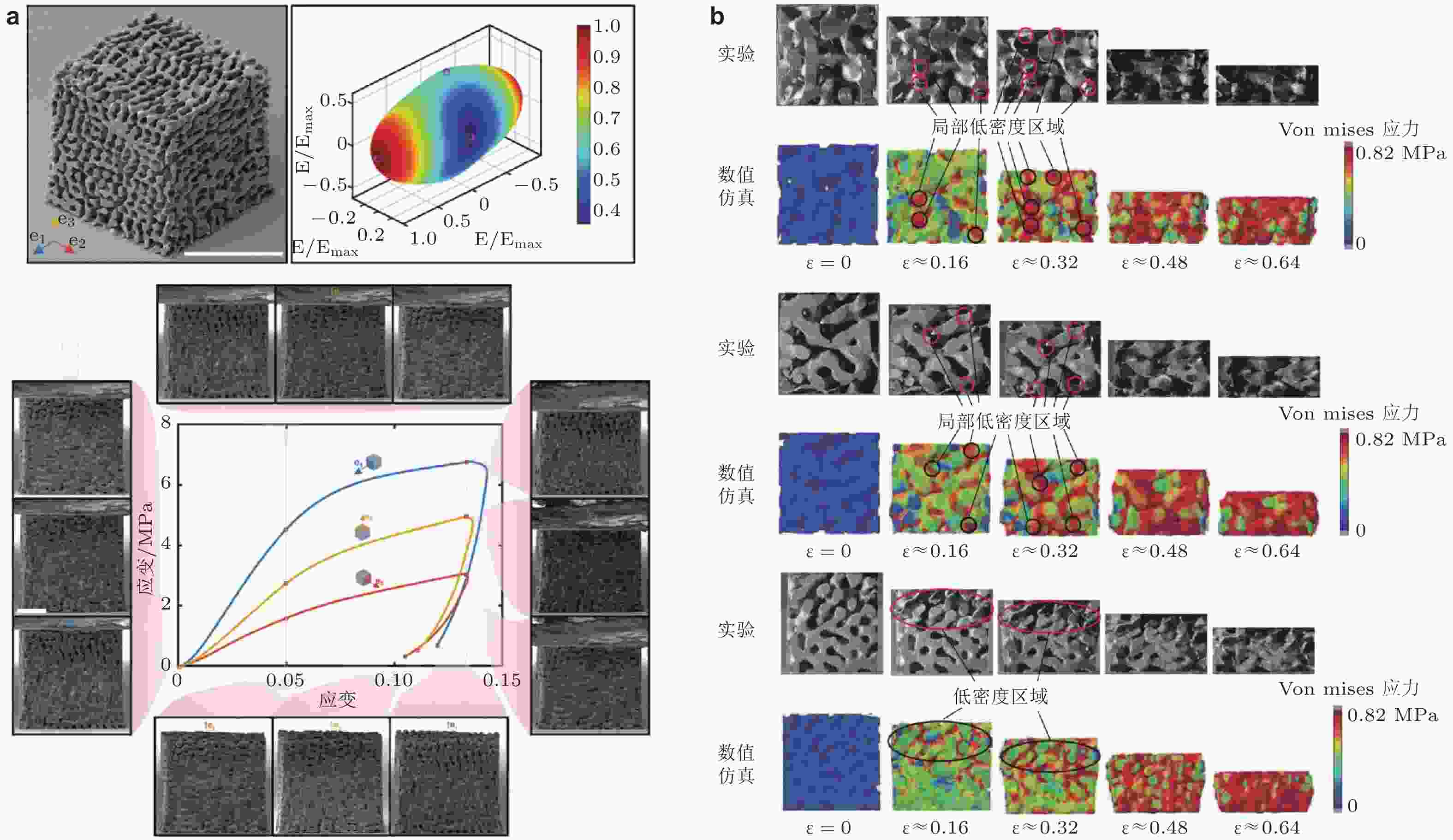
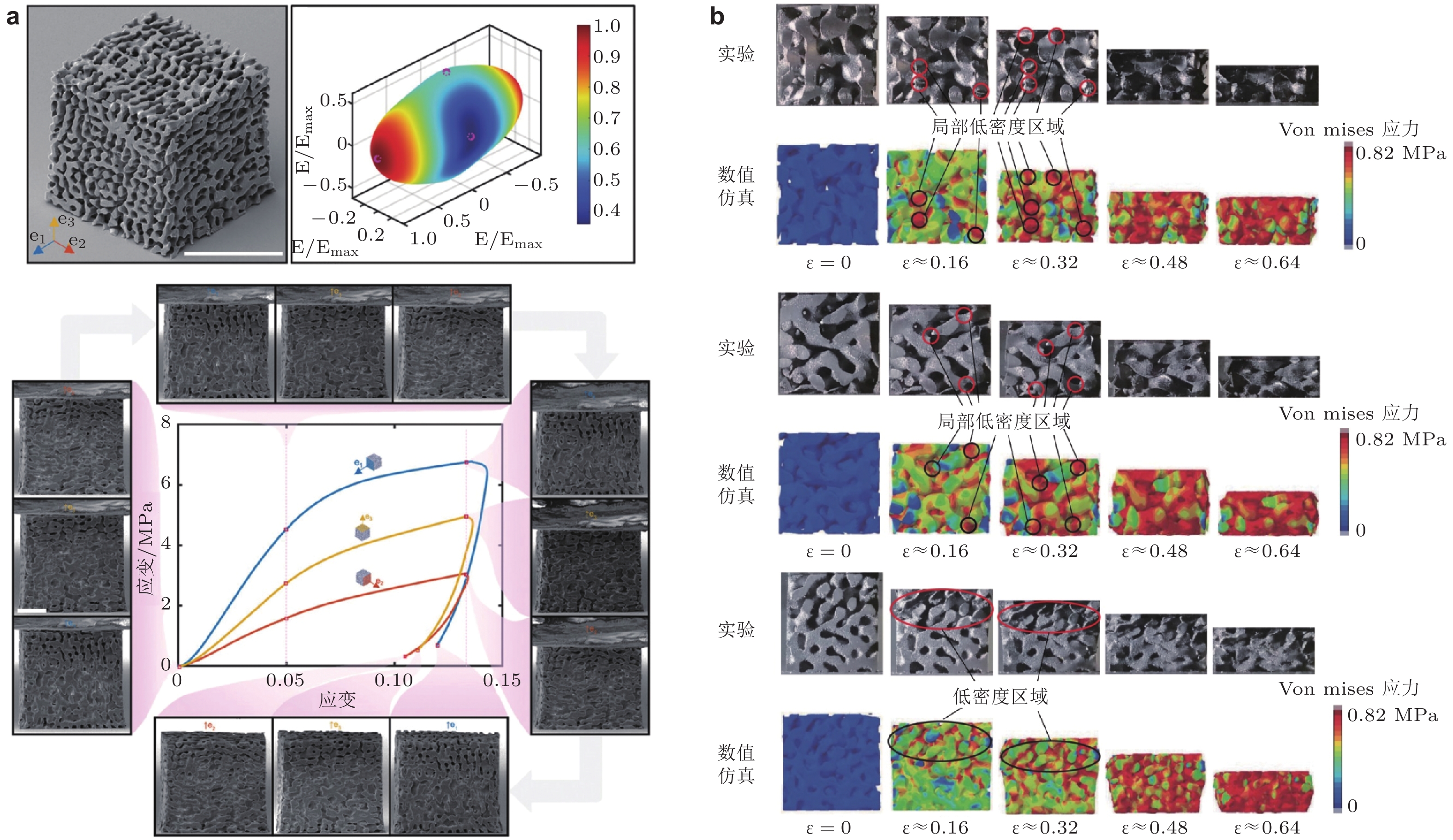
图 7 旋节线结构在单轴压缩载荷下的力学响应. (a)正交各向异性的加卸载过程(Deng et al. 2024), (b)分布于低密度区域的失效过程(Liu Y J et al. 2024)
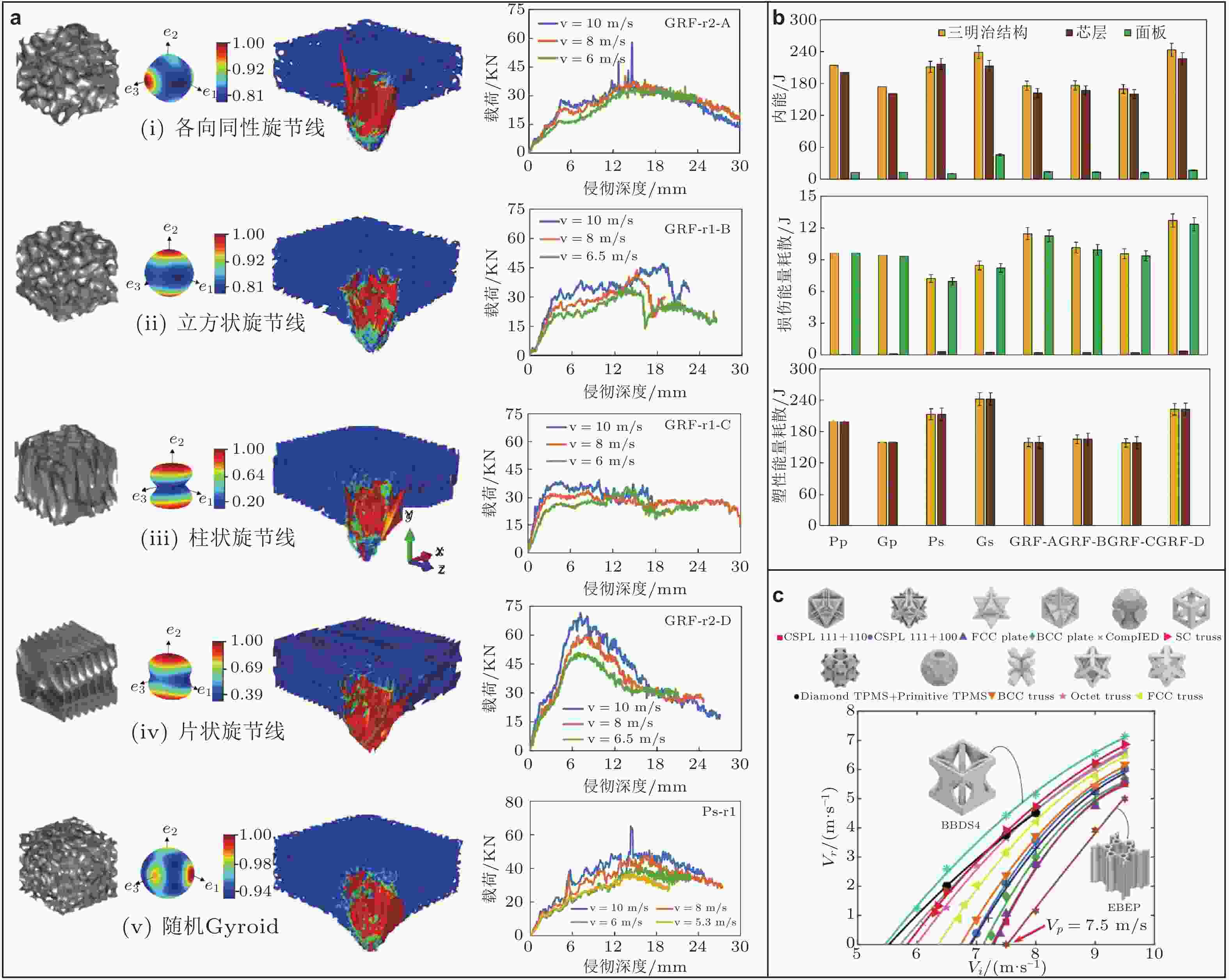
图 8 不同结构化材料的低速抗冲击性能. (a)为四种旋节线壳形式材料和一种随机TPMS材料的示意图、仿真计算结果及相应的载荷−侵彻深度曲线; (b)为周期性、随机性TPMS结构及旋节线结构的能量耗散对比, 自上至下分别为内能、损伤能量耗散、塑性能量耗散(Ejeh et al. 2024); (c)为不同晶格结构的残余速度−冲击速度曲线, 曲线与横轴的交点为极限穿透速度, EBEP结构的极限穿透速度较大, 抗穿透性能较好(Alhembar et al. 2025)
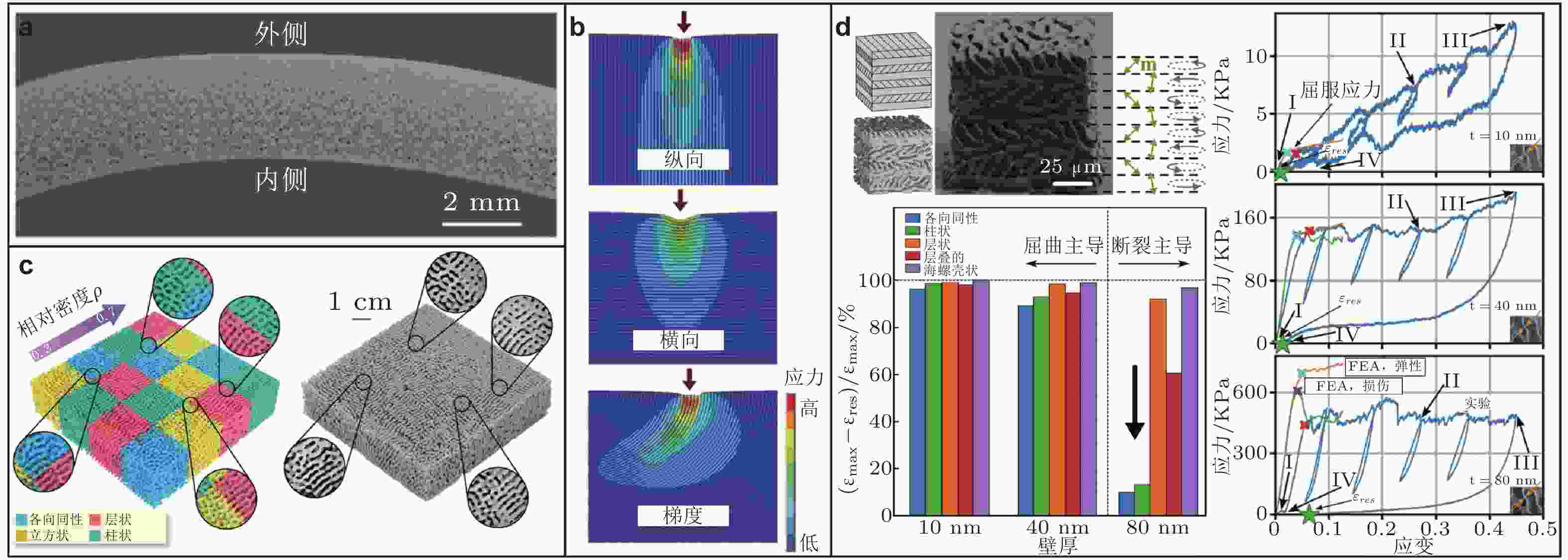
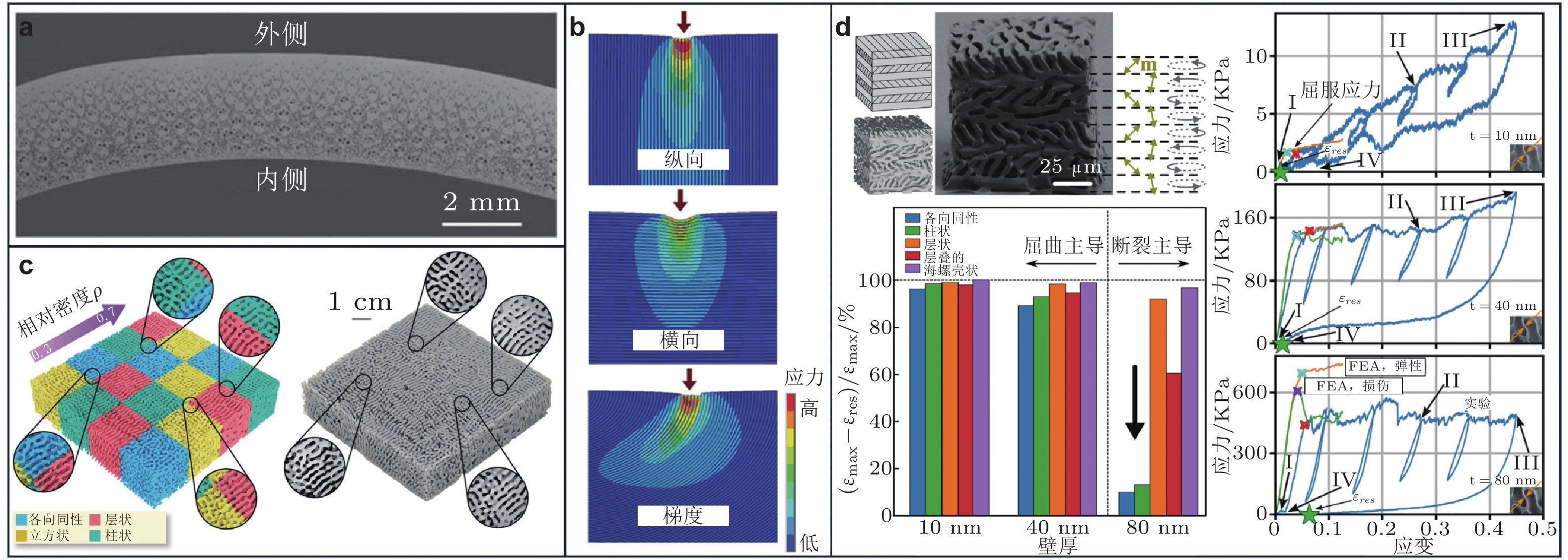
图 9 含有梯度的生物组织与人工设计旋节线结构. (a)竹子横截面的扫描电子显微镜(SEM)图像(Mao et al. 2023); (b)压痕载荷下纵向、横向和梯度结构取向复合材料的应力分布(Liu et al. 2016, 2020); (c)通过插值函数对不同拓扑的旋节线结构单胞实现平滑过渡(Senhora et al. 2022); (d)海螺型(conch)纳米陶瓷功能梯度材料具有高损伤容限的优势: 左上图展示了其具体结构; 右侧图呈现了壳厚为10、40、80 nm时, 结构经反复加卸载后的结构恢复情况; 左下图对比了不同类型结构在加卸载后的恢复率, 海螺型梯度结构无论壳层厚薄, 均表现出良好的损伤容限(Anandan et al. 2025)
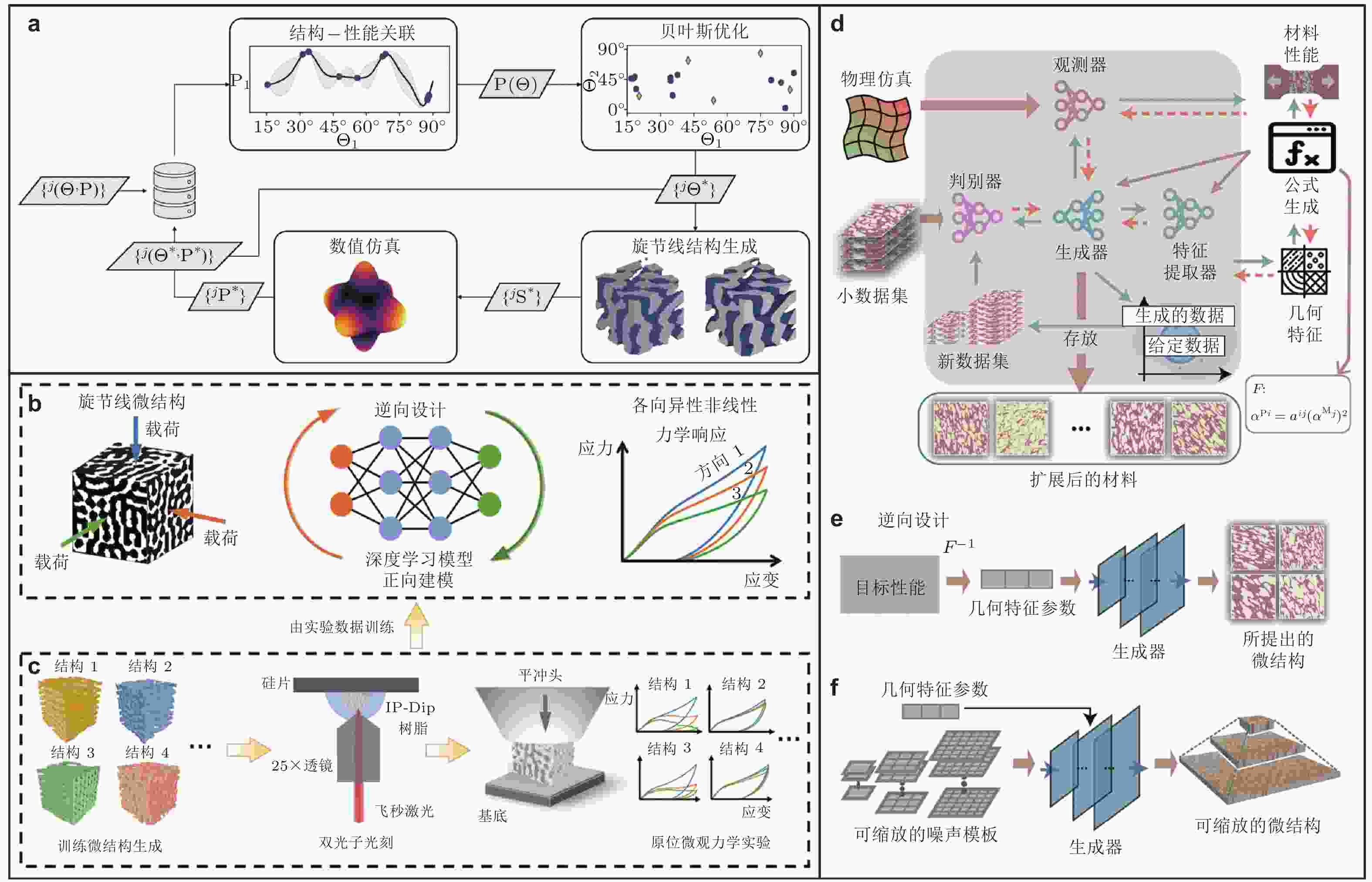
图 10 基于数据驱动的代表性先进逆向设计方法. (a)基于仿真计算小样本量数据驱动的多目标贝叶斯优化方法, 其中$ \{ {}^i({\boldsymbol{\varTheta }},{\boldsymbol{P}})\} $为描述符−性能对的初始数据集, $ {\boldsymbol{P}}({\boldsymbol{\varTheta}} )$为高斯随机过程建立的结构−性能关系; $ \{ {}^j{{\boldsymbol{\varTheta }}^*}\} $为贝叶斯优化新提出的结构描述符, $ \{ {}^j{{\boldsymbol{P}}^*}\} $为对应的性能 (Raßloff et al. 2025), (b) ~ (c)基于非线性实验数据的深度算子网络(DeepONet)代理模型, 其中(b)为正向建模与逆向设计示意图, (c)通过双光子光刻技术制备样品, 利用原位微压缩实验采集训练数据(Jin et al. 2025), (d) ~ (f)为 “建模−计算−预测−设计”一体化的GNDM方法, (d)中GNDM以一组基底材料和物理仿真算法为输入, 通过学习几何特征与性能之间的关系输出具有预期性能的微结构, (e)为面向目标性能的逆向设计流程, (f)说明无论训练样本的几何尺寸如何, GNDM都能生成填充任意空间的连续设计(Shen et al. 2026)
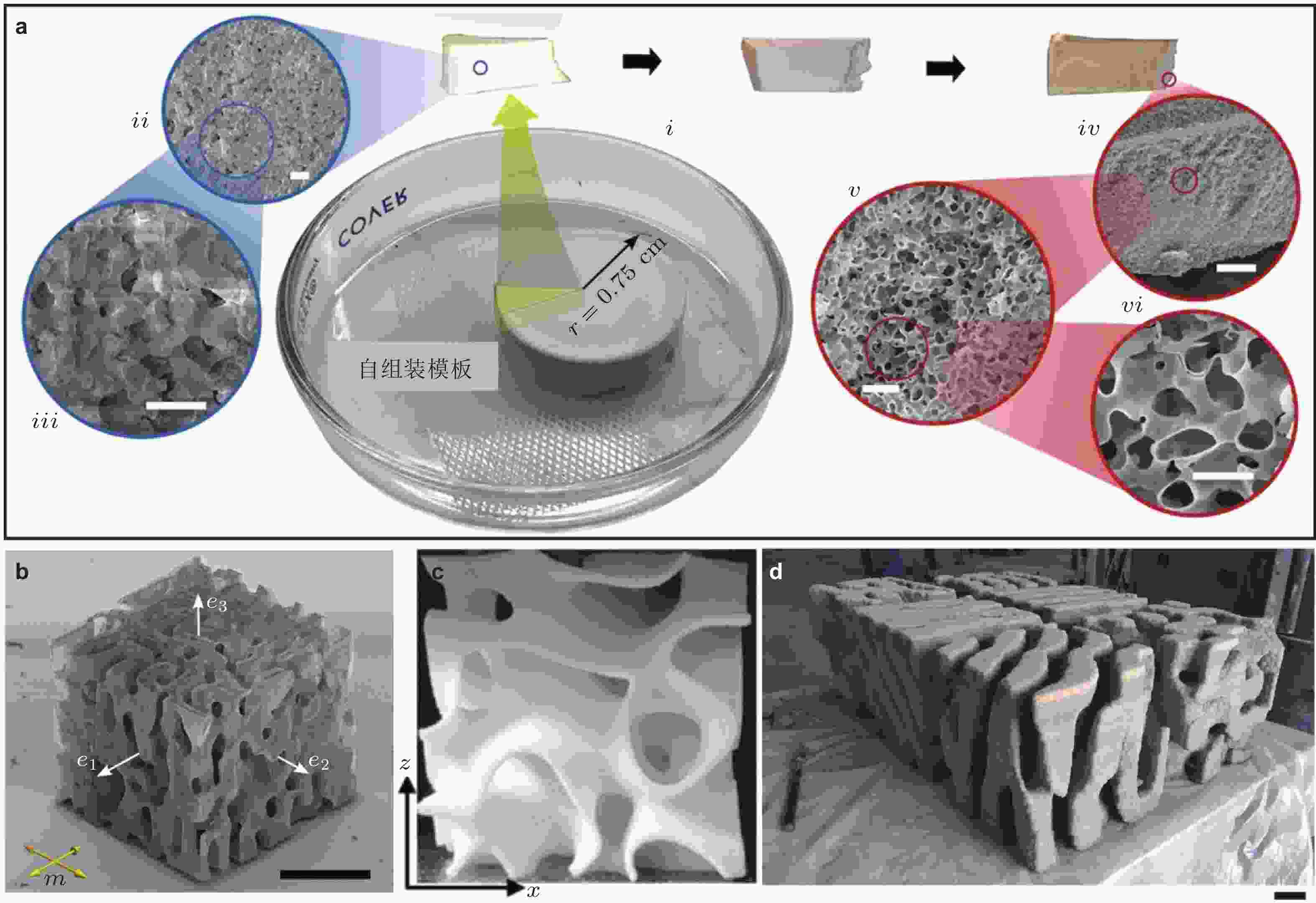
图 11 不同尺度的旋节线材料制造方案. (a)自组装纳米壳基旋节线材料, 比例尺分别为: (ii) ~ (iii) 10 μm, (iv) 100 μm, (v) 10 μm, (vi) 5 μm (Portela et al. 2020); (b)双光子光刻和原子层沉积技术制造的微纳级壳结构(壳厚11 nm), 比例尺: 50 μm; (c) SLS技术打印的TPU壳结构(壳厚约1 mm), 元胞尺寸50 mm (Wang X H et al. 2025); (d)大尺寸水射流粉末床技术制造的镁基水泥旋节线结构, 比例尺: 10 cm (Nale et al. 2025)
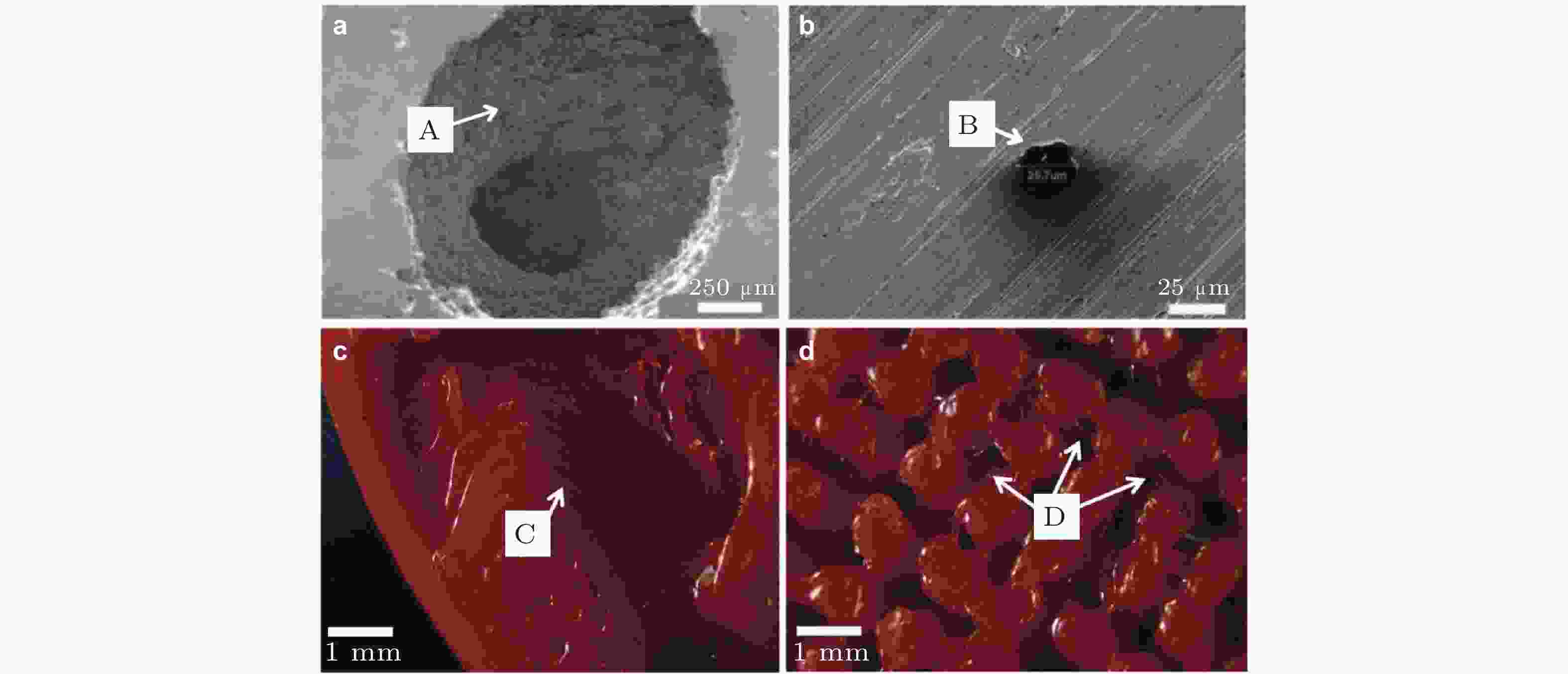
图 12 增材制造在复杂结构中产生的不同缺陷类型. (a)不锈钢颗粒部分熔化导致A处孔隙表面存在大量粘结颗粒(Liu Y J et al. 2024); (b) B处存在表面气孔, 由部分空气或金属蒸汽无法及时逸出导致; (c) C处表面存在阶梯状缺陷, 与结构表面的曲面形态有关(Wojciechowski et al. 2023); (d)支柱间连接的细丝D, 由打印过程喷嘴位置移动引起
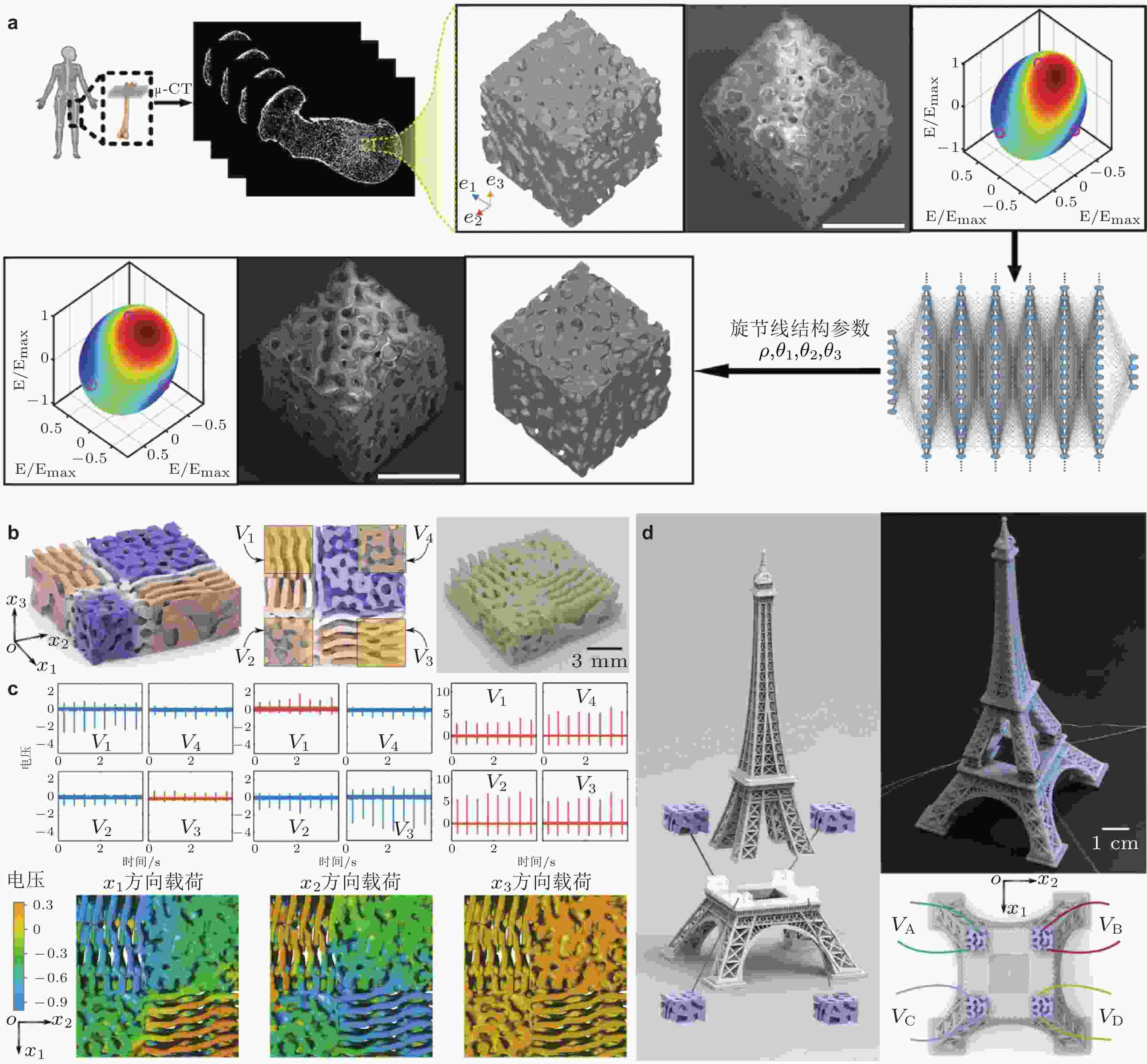
图 13 旋节线结构的典型应用. (a)基于逆向模型, 以弹性常数为目标的人体骨替代物设计: 从影像数据中提取骨小梁结构, 对增材制造骨样本提取力学性能(等效弹性模量曲面图); 借助逆向模型生成具有相似力学性能的旋节线结构, 并进行制造与验证(Deng et al. 2024). (b) ~ (d)利用旋节线铁电材料“力−热−电”响应的具体应用: (b)基于功能梯度旋节线结构设计的一体化三维力传感器及其制备样品, (c)功能梯度设计在三个方向单向冲击下的实验电压响应及有限元模拟结果, (d)将轻质铁电超材料用于埃菲尔铁塔结构健康监测的构建模块(Shi et al. 2024)
表 1 旋节线结构的主要建模方法
建模方法 原理 结构类型 影响形态的
主要参数计算方法 优势 不足 代表文献 相场演化方法 基于Cahn-Hilliard动力学方程的相分离演化 三维壳/实体结构 相对密度$\bar \rho $
演化时间t
相界面宽度参数δ
初始扰动场u0有限差分法 符合真实物理过程, 可用于自组装制备所得材料的
验证.计算速度慢、成本高; 材料以各向同性为主, 难以直观调控结构各向异性. Hsieh
et al. 2019二维结构 相对密度$\bar \rho $
界面宽度、演化速率相关
无量纲参数α、β有限差分法 参数直观、简洁, 物理意义明确; 参数调控自由且便利. 无法生成三维旋节线结构; 参数需控制范围以避免数值不稳定现象. Mandolesi et al. 2025 谱密度函数方法 基于可调谱密度函数由白噪声重构结构 二维结构 相对密度$\rho_{\mathrm{m}} $
空间频率k
各向异性指数αmon、$\alpha _1^{{\rm{ort}}} $、$\alpha _2^{{\rm{ort}}} $
频率旋转角γ基于快速傅里叶变换的频域滤波与阈值化方法 参数物理意义明确, 实现了高效低维参数化; 计算速度快、具有可控的随机性和鲁棒性. 覆盖形态有限; 依赖于原始样本, 存在重构结果失真的风险. Deng et al. 2026 神经网络方法 基于机器学习方法学习相分离演化过程 三维结构 神经网络超参数
演化时间t物理启发的卷积循环神经网络(CRNN) 在线阶段模拟相分离过程快速生成结构, 无需数值计算演化过程; 在时空上具备一定可泛
化性.数据集生成及离线训练所需计算成本高、具有数据集依赖性; 演化时间较长时可能产生误差积累. Lanzoni
et al. 2024高斯随机场方法 基于大量随机波矢叠加的水平集方法 三维壳/实体结构 相对密度$\bar \rho $
GRF锥角参数
θ1、θ2、θ3
波数β高斯随机场方法、水平集方法 结构生成速度相对较快, 计算便捷; 可自由、直观地调控结构形态与各向异性. 叠加波数量、单胞尺寸较大时计算速度较慢; GRF锥角参数与各向异性弹性矩阵缺乏直接
关联.Soyarslan et al. 2018,Kumar
et al. 2020 下载: 导出CSV
-
[1] 关怀. 2023. 仿调幅分解结构纳米金属材料的制备、力学性能及热稳定性研究. [博士论文]. 中国科学技术大学 (Guan H. 2023. Synthesis, mechanical properties and thermal stability of spinodoid nanomaterials. [PhD thesis]. University of Science and Technology of China).Guan H. 2023. Synthesis, mechanical properties and thermal stability of spinodoid nanomaterials. [PhD thesis]. University of Science and Technology of China. [2] 李想, 严子铭, 柳占立, 等. 2021. 基于仿真和数据驱动的先进结构材料设计. 力学进展, 51: 82-105 (Li X, Yan Z M, Liu Z L, et al. 2021. Advanced structural material design based on simulation and data-driven method. Advances in Mechanics, 51: 82-105).Li X, Yan Z M, Liu Z L, et al. 2021. Advanced structural material design based on simulation and data-driven method. Advances in Mechanics, 51: 82-105. [3] 严子铭. 2023. 数据驱动与力学建模融合的骨缺损重建研究. [博士论文]. 中国科学技术大学 (Yan Z M. 2023. A study on bone defect reconstruction based on data-driven method and mechanical modeling. [PhD thesis]. Tsinghua University).Yan Z M. 2023. A study on bone defect reconstruction based on data-driven method and mechanical modeling. [PhD thesis]. Tsinghua University. [4] Aage N, Andreassen E, Lazarov S B, et al. 2017. Giga-voxel computational morphogenesis for structural design. Nature, 550: 84-86. doi: 10.1038/nature23911 [5] Abueidda D W, Bakir M, Abu Al-Rub R K, et al. 2017. Mechanical properties of 3D printed polymeric cellular materials with triply periodic minimal surface architectures. Materials & Design, 122: 255-267. doi: 10.1016/j.matdes.2017.03.018 [6] Akbari M, Mirabolghasemi A, Bolhassani M, et al. 2022. Strut-based cellular to shellular funicular materials. Advanced Functional Materials, 32: 2109725. doi: 10.1002/adfm.202109725 [7] Alhembar A, Barsoum I, Scarpa F. 2025. On the correlation between static and dynamic mechanical properties in architected lattice materials. Materials & Design, 256: 114315. doi: 10.1016/j.matdes.2025.114315 [8] Alkhader M, Vural M. 2008. Mechanical response of cellular solids: Role of cellular topology and microstructural irregularity. International Journal of Engineering Science, 46: 1035-1051. doi: 10.1016/j.ijengsci.2008.03.012 [9] Alzubaidi L, Zhang J L, Humaidi A J, et al. 2021. Review of deep learning: Concepts, CNN architectures, challenges, applications, future directions. Journal of Big Data, 8: 53. doi: 10.1186/s40537-021-00444-8 [10] Al-Ketan O, Al-Rub R K A, Rowshan R. 2017. Mechanical properties of a new type of architected interpenetrating phase composite materials. Advanced Materials Technologies, 2: 1600235. doi: 10.1002/admt.201600235 [11] Al-Ketan O, Rowshan R, Al-Rub R K A. 2018. Topology-mechanical property relationship of 3D printed strut, skeletal, and sheet based periodic metallic cellular materials. Additive Manufacturing, 19: 167-183. doi: 10.1016/j.addma.2017.12.006 [12] Al-Ketan O, Lee D-W, Abu Al-Rub R K. 2021. Mechanical properties of additively-manufactured sheet-based gyroidal stochastic cellular materials. Additive Manufacturing, 48: 102418. doi: 10.1016/j.addma.2021.102418 [13] Anandan N, Wilson C G, Meza L R. 2025. Functionally graded spinodal nanoarchitected ceramics with unprecedented recoverability. International Journal of Mechanical Sciences, 301: 110453. doi: 10.1016/j.ijmecsci.2025.110453 [14] Ashby M F. 2005. The properties of foams and lattices. Philosophical Transactions of the Royal Society A: Mathematical, Physical and Engineering Sciences, 364: 15-30. [15] Arzt E. 1998. Size effects in materials due to microstructural and dimensional constraints: A comparative review. Acta Mater, 46: 5611-5626. doi: 10.1016/S1359-6454(98)00231-6 [16] Bai C C, Yang X X, Liu D S, et al. 2024. Sunflower pith inspired dual-gradient cellular polyurethane architecture with amplified mechanical functions. Chemical Engineering Journal, 500: 156740. doi: 10.1016/j.cej.2024.156740 [17] Bažant Z P. 1999. Size effect on structural strength: A review. Archive of Applied Mechanics (Ingenieur Archiv), 69: 703-725. [18] Bernard A R, ElSayed M S A. 2024. Design, manufacturing, and analysis of periodic three-dimensional cellular materials for energy absorption applications: A critical review. Materials, 17: 2181. doi: 10.3390/ma17102181 [19] Bertoldi K, Reis P M, Willshaw S, et al. 2010. Negative Poisson’s ratio behavior induced by an elastic instability. Advanced Materials, 22: 361-366. doi: 10.1002/adma.200901956 [20] Bhate D. 2019. Four questions in cellular material design. Materials, 12: 1060. doi: 10.3390/ma12071060 [21] Bhate D, Penick C, Ferry L, et al. 2019. Classification and selection of cellular materials in mechanical design: Engineering and biomimetic approaches. Designs, 3: 19. doi: 10.3390/designs3010019 [22] Bhuwal A S, Pang Y, Ashcroft I, et al. 2023. Discovery of quasi-disordered truss metamaterials inspired by natural cellular materials. Journal of the Mechanics and Physics of Solids, 175: 105294. doi: 10.1016/j.jmps.2023.105294 [23] Biener J, Hodge A M, Hayes J R, et al. 2006. Size effects on the mechanical behavior of nanoporous Au. Nano Letters, 6: 2379-2382. doi: 10.1021/nl061978i [24] Binder K, Stauffer D. 1974. Theory for the slowing down of the relaxation and spinodal decomposition of binary mixtures. Physical Review Letters, 33: 1006-1009. doi: 10.1103/PhysRevLett.33.1006 [25] Brezny R, Green D J. 1990. The effect of cell size on the mechanical behavior of cellular materials. Acta Metallurgica et Materialia, 38: 2517-2526. doi: 10.1016/0956-7151(90)90263-G [26] Cahn J W. 1961. On spinodal decomposition. Acta Metallurgica, 9: 795-801. doi: 10.1016/0001-6160(61)90182-1 [27] Cahn J W, Hilliard J E. 1958. Free energy of a nonuniform system. I. Interfacial free energy. The Journal of Chemical Physics, 28: 258-267. doi: 10.1063/1.1744102 [28] Cai J, Seyedkanani A, Shahryari B, et al. 2026. Nano-architected GaN spinodoid metamaterials with tailorable anisotropic piezoelectric properties. Materials Horizons. [29] Chaudhuri S, Ritchie D, Wu J J, et al. 2020. Learning generative models of 3d structures. In Computer Graphics Forum, 39: 643-666. doi: 10.1111/cgf.14020 [30] Chen H-Y, Kwon Y, Thornton K. 2009. Multifunctionality of three-dimensional self-assembled composite structure. Scripta Materialia, 61: 52-55. doi: 10.1016/j.scriptamat.2009.03.006 [31] Chen J X, Wei Z Y, Xiao X Y J, et al. 2025. Mining extreme properties from a large metamaterial database. Nature Communications, 16: 9648. doi: 10.1038/s41467-025-64745-9 [32] Chen K N, Qin H L, He W, et al. 2024. Design of oil-bearing pore structures and its lubrication performance study. SSRN Electric Journal, SSRN: 5043830. [33] Chiang Y, Tung C-C, Lin X-D, et al. 2021. Geometrically toughening mechanism of cellular composites inspired by Fibonacci lattice in liquidambar formosana. Composite Structures, 262: 113349. doi: 10.1016/j.compstruct.2020.113349 [34] Choukir S, van Egmond D A, Hatton B D, et al. 2023. The interplay between constituent material and architectural disorder in bioinspired honeycomb structures. International Journal of Engineering Science, 188: 103863. doi: 10.1016/j.ijengsci.2023.103863 [35] Da D C, Chan Y-C, Wang L W, et al. 2022. Data-driven and topological design of structural metamaterials for fracture resistance. Extreme Mechanics Letters, 50: 101528. doi: 10.1016/j.eml.2021.101528 [36] Daynes S. 2026. TPMS sheet structures with orthorhombic symmetry: Anisotropic elasticity and energy absorption. Journal of the Mechanics and Physics of Solids, 208: 106489. doi: 10.1016/j.jmps.2025.106489 [37] Deng S G, Lee D, Chandrasekhar A, et al. 2026. Data-driven topology optimization for multiscale biomimetic spinodal design. Structural and Multidisciplinary Optimization, 69: 10. doi: 10.1007/s00158-025-04176-8 [38] Deng W T, Kumar S, Vallone A, et al. 2024. AI-enabled materials design of non-periodic 3D architectures with predictable direction-dependent elastic properties. Advanced Materials, 36: 2308149. doi: 10.1002/adma.202308149 [39] Deshpande V S, Ashby M F, Fleck N A. 2001. Foam topology: Bending versus stretching dominated architectures. Acta Materialia, 49: 1035-1040. doi: 10.1016/S1359-6454(00)00379-7 [40] Dhulipala S, Portela C M. 2025. Curvature-guided mechanics and design of spinodal and shell-based architected materials. Journal of the Mechanics and Physics of Solids, 204: 106273. [41] Ejeh C J, Barsoum I, Rashid K A. 2024. Impact behavior of periodic, stochastic, and anisotropic minimal surface-lattice sandwich structures. International Journal of Mechanical Sciences, 276: 109359. doi: 10.1016/j.ijmecsci.2024.109359 [42] Ejeh C J, Alhammadi K K, Abu Al-Rub R K. 2025. Flexural behavior of additively manufactured sheet-based minimal surface periodic, stochastic and spinodoid latticed-beams. Progress in Additive Manufacturing, 10: 11557-11577. doi: 10.1007/s40964-025-01302-2 [43] Eschenauer H A, Olhoff N. 2001. Topology optimization of continuum structures: A review. Applied Mechanics Reviews, 54: 331-390. doi: 10.1115/1.1388075 [44] Findik F. 2012. Improvements in spinodal alloys from past to present. Materials & Design, 42: 131-146. doi: 10.1016/j.matdes.2012.05.039 [45] Frazier P I. 2018. A tutorial on Bayesian optimization. arXiv e-prints, arXiv: 1807.02811. [46] Fujita T, Qian L H, Inoke K, et al. 2008. Three-dimensional morphology of nanoporous gold. Applied Physics Letters, 92: 251902. doi: 10.1063/1.2948902 [47] Fulco S, Budzik M K, Xiao H Y, et al. 2025. Disorder enhances the fracture toughness of 2D mechanical metamaterials. PNAS Nexus, 4: pgaf023. doi: 10.1093/pnasnexus/pgaf023 [48] Gao H L, Zhu Y B, Mao L B, et al. 2016. Super-elastic and fatigue resistant carbon material with lamellar multi-arch microstructure. Nature Communications, 7: 12920. doi: 10.1038/ncomms12920 [49] Gibson L J. 1989. Modelling the mechanical behavior of cellular materials. Materials Science and Engineering: A, 110: 1-36. doi: 10.1016/0921-5093(89)90154-8 [50] Gibson L J. 2003. Cellular solids. MRS Bulletin, 28: 270-274. doi: 10.1557/mrs2003.79 [51] Gibson L J, Ashby M F. 1982. The mechanics of three-dimensional cellular materials. Proceedings of the Royal Society of London. A. Mathematical and Physical Sciences, 382: 43-59. doi: 10.1098/rspa.1982.0088 [52] Golnary F, Asghari M. 2023. Investigating the influence of topology on elastic properties in spinodal microstructures. Modelling and Simulation in Materials Science and Engineering, 32: 015006. doi: 10.1088/1361-651x/acfd48 [53] Golnary F, Asghari M. 2024. Data-driven analysis of spinodoid topologies: Anisotropy, inverse design, and elasticity tensor distribution. International Journal of Mechanics and Materials in Design, 20: 1029-1051. doi: 10.1007/s10999-024-09711-x [54] Golnary F, Asghari M. 2025. Efficient feature extraction for morphologically complex self-assembled porous microstructures using computational homology and unsupervised machine learning. European Journal of Mechanics-A/Solids, 111: 105589. doi: 10.1016/j.euromechsol.2025.105589 [55] Gol’denveizer A L. 1961. Asymptotic properties of eigenvalues in problems of the theory of thin elastic shells. Journal of Applied Mathematics and Mechanics, 25: 1077-1094. doi: 10.1016/s0021-8928(61)80013-0 [56] Goodfellow I, Pouget-Abadie J, Mirza M, et al. 2020. Generative adversarial networks. Communications of the ACM, 63: 139-144. doi: 10.1145/3422622 [57] Greer J R, Deshpande V S. 2019. Three-dimensional architected materials and structures: Design, fabrication, and mechanical behavior. MRS Bulletin, 44: 750-757. doi: 10.1557/mrs.2019.232 [58] Groth J-H, Anderson C, Magnini M, et al. 2022. Five simple tools for stochastic lattice creation. Additive Manufacturing, 49: 102488. doi: 10.1016/j.addma.2021.102488 [59] Guo L, Kansara H, KhosroshahiS F, et al. 2026. Multi-fidelity Bayesian data-driven design of energy absorbing spinodoid cellular structures. Computers & Structures, 323: 108155. [60] Guo Y Q, Sharma S, Kumar S. 2024. Inverse designing surface curvatures by deep learning. Advanced Intelligent Systems, 6: 2300789. doi: 10.1002/aisy.202300789 [61] Han S C, Lee J W, Kang K. 2015. A new type of low density material: Shellular. Advanced Materials, 27: 5506-5511. doi: 10.1002/adma.201501546 [62] Hanna J A, Baker I, Wittmann M W, et al. 2005. A new high-strength spinodal alloy. Journal of Materials Research, 20: 791-795. doi: 10.1557/JMR.2005.0136 [63] Haupt P. 2000. Continuum mechanics and theory of materials. Springer Berlin Heidelberg, Berlin, Heidelberg. [64] Harrigan T P, Mann R W. 1984. Characterization of microstructural anisotropy in orthotropic materials using a second rank tensor. Journal of Materials Science, 19: 761-767. doi: 10.1007/BF00540446 [65] Hsieh M T, Endo B, Zhang Y F, et al. 2019. The mechanical response of cellular materials with spinodal topologies. Journal of the Mechanics and Physics of Solids, 125: 401-419. doi: 10.1016/j.jmps.2019.01.002 [66] Hsieh M T, Begley M R, Valdevit L. 2021. Architected implant designs for long bones: Advantages of minimal surface-based topologies. Materials & Design, 207: 109838. doi: 10.1016/j.matdes.2021.109838 [67] Huang Z Y, Cao X F, Niu H, et al. 2024. Numerical and experimental evaluations on the defect sensitivity of the performance of BCC truss-lattice structures. Mechanics of Materials, 191: 104937. doi: 10.1016/j.mechmat.2024.104937 [68] Izard G A, Bauer J, Crook C, et al. 2019. Ultrahigh energy absorption multifunctional spinodal nanoarchitectures. Small, 15: 1903834. doi: 10.1002/smll.201903834 [69] Jia Y Q, Liu K, Zhang X S. 2024a. Modulate stress distribution with bio-inspired irregular architected materials towards optimal tissue support. Nature Communications, 15: 4072. doi: 10.1038/s41467-024-47831-2 [70] Jia Y Q, Liu K, Zhang X S. 2024b. Topology optimization of irregular multiscale structures with tunable responses using a virtual growth rule. Computer Methods in Applied Mechanics and Engineering, 425: 116864. doi: 10.1016/j.cma.2024.116864 [71] Jia Z A, Yu Y, Hou S Y, et al. 2019. Biomimetic architected materials with improved dynamic performance. Journal of the Mechanics and Physics of Solids, 125: 178-197. doi: 10.1016/j.jmps.2018.12.015 [72] Jiao C, Xie D Q, He Z J, et al. 2022. Additive manufacturing of bio-inspired ceramic bone scaffolds: Structural design, mechanical properties and biocompatibility. Materials & Design, 217: 110610. doi: 10.1016/j.matdes.2022.110610 [73] Jiao P C, Mueller J, Raney J R, et al. 2023. Mechanical metamaterials and beyond. Nature Communications, 14: 6004. doi: 10.1038/s41467-023-41679-8 [74] Jin H X, Zhang B Y, Cao Q Y, et al. 2025. Characterization and inverse design of stochastic mechanical metamaterials using neural operators. Advanced Materials, 37: 2420063. doi: 10.1002/adma.202420063 [75] Jinnai H, Koga T, Nishikawa Y, et al. 1997. Curvature determination of spinodal interface in a condensed matter system. Physical Review Letters, 78: 2248-2251. doi: 10.1103/PhysRevLett.78.2248 [76] Kanit T, Forest S, Galliet I, et al. 2003. Determination of the size of the representative volume element for random composites: Statistical and numerical approach. International Journal of Solids and Structures, 40: 3647-3679. doi: 10.1016/S0020-7683(03)00143-4 [77] Kansara H, Khosroshahi S F, Guo L, et al. 2025. Multi-objective Bayesian optimisation of spinodoid cellular structures for crush energy absorption. Computer Methods in Applied Mechanics and Engineering, 440: 117890. doi: 10.1016/j.cma.2025.117890 [78] Karapiperis K, Kochmann D M. 2023. Prediction and control of fracture paths in disordered architected materials using graph neural networks. Communications Engineering, 2: 32. doi: 10.1038/s44172-023-00085-0 [79] Khaleghi S, Dehnavi F N, Baghani M, et al. 2021. On the directional elastic modulus of the TPMS structures and a novel hybridization method to control anisotropy. Materials & Design, 210: 110074. doi: 10.1016/j.matdes.2021.110074 [80] Kladovasilakis N, Charalampous P, Boumpakis A, et al. 2023. Development of biodegradable customized tibial scaffold with advanced architected materials utilizing additive manufacturing. Journal of the Mechanical Behavior of Biomedical Materials, 141: 105796. doi: 10.1016/j.jmbbm.2023.105796 [81] Kochmann D M, Hopkins J B, Valdevit L. 2019. Multiscale modeling and optimization of the mechanics of hierarchical metamaterials. MRS Bulletin, 44: 773-781. doi: 10.1557/mrs.2019.228 [82] Koons G L, Diba M, Mikos A G. 2020. Materials design for bone-tissue engineering. Nature Reviews Materials, 5: 584-603. doi: 10.1038/s41578-020-0204-2 [83] Kumar R, Kumar M, Chohan J S, et al. 2021. Overview on metamaterial: History, types and applications. Materials Today: Proceedings, 56: 3016-3024. doi: 10.1016/j.matpr.2021.11.423 [84] Kumar S, Tan S, Zheng L, et al. 2020. Inverse-designed spinodoid metamaterials. npj Computational Materials, 6: 73. doi: 10.1038/s41524-020-0341-6 [85] Lanzoni D, Fantasia A, Bergamaschini R, et al. 2024. Extreme time extrapolation capabilities and thermodynamic consistency of physics-inspired neural networks for the 3D microstructure evolution of materials via Cahn-Hilliard flow. Machine Learning Science and Technology, 5: 045017. doi: 10.1088/2632-2153/ad8532 [86] Launey M E, Ritchie R O. 2009. On the fracture toughness of advanced materials. Advanced Materials, 21: 2103-2110. doi: 10.1002/adma.200803322 [87] Lee M N, Mohraz A. 2010. Bicontinuous macroporous materials from Bijel templates. Advanced Materials, 22: 4836-4841. doi: 10.1002/adma.201001696 [88] Lee M N, Thijssen J H J, Witt J A, et al. 2012. Making a robust interfacial scaffold: Bijel rheology and its link to processability. Advanced Functional Materials, 23: 417-423. [89] Lehmann F, Troschitz J, Gude M. 2025. Influence of LPBF process parameters on the surface quality of stainless steel on the adhesion properties with thermoplastics. Engineering Proceedings, 90: 113. doi: 10.3390/engproc2025090113 [90] Li K, Liang H S, Liao R B, et al. 2026. Topologically engineered spinodal scaffolds for tunable mechanics and mass transport in bone tissue engineering. Thin-Walled Structures, 220: 114354. doi: 10.1016/j.tws.2025.114354 [91] Li Y, Feng Z Y, Hao L, et al. 2020. A review on functionally graded materials and structures via additive manufacturing: From multi-scale design to versatile functional properties. Advanced Materials Technologies, 5: 1900981. doi: 10.1002/admt.201900981 [92] Liu K, Sun R, Daraio C. 2022. Growth rules for irregular architected materials with programmable properties. Science, 377: 975-981. doi: 10.1126/science.abn1459 [93] Liu S, Acar P. 2024. Generative adversarial networks for inverse design of two-dimensional spinodoid metamaterials. AIAA Journal, 62: 2433-2442. doi: 10.2514/1.J063697 [94] Liu Y, Xia B Z, Zhou Y, et al. 2024. Disordered mechanical metamaterials with programmable properties. Acta Materialia, 285: 120700. [95] Liu Y J, Wang H Y, Yan L W, et al. 2024. Mechanical properties of homogeneous and functionally graded spinodal structures. International Journal of Mechanical Sciences, 269: 109043. doi: 10.1016/j.ijmecsci.2024.109043 [96] Liu Z Q, Zhang Z F, Ritchie, R O. 2020. Structural orientation and anisotropy in biological materials: Functional designs and mechanics. Advanced Functional Materials, 30: 1908121. doi: 10.1002/adfm.201908121 [97] Liu Z Q, Zhu Y K, Jiao D, et al. 2016. Enhanced protective role in materials with gradient structural orientations: Lessons from nature. Acta Biomaterialia, 44: 31-40. doi: 10.1016/j.actbio.2016.08.005 [98] Lu L, Jin P Z, Pang G F, et al. 2021. Learning nonlinear operators via DeepONet based on the universal approximation theorem of operators. Nature Machine Intelligence, 3: 218-229. doi: 10.1038/s42256-021-00302-5 [99] Luxner M, Woesz A, Stampfl J, et al. 2009. A finite element study on the effects of disorder in cellular structures. Acta Biomaterialia, 5: 381-390. doi: 10.1016/j.actbio.2008.07.025 [100] Magrini T, Fox C, Wihardja A, et al. 2023. Control of mechanical and fracture properties in two-phase materials reinforced by continuous, irregular networks. Advanced Materials, 36: 2305198. doi: 10.1002/adma.202305198 [101] Mahabadi R K, Chen Z, Ogren A C, et al. 2025. Graph-based design of irregular metamaterials. International Journal of Mechanical Sciences, 295: 110203. doi: 10.1016/j.ijmecsci.2025.110203 [102] Mandolesi B, Iandiorio C, Belardi V G, et al. 2025. Spinodal decomposition-inspired metamaterial: Tailored homogenized elastic properties via the dimensionless Cahn-Hilliard equation. European Journal of Mechanics-A/Solids, 112: 105615. doi: 10.1016/j.euromechsol.2025.105615 [103] Mao A R, Chen J W, Bu X C, et al. 2023. Bamboo-inspired structurally efficient materials with a large continuous gradient. Small, 19: 2301144. doi: 10.1002/smll.202301144 [104] Martina M, Subramanyam G, Weaver J C, et al. 2005. Developing macroporous bicontinuous materials as scaffolds for tissue engineering. Biomaterials, 26: 5609-5616. doi: 10.1016/j.biomaterials.2005.02.011 [105] Maskery I, Aremu A O, Parry L, et al. 2018. Effective design and simulation of surface-based lattice structures featuring volume fraction and cell type grading. Materials & Design, 155: 220-232. doi: 10.1016/j.matdes.2018.05.058 [106] McMillan K L, Öztürk D S, Acar P. 2022. Inverse design of 2D-mechanical metamaterials with spinodal topologies under uncertainty. In AIAA SCITECH 2022 Forum. [107] Musthafa H-S N, Walker J. 2024. Design of trabecular bone mimicking voronoi lattice-based scaffolds and CFD modelling of non-newtonian power law blood flow. Behaviour. Computation, 12: 241. doi: 10.3390/computation12120241 [108] Nale A, Chiozzi A, Senhora F V, et al. 2025. Large-scale additive manufacturing of optimally-embedded spinodal material architectures. Additive Manufacturing, 101: 104700. doi: 10.1016/j.addma.2025.104700 [109] Nitsche J C C. 1993. Periodic surfaces that are extremal for energy functionals containing curvature functions. Statistical Thermodynamics and Differential Geometry of Microstructured Materials. The IMA Volumes in Mathematics and its Applications, 51: 69-98. doi: 10.1007/978-1-4613-8324-6_6 [110] O’Shea K, Nash R. 2015. An introduction to convolutional neural networks. arXiv e-print, ArXiv: 1511.08458. [111] Otto A, Rosenkranz M, Kalina K A, et al. 2025. Data-driven inverse design of spinodoid architected materials. GAMM-Mitteilungen, 48: e70008. doi: 10.1002/gamm.70008 [112] Peng B, Ye W, Qin Y, et al. 2023. Machine learning-enabled constrained multi-objective design of architected materials. Nature Communications, 14: 6630. doi: 10.1038/s41467-023-42415-y [113] Peng J, Wang R C, Zhu M X, et al. 2022. 2430% superplastic strain in a eutectic Au-Sn alloy with micrometer-sized grains maintained by spinodal-like decomposition. Acta Materialia, 228: 117766. doi: 10.1016/j.actamat.2022.117766 [114] Pham M-S, Liu C, Todd I, et al. 2019. Damage-tolerant architected materials inspired by crystal microstructure. Nature, 565: 305-311. doi: 10.1038/s41586-018-0850-3 [115] Polarz S, Antonietti M. 2002. Porous materials via nanocasting procedures: Innovative materials and learning about soft-matter organization. Chemical Communications, 22: 2593-2604. doi: 10.1039/b205708p [116] Portela C M, Vidyasagar A, Krödel S, et al. 2020. Extreme mechanical resilience of self-assembled nanolabyrinthine materials. Proceedings of the National Academy of Sciences, 117: 5686-5693. doi: 10.1073/pnas.1916817117 [117] Pugliese R, Graziosi S. 2023. Biomimetic scaffolds using triply periodic minimal surface-based porous structures for biomedical applications. SLAS Technology, 28: 165-182. doi: 10.1016/j.slast.2023.04.004 [118] Ramirez-Chavez I E, Anderson D, Sharma R, et al. 2022. A classification of aperiodic architected cellular materials. Designs, 6: 63. doi: 10.3390/designs6040063 [119] Raßloff A, Seibert P, Kalina K A, et al. 2025. Inverse design of spinodoid structures using Bayesian optimization. Computational Mechanics, 77: 275-296. doi: 10.1007/s00466-024-02587-w [120] Reyes-Martinez M A, Chan E P, Soles C L, et al. 2022. Tuning the mechanical impedance of disordered networks for impact mitigation. Soft Matter, 18: 2039-2045. doi: 10.1039/D1SM01649K [121] Roberts A P, Garboczi E J. 2002a. Elastic properties of model random three-dimensional open-cell solids. Journal of the Mechanics and Physics of Solids, 50: 33-55. doi: 10.1016/S0022-5096(01)00056-4 [122] Roberts A P, Garboczi E J. 2002b. Computation of the linear elastic properties of random porous materials with a wide variety of microstructure. Proceedings of the Royal Society A: Mathematical, Physical and Engineering Sciences, 458: 1033-1054. doi: 10.1098/rspa.2001.0900 [123] Röding M, Wåhlstrand Skärström V, Lorén N. 2022. Inverse design of anisotropic spinodoid materials with prescribed diffusivity. Scientific Reports, 12: 17413. doi: 10.1038/s41598-022-21451-6 [124] Rosenkranz M, Kästner M, Sbalzarini I F. 2025. Data-efficient inverse design of spinodoid metamaterials. Integrating Materials and Manufacturing Innovation, 14: 695-713. [125] Sarvestani H Y, Akbarzadeh A H, Niknam H, et al. 2018. 3D printed architected polymeric sandwich panels: Energy absorption and structural performance. Composite Structures, 200: 886-909. [126] Schaedler T A, Carter W B. 2016. Architected cellular materials. Annual Review of Materials Research, 46: 187-210. doi: 10.1146/annurev-matsci-070115-031624 [127] Schulz E, Speekenbrink M, Krause A. 2018. A tutorial on Gaussian process regression: Modelling, exploring, and exploiting functions. Journal of Mathematical Psychology, 85: 1-16. doi: 10.1101/095190 [128] Senhora F V, Sanders E D, Paulino G H. 2022. Optimally-tailored spinodal architected materials for multiscale design and manufacturing. Advanced Materials, 34: 2109304. doi: 10.1002/adma.202109304 [129] Senhora F V, Sanders E D, Paulino G H. 2025. Unbiased mechanical cloaks. Proceedings of the National Academy of Sciences, 122: e2415056122. doi: 10.1073/pnas.2415056122 [130] Shahriari B, Swersky K, Wang Z Y, et al. 2016. Taking the human out of the loop: A review of Bayesian optimization. Proceedings of the IEEE, 104: 148-175. doi: 10.1109/JPROC.2015.2494218 [131] Shen M, Liu K, Mao S, et al. 2026. Self-supervised AI for decoding and designing disordered metamaterials. Science Advances, 12: eadx7389. doi: 10.1126/sciadv.adx7389 [132] Shi J H, Ju K, Chen H Y, et al. 2024. 3D printed architected shell-based ferroelectric metamaterials with programmable piezoelectric and pyroelectric properties. Nano Energy, 123: 109385. doi: 10.1016/j.nanoen.2024.109385 [133] Song A. 2022. Generation of tubular and membranous shape textures with curvature functionals. Journal of Mathematical Imaging and Vision, 64: 17-40. doi: 10.1007/s10851-021-01049-9 [134] Soyarslan C, Bargmann S, Pradas M, et al. 2018. 3D stochastic bicontinuous microstructures: Generation, topology and elasticity. Acta Materialia, 149: 326-340. doi: 10.1016/j.actamat.2018.01.005 [135] Sreenivasa V, Kaliske M. 2026. Mechanical behavior and damage evolution in additively manufactured spinodoids. Proceedings in Applied Mathematics and Mechanics, 26: e70070. doi: 10.1002/pamm.70070 [136] Steigmann D J. 2008. Two-dimensional models for the combined bending and stretching of plates and shells based on three-dimensional linear elasticity. International Journal of Engineering Science, 46: 654-676. doi: 10.1016/j.ijengsci.2008.01.015 [137] Surjadi J M, Portela C M. 2025. Enabling three-dimensional architected materials across length scales and timescales. Nature Materials, 24: 493-505. doi: 10.1038/s41563-025-02119-8 [138] Thakolkaran P, Espinal M, Dhulipala S, et al. 2025. Experiment-informed finite-strain inverse design of spinodal metamaterials. Extreme Mechanics Letters, 74: 102274. doi: 10.1016/j.eml.2024.102274 [139] Turunen M J, Le Cann S, Tudisco E, et al. 2020. Sub-trabecular strain evolution in human trabecular bone. Scientific Reports, 10: 13788. doi: 10.1038/s41598-020-69850-x [140] Tüzes D, Ispánovity P D, Zaiser M. 2017. Disorder is good for you: The influence of local disorder on strain localization and ductility of strain softening materials. International Journal of Fracture, 205: 139-150. doi: 10.1007/s10704-017-0187-1 [141] Uche O U, Stillinger F H, Torquato S. 2004. Constraints on collective density variables: Two dimensions. Physical Review E, 70: 046122. doi: 10.1103/PhysRevE.70.046122 [142] Vafaeefar M, Moerman K M, Kavousi M, et al. 2023a. A morphological, topological and mechanical investigation of gyroid, spinodoid and dual-lattice algorithms as structural models of trabecular bone. Journal of the Mechanical Behavior of Biomedical Materials, 138: 105584. doi: 10.1016/j.jmbbm.2022.105584 [143] Vafaeefar M, Moerman K M, Vaughan T J. 2023b. Experimental and computational analysis of energy absorption characteristics of three biomimetic lattice structures under compression. Journal of the Mechanical Behavior of Biomedical Materials, 151: 106328. doi: 10.2139/ssrn.4555182 [144] Vangelatos Z, Sheikh H M, Marcus P S, et al. 2021. Strength through defects: A novel Bayesian approach for the optimization of architected materials. Science Advances, 7: eabk2218. doi: 10.1126/sciadv.abk2218 [145] van Egmond D A, Yu B, Choukir S, et al. 2021. The benefits of structural disorder in natural cellular solids. arXiv preprint, arXiv: 2110.04607. [146] Veluvali H S, Beniwal S, Nika G, et al. 2026. When scale matters: Size-dependent mechanics of architected lattices for implants and beyond. Small Structures, 7: e202500434. doi: 10.1002/sstr.202500434 [147] Vidyasagar A, Krödel S, Kochmann M D. 2018. Microstructural patterns with tunable mechanical anisotropy obtained by simulating anisotropic spinodal decomposition. Proceedings of the Royal Society a Mathematical Physical and Engineering Sciences, 474: 20180535. doi: 10.1098/rspa.2018.0535 [148] Vuijk H D, Brader J M, Sharma A. 2019. Effect of anisotropic diffusion on spinodal decomposition. Soft Matter, 15: 1319-1326. doi: 10.1039/C8SM02017E [149] Wang E D, Yao R Y, Li Q, et al. 2023. Lightweight metallic cellular materials: A systematic review on mechanical characteristics and engineering applications. International Journal of Mechanical Sciences, 270: 108795. doi: 10.1016/j.ijmecsci.2023.108795 [150] Wang G D, Jiao P, Bai J B, et al. 2025. Quasi-isotropy in non-periodic metastructures and topological solution for directional freedom. Thin-Walled Structures, 214: 113396. doi: 10.1016/j.tws.2025.113396 [151] Wang H, Lyu Y T, Jiang J, et al. 2025a. Data-driven inverse design of novel spinodoid bone scaffolds with highly matched mechanical properties in three orthogonal directions. Materials & Design, 251: 113697. doi: 10.1016/j.matdes.2025.113697 [152] Wang H, Wu J Y, Chen Y H, et al. 2025b. Design of novel non-periodic biomimetic bone scaffolds using the moving morphable components method. Materials & Design, 259: 114815. doi: 10.1016/j.matdes.2025.114815 [153] Wang L W, Boddapati J, Liu K, et al. 2022. Mechanical cloak via data-driven aperiodic metamaterial design. Proceedings of the National Academy of Sciences, 119: e2122185119. doi: 10.1073/pnas.2122185119 [154] Wang L W, Chan Y C, Ahmed F, et al. 2020. Deep generative modeling for mechanistic-based learning and design of metamaterial systems. Computer Methods in Applied Mechanics and Engineering, 372: 113377. doi: 10.1016/j.cma.2020.113377 [155] Wang R C, Liu K, Bian Y J. 2025. Nonlinear mechanical properties of irregular architected materials. Journal of Applied Mechanics, 92: 031005. doi: 10.1115/1.4067570 [156] Wang X H, Yan Z M, Guo S, et al. 2025. Enhancing compressive mechanical properties of anisotropic shell-based architected materials. Composite Structures, 367: 119240. doi: 10.1016/j.compstruct.2025.119240 [157] Wei Z Y, Chen J X, Wei K. 2025. Generative deep learning for designing irregular metamaterials with programmable nonlinear mechanical responses. International Journal of Mechanical Sciences, 291-292: 110123. [158] Wei Z Y, Wei K, Yang X J. 2024. Inverse design of irregular architected materials with programmable stiffness based on deep learning. Composite Structures, 340: 118210. doi: 10.1016/j.compstruct.2024.118210 [159] Wegst U G, Ashby M F. 2004. The mechanical efficiency of natural materials. Philosophical Magazine, 84: 2167-2186. doi: 10.1080/14786430410001680935 [160] Wojciechowski B. 2023. Experimental investigation of acoustic absorption of additively manufactured spinodoid metamaterials. [Master Thesis]. Wichita State University. [161] Wojciechowski B, Xue Y T, Rabbani A, et al. 2023. Additively manufactured spinodoid sound absorbers. Additive Manufacturing, 71: 103608. doi: 10.1016/j.addma.2023.103608 [162] Wu W W, Xia R, Qian G, et al. 2023. Mechanostructures: Rational mechanical design, fabrication, performance evaluation, and industrial application of advanced structures. Progress in Materials Science, 131: 101021. doi: 10.1016/j.pmatsci.2022.101021 [163] Xia L, Breitkopf P. 2016. Recent advances on topology optimization of multiscale nonlinear structures. Archives of Computational Methods in Engineering, 24: 227-249. [164] Xiang Y J, Tian J, Tang K K, et al. 2024. Morphological design and tunable mechanical properties of 3D spinodal membrane structures: Adaptive coarse-grained modelling. Acta Mechanica Sinica, 40: 423655. doi: 10.1007/s10409-024-23655-x [165] Xing H Z, Wang Y J, Zhang S Y, et al. 2025. Design, fabrication, mechanics, and multifunctional applications of shell-based nanoarchitected materials. Small Structures, 6: 2500440. doi: 10.1002/sstr.202500440 [166] Xu Y D, Zhang H Z, Šavija B, et al. 2019. Deformation and fracture of 3D printed disordered lattice materials: Experiments and modeling. Materials & Design, 162: 143-153. doi: 10.1016/j.matdes.2018.11.047 [167] Yan M H, Wang R C, Liu K. 2025. Populating cellular metamaterials on the extrema of attainable elasticity through neuroevolution. Computer Methods in Applied Mechanics and Engineering, 440: 117950. doi: 10.1016/j.cma.2025.117950 [168] Yang S N, Xie H, Guan H, et al. 2024. Recoverable tuning of lattice mismatch and strength in ultrastable-nanostructured Cu/Ag spinodoid alloys. Acta Materialia, 269: 119827. doi: 10.1016/j.actamat.2024.119827 [169] Yassine M, Almaskari F, Zaki W. 2025. Low-speed impact penetration characterization of sheet-based triply periodic minimal surfaces. International Journal of Mechanical Sciences, 303: 110561. doi: 10.1016/j.ijmecsci.2025.110561 [170] Yavas D, Liu Q Y, Zhang Z Y, et al. 2022. Design and fabrication of architected multi-material lattices with tunable stiffness, strength, and energy absorption. Materials & Design, 217: 110613. doi: 10.1016/j.matdes.2022.110613 [171] Yeranee K, Rao Y. 2022. A review of recent investigations on flow and heat transfer enhancement in cooling channels embedded with triply periodic minimal surfaces (TPMS). Energies, 15: 8994. doi: 10.3390/en15238994 [172] Yildiz S, Eger Z E, Acar P. 2025. Additively manufactured spinodal metamaterials for aerospace systems: A data-driven design framework. In AIAA SCITECH 2025 Forum. [173] Zaiser M, Zapperi S. 2023. Disordered mechanical metamaterials. Nature Reviews Physics, 5: 679-688. doi: 10.1038/s42254-023-00639-3 [174] Zhang Y X, Yang Y, Xie R, et al. 2026. Structural design of tough porous materials: From natural to biomimetic. Small, e10329. [175] Zheng L, Kumar S, Kochmann D M. 2021. Data-driven topology optimization of spinodoid metamaterials with seamlessly tunable anisotropy. Computer Methods in Applied Mechanics and Engineering, 383: 113894. doi: 10.1016/j.cma.2021.113894 [176] Zheng Y L, Li Z, Song Z G. 2024. A generative machine learning model for the 3D reconstruction of material microstructure and performance evaluation. Computer Methods in Applied Mechanics and Engineering, 430: 117224. doi: 10.1016/j.cma.2024.117224 [177] Zhou Y H, Zheng Y F, Zhang Y Q, et al. 2024. Inverse design of growth-inspired irregular architected materials for programmable properties. Extreme Mechanics Letters, 70: 102196. doi: 10.1016/j.eml.2024.102196 -

 下载:
下载:






计量
- 文章访问数: 1099
- HTML全文浏览量: 368
- PDF下载量: 256
- 被引次数: 0