


Mode I elastic-plastic fracture theory from the perspective of fracture process zone
-
摘要: 以飞机金属薄壁结构失效为典型代表的等温或常温环境下弹塑性裂纹扩展问题, 因涉及大范围屈服与稳态扩展特征, 对线弹性断裂力学及J积分理论的适用性构成了严峻挑战. 尽管学术界相继提出了断裂应变、裂纹尖端张开角/位移、断裂本征功及增量裂纹尖端积分等多种参量, 但因其物理内涵差异显著、内在关联模糊且“可迁移性”存疑, 严重阻碍了统一理论的构建与工程应用. 针对上述困境, 本文以断裂过程区 (FPZ) 为核心视角, 在忽略热源效应及体积力的简化假设下, 构建了一套统一的弹塑性断裂理论框架. 该框架不仅对Rice悖论等历史难题提供了统一且自洽的解释, 更系统论证了增量积分、裂纹尖端张开角/位移、断裂应变与断裂本征功等主流参数在本质上均等价于“定常FPZ”的驱动力, 从而揭示了现有弹塑性断裂参数的内在统一性. 在此基础上, 通过阐释含扩展裂纹体功率平衡定律的热力学意义, 该框架证明了FPZ可视为具有“自治性”的独立热力学系统, 为断裂参数的“可迁移性”提供了坚实的理论支撑. 本文系统阐述了该理论框架的构建过程、核心论点及其学术价值.Abstract: The problem of elastoplastic crack propagation in isothermal or room temperature environments, typified by the failure of thin-walled aircraft metallic structures, poses a severe challenge to the applicability of linear elastic fracture mechanics (LEFM) and J-integral theory due to characteristics such as large-scale yielding and stable crack growth. Despite the successive proposal of various parameters—including fracture strain, crack tip opening angle/displacement (CTOA/D), essential work of fracture (EWF), and incremental crack-tip integrals—the distinct physical interpretations, ambiguous interrelationships, and questionable “transferability” of these parameters have severely hindered the development of a unified theory and its engineering applications. To address this dilemma, this paper constructs a unified theoretical framework for elastoplastic fracture, adopting the fracture process zone (FPZ) as the core perspective under the simplifying assumptions of neglecting thermal source effects and body forces. This framework not only offers a unified and self-consistent explanation for historical conundrums such as the Rice paradox but also systematically demonstrates that mainstream parameters, including incremental integrals, CTOA/D, fracture strain, and EWF, are intrinsically equivalent to the driving force on “steady FPZ”, thereby revealing the inherent unity among existing elastoplastic fracture parameters. Furthermore, by elucidating the thermodynamic significance of the power balance laws for a body with an extending crack, the framework establishes the FPZ as an independent thermodynamic system possessing “autonomy”, providing a solid theoretical foundation for the “transferability” of fracture parameters. This paper aims to systematically elaborate on the construction process, core arguments, and academic significance of this theoretical framework.
-

图 12 弹塑性裂纹扩展过程中不同围线的能量耗散率(Brust et al. 1985, Okada et al. 1999)
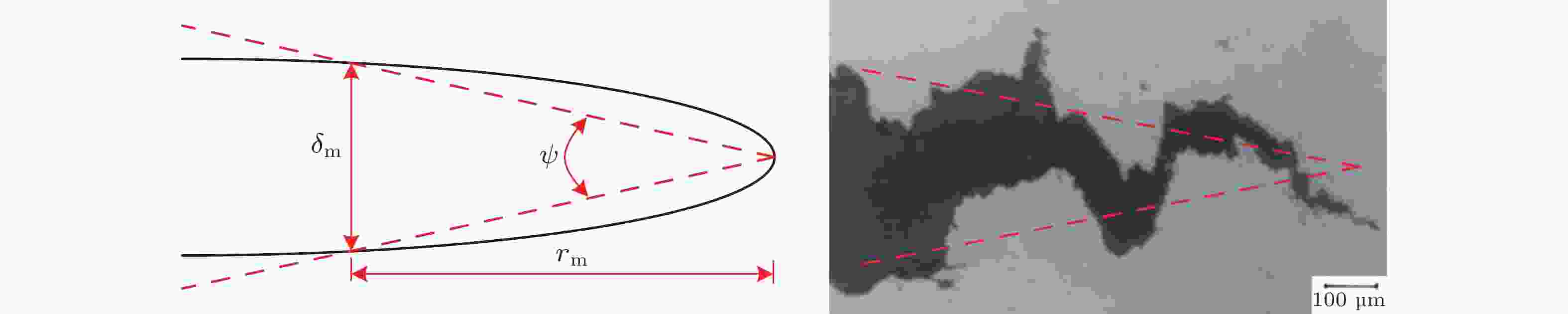
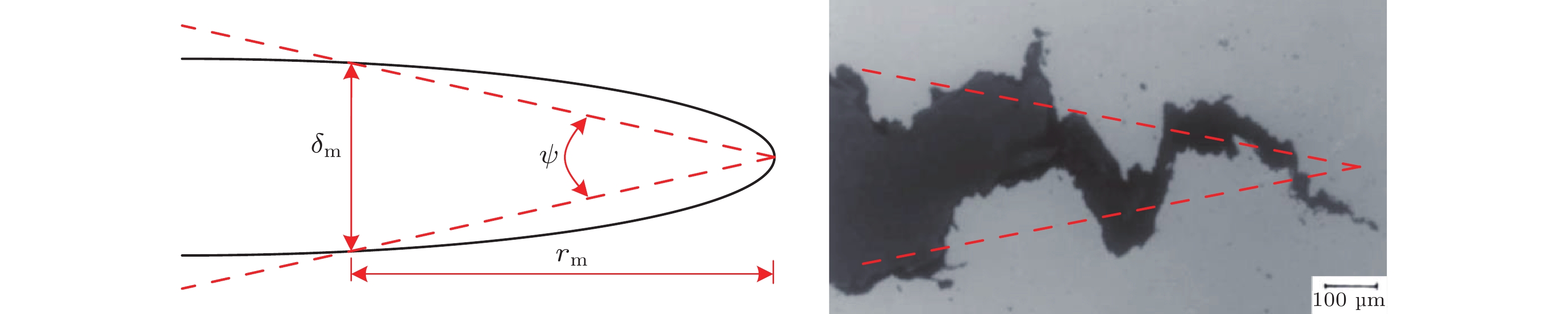
图 16 CTOA的工程定义与裂纹面的三角形等效 (右图为A710高强度低合金钢韧性裂纹扩展的光学显微照片, 引自McMeeking & Parks 1979)
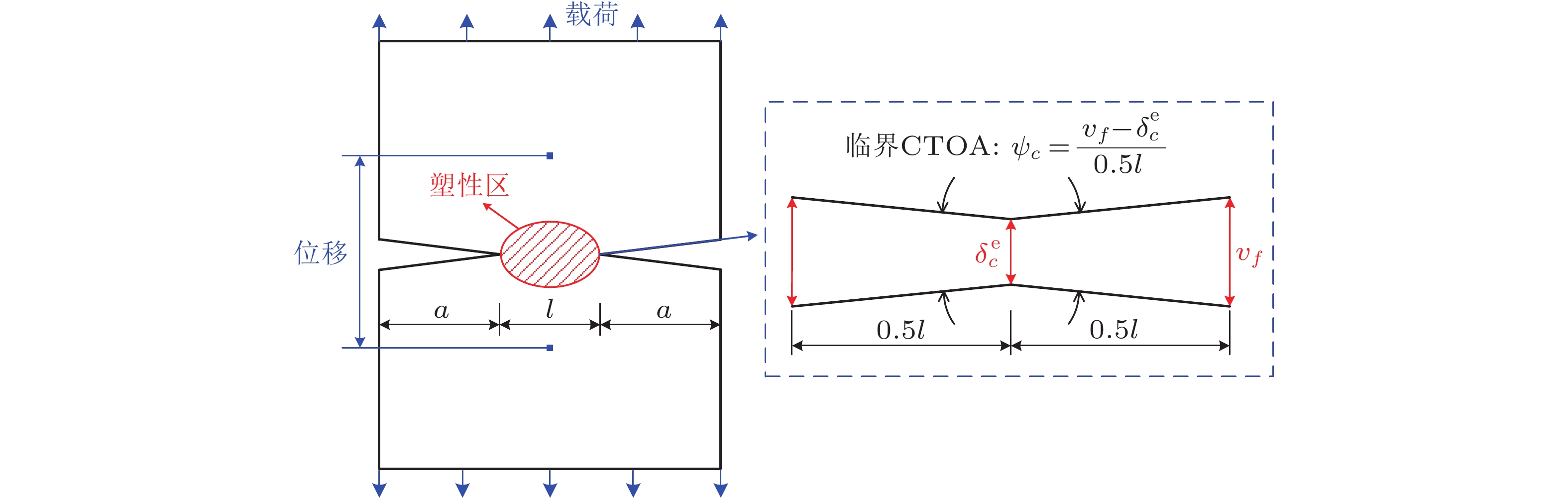
表 1 基于DENT试样的“临界CTOA与EWF关系式”验证
文献 材料 B/mm $ {w}_{\mathrm{e}} $/(N·mm−1) $ {\sigma }_{\mathrm{u}} $/MPa $ {l}_{\text{FPZ}} $/mm $ {\psi }_{\mathrm{c}} $ $ \psi _{\mathrm{c}}^{\text{es}} $ Chandra et al. 2018 IF 1 210.1 324 2 0.316 0.282 Sarkara et al. 2019 DP780 1 233 840 2 0.132 0.121 Mohammed 2017 AL-C* 1.55 51.5 93.2 2 0.254 0.24 Marchal & Delannay 1996 Zn* 0.6 78.2 140 3 0.142 0.161 Marchal & Delannay 1996 Zn* 1 102.8 140 4 0.160 0.160 Marchal & Delannay 1996 Zn* 1.3 128.7 140 4 0.213 0.200 Knockaert et al. 1996 LC* 0.7 206 360 3 0.22 0.169 Knockaert et al. 1996 LC* 1 247 360 3 0.216 0.203 Knockaert et al. 1996 LC* 1.5 400.5 360 4 0.222 0.247 Knockaert et al. 1996 LC* 2 442 360 4 0.237 0.272 Cotterell & Reddel 1977 LA* 1.6 234 510 3 0.1 0.125 Chaitanya et al. 2018 PC* 1 28.5 56 2 0.215 0.221  下载: 导出CSV
-
[1] 黄克智, 高玉臣. 1984. 断裂力学中的裂纹尖端奇异场. 力学进展, 14: 405-414 (Hwang K C, Gao Y C. 1984. Crack tip singularity field in fracture mechanics. Advances in Mechanics, 14: 405-414).Hwang K C, Gao Y C. 1984. Crack tip singularity field in fracture mechanics. Advances in Mechanics, 14: 405-414 [2] 黄克智, 罗学富. 1988. 弹塑性裂纹尖端场研究的最近进展. 科学通报, 15: 1140-1143 (Hwang K C, Luo X F. 1988. Recent progress in the study of elastic-plastic crack tip fields. Science Bulletin, 15: 1140-1143).Hwang K C, Luo X F. 1988. Recent progress in the study of elastic-plastic crack tip fields. Science Bulletin, 15: 1140-1143 [3] 王自强, 陈少华. 2009. 高等断裂力学. 北京: 科学出版社 (Wang Z Q, Chen S H. 2009. Advanced fracture mechanics. Beijing: Science Press).Wang Z Q, Chen S H. 2009. Advanced fracture mechanics. Beijing: Science Press. [4] 闫楚良. 2022. 中国飞机结构寿命可靠性评定技术的发展与展望. 航空学报, 43: 5278695 (Yan C L. 2022. Development and prospect of aircraft structural life reliability assessment technology in China. Acta Aeronautic et Astronautica Sinca, 43: 5278695).Yan C L. 2022. Development and prospect of aircraft structural life reliability assessment technology in China. Acta Aeronautic et Astronautica Sinca, 43: 5278695 [5] 杨卫. 1995. 宏微观断裂力学. 北京: 国防工业出版社 (Yang W. 1995. Macro and micro fracture mechanics. Beijing: National Defense Industry Press).Yang W. 1995. Macro and micro fracture mechanics. Beijing: National Defense Industry Press. [6] 姚卫星, 顾怡. 2016. 飞机结构设计. 北京: 国防工业出版社 (Yao W X, Gu Y. 2016. Aircraft structural design. Beijing: National Defense Industry Press).Yao W X, Gu Y. 2016. Aircraft structural design. Beijing: National Defense Industry Press. [7] Achenbach J D, Kanninen M F, Popelar C H. 1981. Crack-tip fields for fast fracture of an elastic-plastic material. Journal of the Mechanics and Physics of Solids, 29: 211-225. doi: 10.1016/0022-5096(81)90027-2 [8] Amazigo J C, Hutchinson J W. 1977. Crack-tip fields in steady crack growth with linear strain-hardening. Journal of the Mechanics and Physics of Solids, 25: 81-97. doi: 10.1016/0022-5096(77)90005-9 [9] Anderson T L. 2017. Fracture mechanics: Fundamentals and applications (fourth edition). Boca Raton: CRC Press. [10] Atkins A G, Mai Y W. 1987. Fracture strains in sheet metalforming and specific essential work of fracture. Engineering Fracture Mechanics, 27: 291-297. doi: 10.1016/0013-7944(87)90147-0 [11] Atkinson C, Eshelby J D. 1968. The flow of energy into the tip of a moving crack. International Journal of Fracture, 4: 3-8. doi: 10.1007/BF00189137 [12] Atluri S N. 1982. Path-independent integrals in finite elasticity, and inelasticity, with body forces, inertia, and arbitrary crack-face conditions. Engineering Fracture Mechanics, 16: 341-364. doi: 10.1016/0013-7944(82)90113-8 [13] Atluri S N, Nishioka T, Nakagaki M. 1984. Incremental path-independent integrals in inelastic and dynamic fracture mechanics. Engineering Fracture Mechanics, 20: 209-244. doi: 10.1016/0013-7944(84)90129-2 [14] Bao Y B, Wierzbicki T. 2004. On fracture locus in the equivalent strain and stress triaxiality space. International Journal of Mechanical Sciences, 46: 81-98. doi: 10.1016/j.ijmecsci.2004.02.006 [15] Barenblatt G A. 1962. The mathematical theory of equilibrium cracks in brittle fracture. Advances in Applied Mechanics, 7: 55-129. doi: 10.1016/s0065-2156(08)70121-2 [16] Boyce B L, Kramer S L B, Fang H E, et al. 2014. The Sandia fracture challenge: Blind round robin predictions of ductile tearing. International Journal of Fracture, 186: 5-68. doi: 10.1007/s10704-013-9904-6 [17] Boyce B L, Kramer S L B, Bosiljevac T R, et al. 2016. The second Sandia fracture challenge: Predictions of ductile failure under quasi-static and moderate-rate dynamic loading. International Journal of Fracture, 198: 5-100. doi: 10.1007/s10704-016-0089-7 [18] Broberg K B. 1999. Cracks and fracture. London: Academic Press. [19] Brust F W, Nishioka T, Atluri S N, et al. 1985. Further studies on elastic-plastic stable fracture utilizing the T* integral. Engineering Fracture Mechanics, 22: 1079-1103. doi: 10.1016/0013-7944(85)90046-3 [20] Burton W, Mahmoud S, Lease K. 2004. Effects of measurement techniques on the experimental characterization of crack tip opening angle-∆a resistance curves. Experimental Mechanics, 44: 425-432. doi: 10.1177/0014485104046089 [21] Castaneda P P, Mataga P A. 1991. Stable crack growth along a brittle/ductile interface-I. Near-tip fields. International Journal of Solids and Structures, 27: 105-133. doi: 10.1016/0020-7683(91)90148-9 [22] Chaitanya K D, Venkitanarayanan P, Sumit B. 2018. Formulating a cohesive zone model for thin polycarbonate sheets using the concept of the essential work of fracture. Engineering Fracture Mechanics, 201: 144-156. doi: 10.1016/j.engfracmech.2018.05.020 [23] Chandra S K, Sarkara R, Bhowmick A D, et al. 2018. Fracture toughness evaluation of interstitial free steel sheet using essential work of fracture (EWF) method. Engineering Fracture Mechanics, 204: 29-45. doi: 10.1016/j.engfracmech.2018.09.026 [24] Chandra S K, Sarkara R, Bhowmick A D, et al. 2020. Crack tip opening angle (CTOA) and $ {\delta }_{5} $ measurements on SENT and DENT specimens of a thin interstitial-free steel sheet. Engineering Fracture Mechanics, 225: 106861. doi: 10.1016/j.engfracmech.2019.106861 [25] Chitaley A D, McClintock F A. 1971. Elastic-plastic mechanics of steady crack growth under anti-plane shear. Journal of the Mechanics and Physics of Solids, 19: 147-163. doi: 10.1016/0022-5096(71)90025-1 [26] Cotterell B, Atkins A G. 1996. A review of the J and I integrals and their implications for crack growth resistance and toughness in ductile fracture. International Journal of Fracture, 81: 357-372. doi: 10.1007/BF00012428 [27] Cotterell B, Pardoen T, Atkins A G. 2005. Measuring toughness and the cohesive stress-displacement relationship by the essential work of fracture concept. Engineering Fracture Mechanics, 72: 827-848. doi: 10.1016/j.engfracmech.2004.10.002 [28] Cotterell B, Reddel J K. 1977. The essential work of plane stress fracture. International Journal of Fracture, 13: 267-277. doi: 10.1007/BF00040143 [29] Cui P F, She C M, Deng R, et al. 2023. Geometry independent $ J-{T}_{z} $ domination of three-dimensional steady growing crack-tip fields in ductile materials. International Journal of Solids and Structures, 279: 112370. doi: 10.1016/j.ijsolstr.2023.112370 [30] Darcis P P, McCowan C N, Windhoff H, et al. 2008. Crack tip opening angle optical measurement methods in five pipeline steels. Engineering Fracture Mechanics, 75: 2453-2468. doi: 10.1016/j.engfracmech.2007.08.004 [31] Drugan W J, Rice J R, Sham T L. 1982. Asymptotic analysis of growing plane strain tensile crack in elastic ideally plastic solids. Journal of the Mechanics and Physics of Solids, 30: 447-473. doi: 10.1016/0022-5096(82)90027-8 [32] Eshelby J D. 1951. The force on an elastic singularity. Philosophical Transactions of the Royal Society of London. Series A: Mathematical, Physical and Engineering Sciences, 244: 87-112. doi: 10.1007/1-4020-4499-2_6 [33] Eshelby J D. 1956. The continuum theory of lattice defects. Solid State Physics, 3: 79-144. doi: 10.1016/s0081-1947(08)60132-0 [34] Eshelby J D. 1970. Energy relations and the energy-momentum tensor in continuum mechanics. In Inelastic Behavior of Solids, McGraw Hill, New York, 77-115. [35] Freund L B. 1972. Energy flux into the tip of an extending crack in an elastic solid. Journal of Elasticity, 2: 341-349. doi: 10.1007/BF00045718 [36] Freund L B. 1990. Dynamic fracture mechanics. Cambridge: Cambridge University Press. [37] Gao Y C, Nemat-Nasser S. 1983. Near tip dynamic fields for a crack advancing in a power law elastic-plastic material: Mode I, II and III. Mechanics of Materials, 2: 305-317. doi: 10.1016/0167-6636(83)90022-4 [38] Griffith A A. 1921. The phenomena of rupture and flow in solids. Philosophical Transactions of the Royal Society of London. Series A: Mathematical, Physical and Engineering Sciences, 221: 163-198. [39] Guo W L. 1993a. Elastoplastic three-dimensional crack border field-I: Singular structure of the field. Engineering Fracture Mechanics, 46: 93-104. doi: 10.1016/0013-7944(93)90306-D [40] Guo W L. 1993b. Elastoplastic three-dimensional crack border field-II: Asymptotic solution for the field. Engineering Fracture Mechanics, 46: 105-113. doi: 10.1016/0013-7944(93)90307-E [41] Guo W L. 1995. Elastoplastic three-dimensional crack border field-III: Fracture parameters. Engineering Fracture Mechanics, 51: 51-71. [42] Gurtin M E. 1979. Thermodynamics and the cohesive zone in fracture. Journal of Applied Mathematics and Physics (ZAMP), 30: 991-1003. doi: 10.1007/BF01590496 [43] Gurtin M E. 2000. Configurational forces as basic concepts of continuum physics. New York: Springer New York. [44] Gurtin M E, Fried E, Anand L. 2009. The mechanics and thermodynamics of continua. Cambridge: Cambridge University Press. [45] Gurtin M E, Podio-Guidugli P. 1996. Configurational forces and the basic laws for crack propagation. Journal of the Mechanics and Physics of Solids, 44: 905-927. doi: 10.1016/0022-5096(96)00014-2 [46] Gurtin M E, Podio-Guidugli P. 1998. Configurational forces and a constitutive theory for crack propagation that allows for kinking and curving. Journal of the Mechanics and Physics of Solids, 46: 1343-1378. doi: 10.1016/S0022-5096(98)00002-7 [47] Heerens J, Schodel M. 2003. On the determination of crack tip opening angle, CTOA, using light microscopy and $ {\delta }_{5} $ measurement technique. Engineering Fracture Mechanics, 51: 51-71. doi: 10.1016/s0013-7944(02)00128-5 [48] Hill R. 1950. The mathematical theory of plasticity. New York: Oxford University Press. [49] Hill R. 1952. On discontinuous plastic states, with special reference to localized necking in thin sheets. Journal of the Mechanics and Physics of Solids, 1: 19-30. doi: 10.1016/0022-5096(52)90003-3 [50] Hutchinson J W. 1968. Plastic stress and strain fields at a crack tip. Journal of the Mechanics and Physics of Solids, 16: 337-347. doi: 10.1016/0022-5096(68)90021-5 [51] Hutchinson J W. 1974. On steady quasi-static crack growth. Harvard University, AFSOR-TR74-1042. [52] Hutchinson J W. 1983. Fundamentals of the phenomenological theory of nonlinear fracture mechanics. Journal of Applied Mechanics-ASME, 50: 1042-1051. doi: 10.1115/1.3167187 [53] Hutchinson J W, Evans A G. 2000. Mechanics of materials: Top-down approaches to fracture. Acta Materialia, 48: 125-135. doi: 10.1016/S1359-6454(99)00291-8 [54] Hwang K C, Luo X F. 1989. Near tip fields of growing cracks and resistance curves. Mechanics of Materials, 7: 271-278. doi: 10.1016/0167-6636(89)90018-5 [55] Hwang K C, Yu S W, Yang W. 1990. Theoretical study of crack-tip singularity fields in China. Applied Mechanics Reviews, 43: 19-32. doi: 10.1115/1.3119159 [56] Irwin G R. 1957. Analysis of stress and strains near the end of a crack transversing a plate. Journal of Applied Mechanics-ASME, 24: 109-114. doi: 10.1115/1.4011547 [57] Kanninen M F, Popelar C H. 1985. Advanced fracture mechanics. New York: Oxford University Press. [58] Kfouri A P. 1979. Continuous crack growth or quantized growth steps. International Journal of Fracture, 15: 23-29. doi: 10.1007/BF00115905 [59] Kfouri A P, Miller K J. 1976. Crack separation energy rates in elastic-plastic fracture mechanics. Proceedings Institution of Mechanical Engineers, 190: 571-584. doi: 10.1243/PIME_PROC_1976_190_060_02 [60] Knockaert R, Doghri I, Marchal Y, et al. 1996. Experimental and numerical investigation of fracture in double-edge notched steel plates. International Journal of Fracture, 81: 383-399. doi: 10.1007/BF00012430 [61] Kolednik O, Schongrundner R, Fischer F D. 2014. A new view on J-integrals in elastic-plastic materials. International Journal of Fracture, 187: 77-107. [62] Knowles J K, Sternberg E. 1972. On a class of conservation laws in linearized and finite elastostatics. Archive for Rational Mechanics and Analysis, 44: 187-211. doi: 10.1007/BF00250778 [63] Lu L K. 2024. A quantitative description of the influence of plastic dissipation on crack growth behaviors. Engineering Fracture Mechanics, 305: 110197. doi: 10.1016/j.engfracmech.2024.110197 [64] Lu L K. 2025a. A comparison of two power balance laws to elucidate the role of fracture process zone in resolving the transferability problems. Engineering Fracture Mechanics, 327: 111480. doi: 10.1016/j.engfracmech.2025.111480 [65] Lu L K. 2025b. A strategy of converting K-R curves to critical CTOA values by a comparison between ASTM E561 and ASTM E2472. Engineering Fracture Mechanics, 330: 111705. doi: 10.1016/j.engfracmech.2025.111705 [66] Lu L K, Liu Z L, Cui Y N, et al. 2021a. Driving force on line fracture process zone and fracture parameters suitable for elastic-plastic materials. International Journal of Solids and Structures, 217-218: 15-26. [67] Lu L K, Liu Z L, Wang T, et al. 2020. An analytical model of fracture process zone to explain why crack-tip opening angle works. Engineering Fracture Mechanics, 233: 107054. doi: 10.1016/j.engfracmech.2020.107054 [68] Lu L K, Liu Z L, Zhuang Z. 2021b. A unified perspective of incremental J-integrals by the generalized Griffith framework. Engineering Fracture Mechanics, 254: 107907. doi: 10.1016/j.engfracmech.2021.107907 [69] Lu L K, Liu Z L, Zhuang Z. 2022. The physical meanings of two incremental-J-integral-based fracture criteria for crack growth in elastic-plastic materials. Engineering Fracture Mechanics, 259: 108106. doi: 10.1016/j.engfracmech.2021.108106 [70] Lu L K, Liu Z L, Zhuang Z. 2023. A theoretical analysis for the normal impact fracture in thin brittle plates based on the principle of minimum external work. Journal of the Mechanics and Physics of Solids, 171: 105158. doi: 10.1016/j.jmps.2022.105158 [71] Lu L K, Wang S N. 2017. Relationship between crack growth resistance curves and CTOA. Engineering Fracture Mechanics, 173: 146-156. doi: 10.1016/j.engfracmech.2016.12.010 [72] Lu L K, Wang S N. 2018a. An analytical model to predict residual strength based on critical CTOA. Engineering Fracture Mechanics, 200: 31-41. doi: 10.1016/j.engfracmech.2018.07.023 [73] Lu L K, Wang S N. 2018b. New insight on physical meaning of fracture criteria for growing cracks. International Journal of Solids and Structures, 147: 146-155. doi: 10.1016/j.ijsolstr.2018.05.024 [74] Lu L K, Wang S N. 2018c. A simple model to explain the transferability of crack tip opening angle. Engineering Fracture Mechanics, 218: 197-213. doi: 10.1016/j.engfracmech.2017.11.025 [75] Lu L K, Wang S N, Tong G R. 2019. Relationship between incremental J integral and crack tip opening angle in elastic plastic materials. European Journal of Mechanics-A/Solids, 75: 399-409. doi: 10.1016/j.euromechsol.2019.01.017 [76] Mahmoud S, Lease K. 2003. The effect of specimen thickness on the experimental characterization of critical crack-tip-opening angle in 2024-T351 aluminum alloy. Engineering Fracture Mechanics, 70: 443-456. doi: 10.1016/S0013-7944(02)00130-3 [77] Mahmoud S, Lease K. 2004. Two-dimensional and three-dimensional finite element analysis of critical crack-tip-opening angle in 2024-T351 aluminum alloy at four thicknesses. Engineering Fracture Mechanics, 71: 1379-1391. doi: 10.1016/S0013-7944(03)00167-X [78] Mai Y W. 1993. On the plane-stress essential facture work in plastic failure of ductile materials. International Journal of Mechanical Sciences, 35: 995-1005. doi: 10.1016/0020-7403(93)90051-U [79] Mai Y W, Cotterell B. 1984. The essential work of fracture for tearing of ductile metals. International Journal of Fracture, 24: 229-236. doi: 10.1007/BF00032685 [80] Marchal Y, Delannay F. 1996. Influence of test parameters on the measurement of the essential work of fracture of zinc sheets. International Journal of Fracture, 80: 295-310. doi: 10.1007/BF00018509 [81] Maugin G A. 1992. The Thermomechanics of plasticity and fracture. Cambridge: Cambridge University Press. [82] Maugin G A. 2011. Configurational forces: Thermomechanics, physics, mathematics, and numerics. Boca Raton: CRC Press. [83] McClintock F A. 1968. A criterion for ductile fracture by the growth of holes. Journal of Applied Mechanics-ASME, 35: 363-371. [84] McMeeking R M, Parks D M. 1979. On criteria for J-dominance of crack-tip fields in large-scale yielding. ASTM STP 668, Philadelphia, American Society for Testing and Materials, 175-194. [85] Mohammed Y A. 2017. Essential work of fracture assessment for thin aluminum strips using finite element analysis. Engineering Fracture Mechanics, 179: 190-202. doi: 10.1016/j.engfracmech.2017.04.042 [86] Moran B, Shih C F. 1987a. A general treatment of crack tip contour integrals. International Journal of Fracture, 35: 295-310. doi: 10.1007/BF00276359 [87] Moran B, Shih C F. 1987b. Crack tip and associated domain integrals from momentum and energy balance. Engineering Fracture Mechanics, 27: 615-642. doi: 10.1016/0013-7944(87)90155-X [88] Newman J C, James M A, Zerbst U. 2003. A review of the CTOA/CTOD fracture criterion. Engineering Fracture Mechanics, 70: 371-385. doi: 10.1016/S0013-7944(02)00125-X [89] Nishioka T, Atluri S N. 1983. Path-independent integrals, energy release rates, and general solutions of near-tip fields in mixed mode dynamic fracture mechanics. Engineering Fracture Mechanics, 18: 1-22. doi: 10.1016/0013-7944(83)90091-7 [90] Ochensberger W, Kolednik O. 2015. Physically appropriate characterization of fatigue crack propagation rate in elastic-plastic materials using J-integral concept. International Journal of Fracture, 192: 25-45. doi: 10.1007/s10704-014-9983-z [91] Okada H, Atluri S N. 1999. Further studies on the characteristics of the $ T_{\varepsilon }^{*} $ integral: Plane stress stable crack propagation in ductile materials. Computational Mechanics, 23: 339-352. doi: 10.1007/s004660050414 [92] Okada H, Atluri S N, Omori Y, et al. 1999. Direct evaluation of $ T_{\varepsilon }^{*} $ integral from experimentally measured near tip displacement field, for a plate with stably propagating crack. International Journal of Plasticity, 15: 869-897. doi: 10.1016/S0749-6419(99)00016-9 [93] Omori Y, Kobayashi A S, Okada H, et al. 1998. $ T_{\varepsilon }^{*} $ integral as a crack growth criterion. Mechanics of Materials, 28: 147-154. [94] Pardoen T, Hachez F, Marchioni B, et al. 2004. Mode I fracture of sheet metal. Journal of the Mechanics and Physics of Solids, 52: 423-452. doi: 10.1016/S0022-5096(03)00087-5 [95] Pardoen T, Marchioni B, Delannay F. 1999. Thickness dependence of cracking resistance in thin aluminum plates. Journal of the Mechanics and Physics of Solids, 47: 2093-2123. doi: 10.1016/S0022-5096(99)00011-3 [96] Rice J R. 1968. A path independent integral and the approximate analysis of strain concentration by notches and cracks. Journal of Applied Mechanics-ASME, 35: 379-386. doi: 10.21236/ad0653716 [97] Rice J R. 1979. The mechanics of quasi-static crack growth. In the Proceedings of the Eighth U. S. National Congress of Applied Mechanics, 191-216. [98] Rice J R, Drugan W J, Sham T L. 1980. Elastic-plastic analysis of growing cracks. ASTM STP 700, Philadelphia, American Society for Testing and Materials, 189-221. [99] Rice J R, Rosengren G F. 1968. Plane strain deformation near a crack tip in a power law hardening material. Journal of the Mechanics and Physics of Solids, 16: 1-12. doi: 10.21236/ad0659300 [100] Rice J R, Sorensen E P. 1978. Continuing crack-tip deformation and fracture for plane-strain crack growth in elastic-plastic solids. Journal of the Mechanics and Physics of Solids, 26: 168-186. doi: 10.2172/12135155 [101] Sarkara R, Chandra S K, De P S, et al. 2019. Evaluation of ductile tearing resistance of dual-phase DP 780 grade automotive steel sheet from essential work of fracture (EWF) tests. Theoretical and Applied Fracture Mechanics, 103: 102278. doi: 10.1016/j.tafmec.2019.102278 [102] Schwalbe K H, Scheider I, Cornec A. 2012. Guidelines for applying cohesive models to the damage behaviour of engineering materials and structures. Springer Berlin Heidelberg. [103] Simha N K, Fischer F D, Shan G X, et al. 2008. J-integral and crack driving force in elastic-plastic materials. Journal of the Mechanics and Physics of Solids, 56: 2876-2895. [104] Tyson W R, Newman J C, Xu S. 2018. Characterization of stable ductile crack propagation by CTOA: Review of theory and applications. Fatigue and Fracture of Engineering Materials and Structures, 41: 1-17. doi: 10.1111/ffe.12916 [105] Wang L, Brust F W, Atluri S N. 1997. The elastic-plastic finite element alternating method (EPFEAM) and the prediction of fracture under WFD conditions in aircraft structures Part II: Fracture and the $ {T}^{*}- $integral parameter. Computational Mechanics, 19: 370-379. doi: 10.1007/s004660050240 [106] Willis J R. 1967. A comparison of the fracture criteria of Griffith and Barenblatt. Journal of the Mechanics and Physics of Solids, 15: 151-162. doi: 10.1016/0022-5096(67)90029-4 [107] Wnuk M P. 1974. Quasi-static extension of a tensile crack contained in a viscoelastic-plastic solid. Journal of Applied Mechanics-ASME, 41: 234-242. doi: 10.1115/1.3423233 [108] Wnuk M P. 1979. Occurrence of catastrophic fracture in fully yielded components, stability analysis. International Journal of Fracture, 15: 553-581. doi: 10.1007/BF00019923 [109] Wnuk M P. 1981. Stable phase of ductile fracture in two and three dimensions, final stretch model. Journal of Applied Mechanics-ASME, 48: 500-508. [110] Xiang M, Guo W L. 2013. Formulation of the stress fields in power law solids ahead of three-dimensional tensile cracks. International Journal of Solids and Structures, 50: 3067-3088. doi: 10.1016/j.ijsolstr.2013.05.011 [111] Xiao S, Wang H L, Liu B, et al. 2015. The surface-forming energy release rate based fracture criterion for elastic-plastic crack propagation. Journal of the Mechanics and Physics of Solids, 84: 336-357. doi: 10.1016/j.jmps.2015.08.011 [112] Xiao S, Wang H L, Liu B, et al. 2017. The surface-forming energy release rate versus the local energy release rate. Engineering Fracture Mechanics, 175: 86-100. doi: 10.1016/j.engfracmech.2017.02.006 [113] Xu W, Ren Y S, Xiao S, et al. 2023. A finite crack growth energy release rate for elastic-plastic fracture. Journal of the Mechanics and Physics of Solids, 181: 105447. doi: 10.1016/j.jmps.2023.105447 [114] Yuan H, Li X. 2018. Critical remarks to cohesive zone modeling for three-dimensional elastoplastic fatigue crack propagation. Engineering Fracture Mechanics, 202: 311-331. doi: 10.1016/j.engfracmech.2018.03.018 [115] Zerbst U, Heinimann M, Donne C D, et al. 2009. Fracture and damage mechanics modeling of thin-walled structures—An overview. Engineering Fracture Mechanics, 76: 5-43. [116] Zhu X K, Hwang K C. 2008. Asymptotic crack-tip fields for dynamic crack growth in compressive power-law hardening materials. International Journal of Solids and Structures, 45: 3644-3659. doi: 10.1016/j.ijsolstr.2007.07.019 [117] Zhu X K, Joyce J A. 2012. Review of fracture toughness (G, K, J, CTOD, CTOA) testing and standardization. Engineering Fracture Mechanics, 85: 1-46. doi: 10.1016/j.engfracmech.2012.02.001 -

 下载:
下载:

























图(27) / 表(1)
计量
- 文章访问数: 603
- HTML全文浏览量: 196
- PDF下载量: 67
- 被引次数: 0