


Cross-scale mechanisms of interfacial coating-enabled synergistic regulation of mechano–thermal properties in energetic composites
-
摘要: 含能复合材料是一类典型的结构可设计材料体系, 其力学、热学及安全相关性能可通过多尺度结构设计在宽广的设计空间内实现调控. 然而, 其综合性能往往受限于源自颗粒/基体界面的退化机制, 如热失配、应力集中及界面脱粘等, 这些效应在极端服役条件下被进一步放大, 进而削弱工程服役可靠性. 这本质上构成了一个力–热–安全性能高度耦合的多目标优化问题. 界面工程为应对这一问题提供了一种有效途径. 通过颗粒尺度的功能化涂层实现力学与热传输行为的协同调控, 从而使含能复合材料进入力学稳健性与热稳定性得以共存的性能区间. 尽管在实验、建模与数据驱动研究方面已取得快速进展, 但尚缺乏一个将界面结构设计与力–热协同调控机制系统关联的统一框架. 本文系统综述了含能复合材料界面涂层策略的最新研究进展, 重点评述了涂层材料体系、制备工艺及微结构描述参数, 并梳理其对宏观力学与热学性能的影响规律. 进一步阐明了实现刚度、强度、热导率及热膨胀系数等性能协同提升的界面耦合机理. 在此基础上, 形成了一种集成“材料–微结构–工艺–表征–模型–人工智能(AI)”的系统化研究框架, 为多功能含能复合材料及其结构构件的理性设计与规模化制造提供指导.Abstract: Energetic composites constitute a class of architected material systems whose mechanical, thermal, and safety-related properties can be tailored over a broad design space through multiscale structural design. However, their overall performance is often constrained by degradation mechanisms originating at the particle/matrix interface, including thermal mismatch, stress concentration, and interfacial debonding. These effects are further amplified under extreme service conditions, thereby undermining structural reliability and operational safety. Fundamentally, this challenge reflects a highly coupled multi-objective optimization problem involving mechanical, thermal, and safety performance. Interfacial engineering offers an effective pathway to address this challenge. By introducing functionalized coatings at the particle scale, stress transfer and heat-transport behaviors can be synergistically regulated, enabling energetic composites to access performance regimes in which mechanical robustness and thermal stability coexist. Despite rapid advances in experimental characterization, theoretical modeling, and data-driven approaches, a unified framework that systematically links interfacial architectural design with mechano–thermal synergy remains lacking. This review provides a comprehensive survey of recent progress in interfacial coating strategies for energetic composites. Emphasis is placed on coating material systems, fabrication routes, and microstructural descriptors, together with their influences on macroscopic mechanical and thermal properties. The interfacial coupling mechanisms responsible for coordinated enhancements in stiffness, strength, thermal conductivity, and thermal expansion behavior are further elucidated. On this basis, an integrated “materials–microstructure–process–characterization–model–artificial intelligence (AI)” framework is outlined to guide the rational design and scalable manufacture of multifunctional energetic composites and structural components.
-
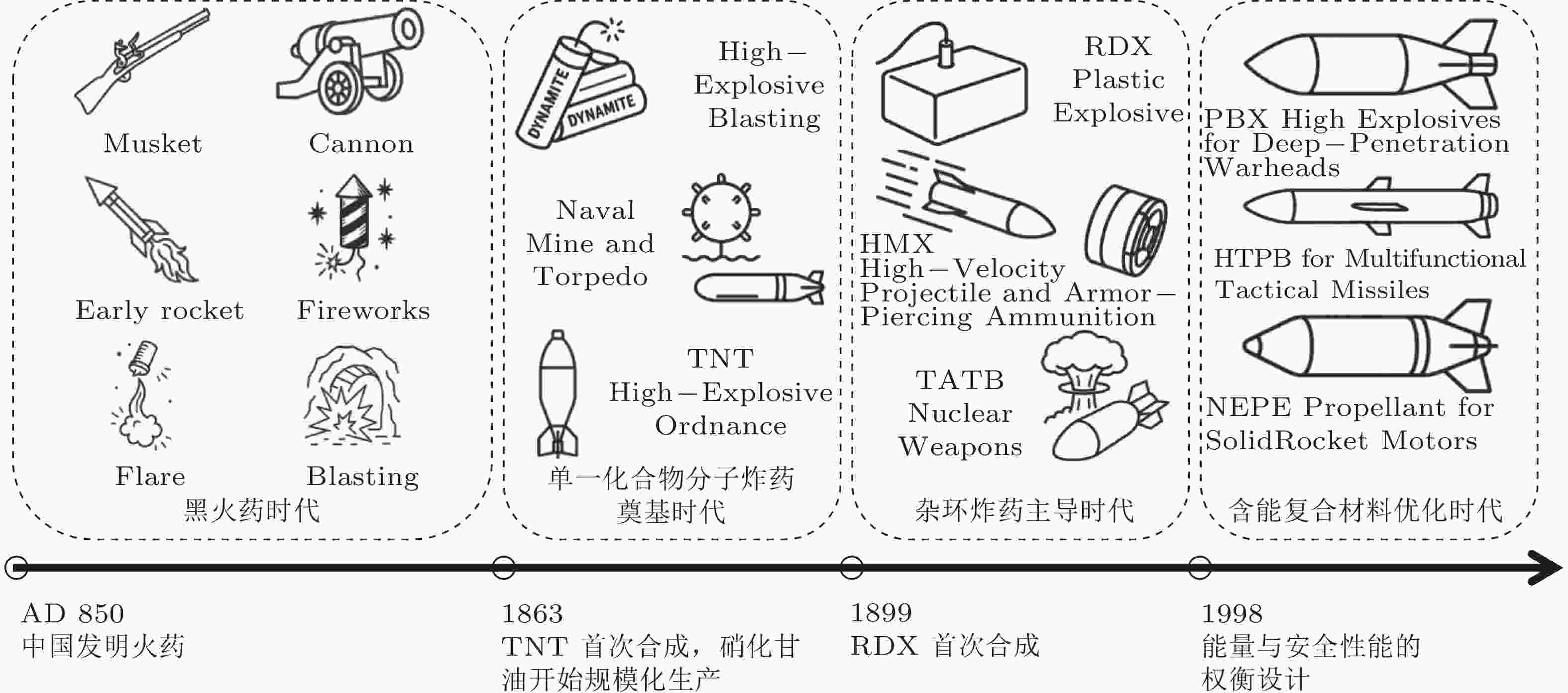
图 1 含能材料发展历程与应用场景概览: 四个历史阶段及典型应用. AD 850 (李约瑟 2005), 1863 (Nielsen et al. 1994, Axel 2017), 1899 (Axel 2017, Hale 1925, Bachmann & Sheehan 1949), 1998 (NATO Standardization Agency 1998)
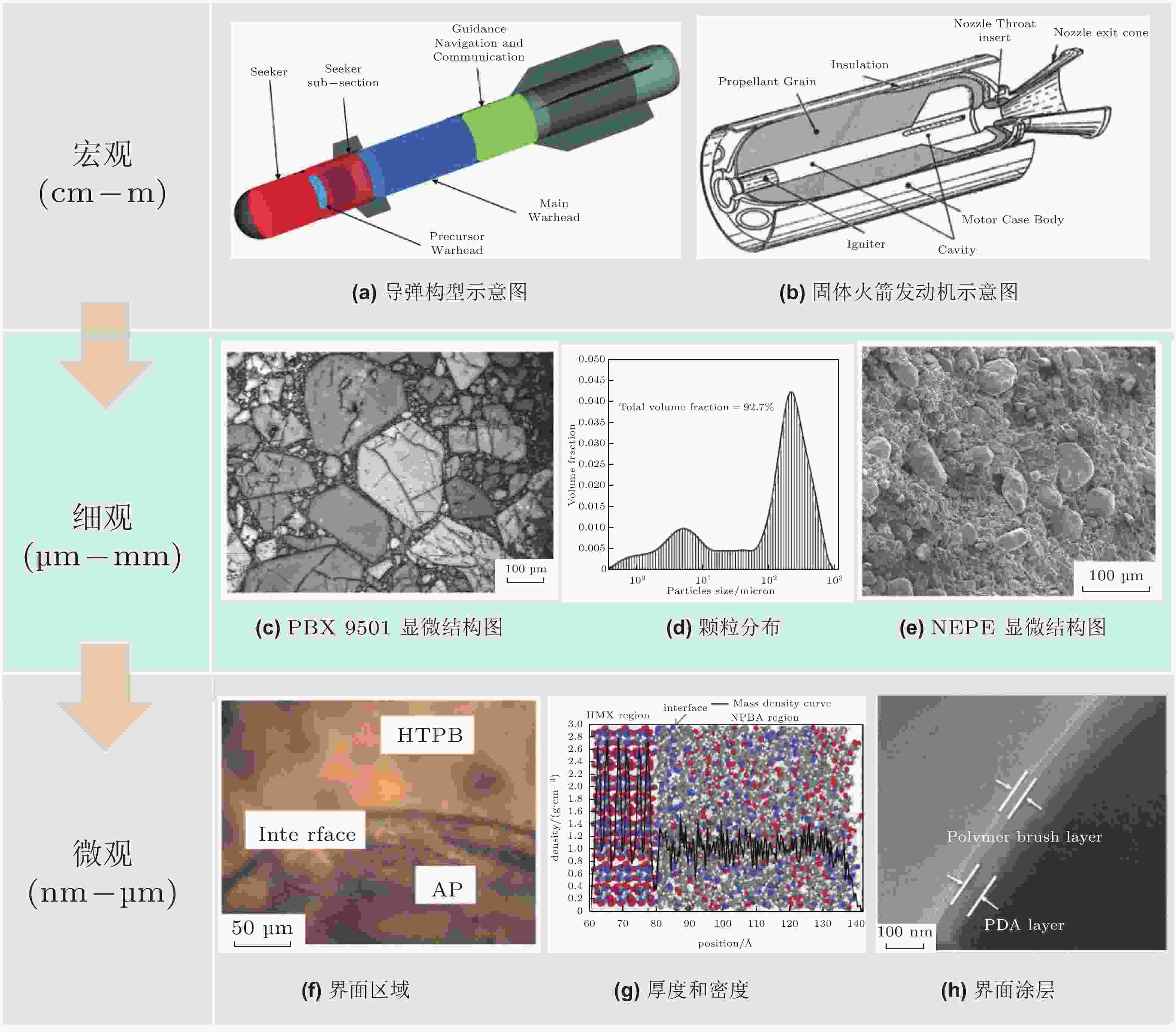
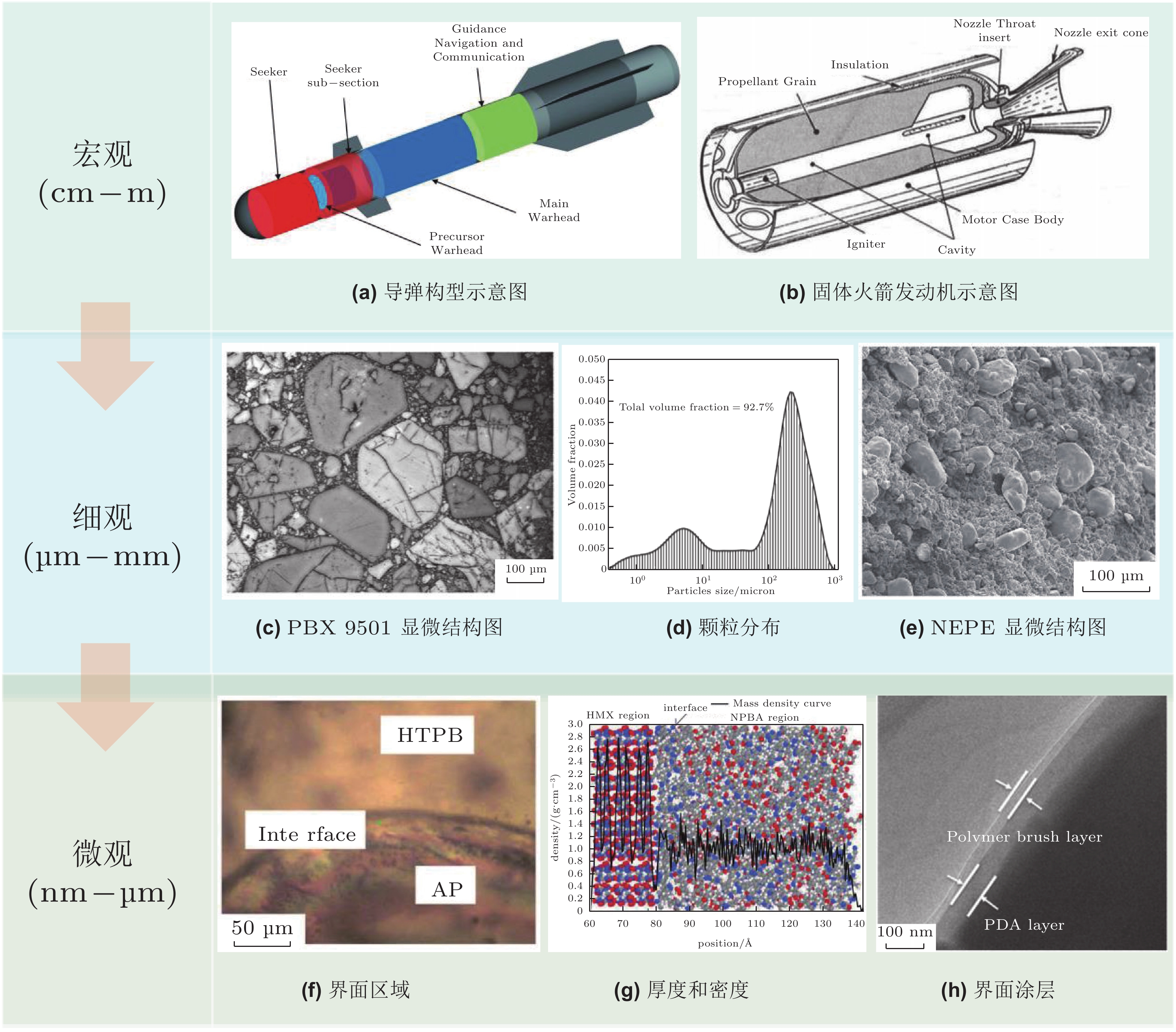
图 3 含能复合材料的典型组分与界面微结构. (a) (Whelan 2011), (b) (Teja et al. 2020), (c) ~ (d) (Tan et al. 2005a), (e) (Wubuliaisan et al. 2024), (f) (Prakash et al. 2018), (g) (Zhang et al. 2023, Feng et al. 2024), (h) (Zheng et al. 2025)
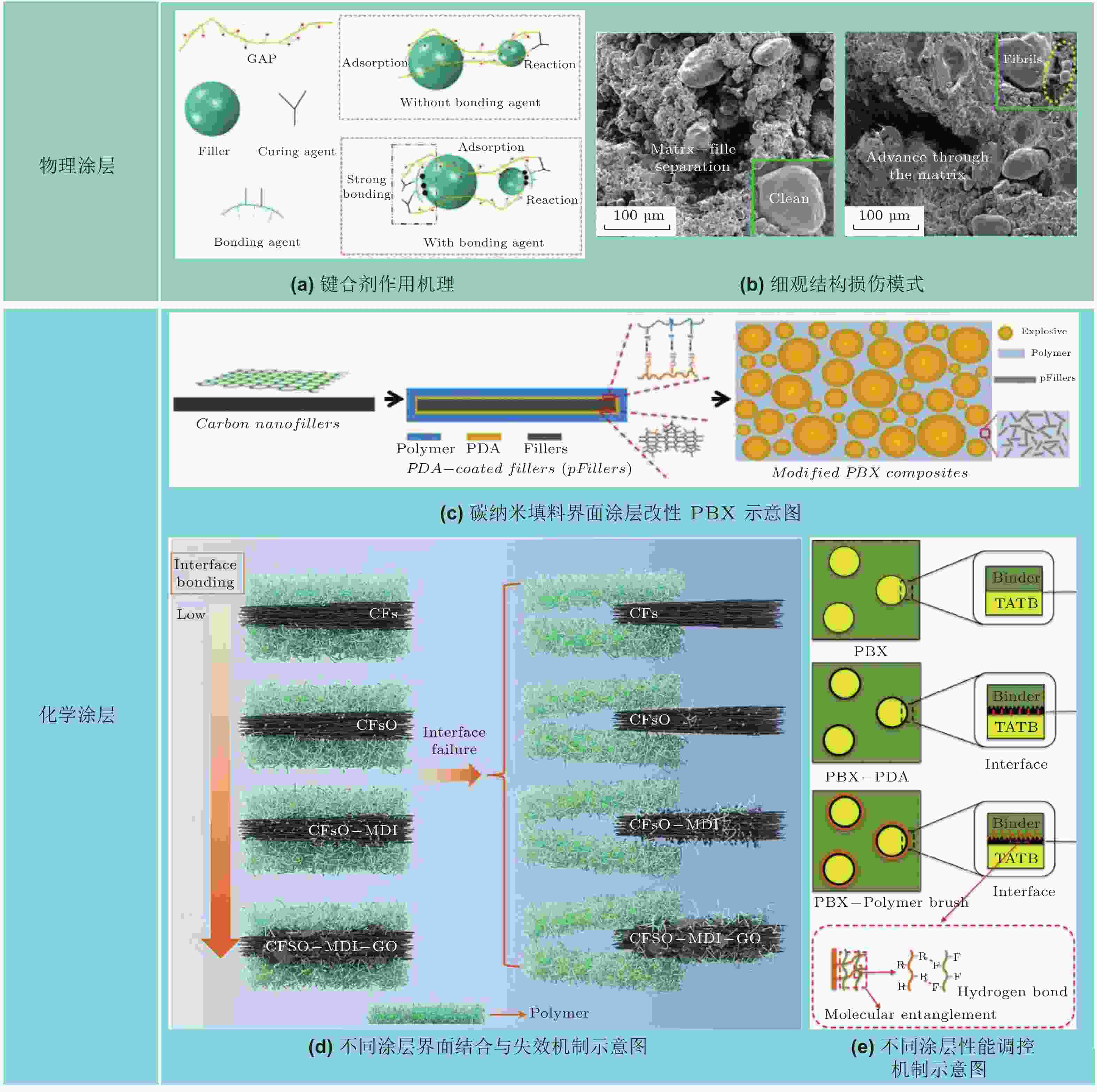
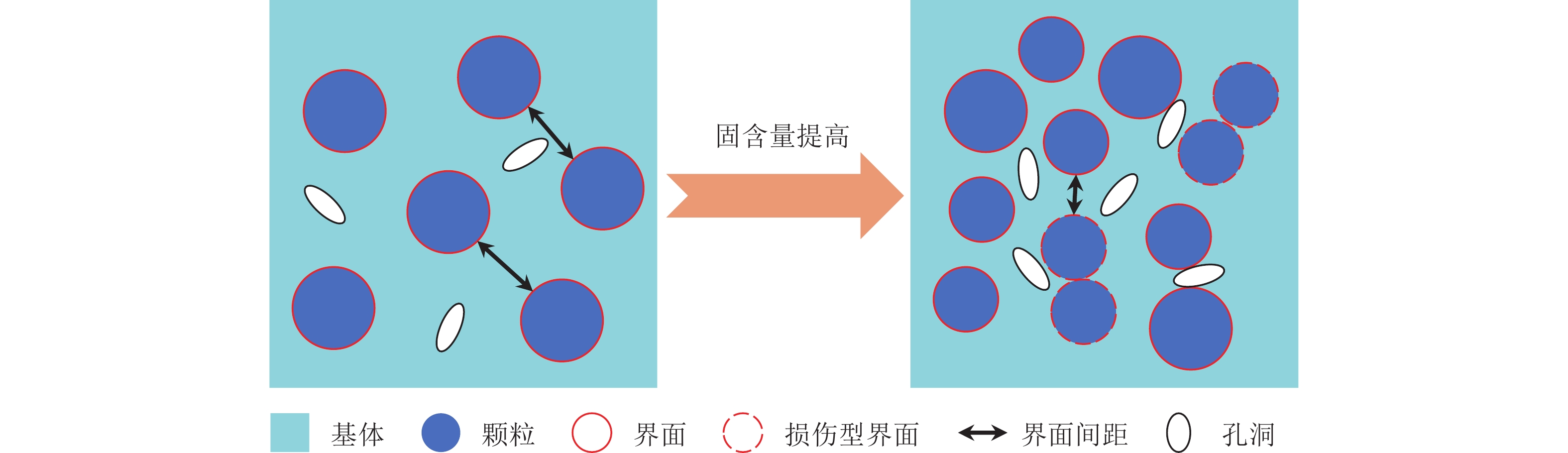
图 4 界面微结构对力−热性能影响机制示意图. (a) ~ (b) (Wubuliaisan et al. 2024), (c) (He et al. 2018), (d) (He et al. 2024), (e) (Zheng et al. 2025)
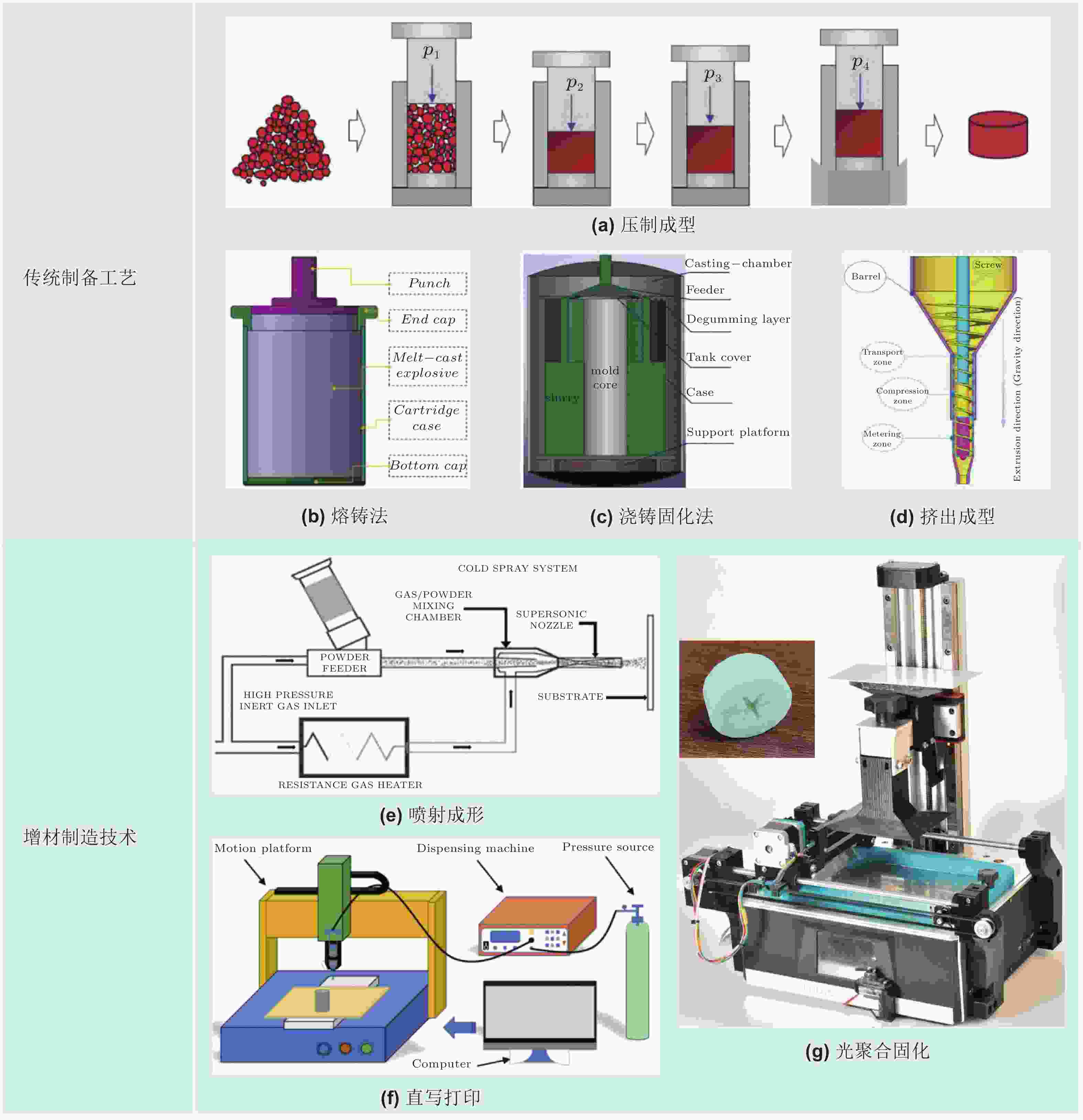
图 5 含能复合材料的典型制备工艺示意图. (a) (孙海涛 等 2024), (b) (Wang S W et al. 2023), (c) (黄钰棋 等 2025), (d) (Lin et al. 2025), (e) (Dean et al. 2013), (f) (Deng et al. 2021), (g) (Tkachev et al. 2023)
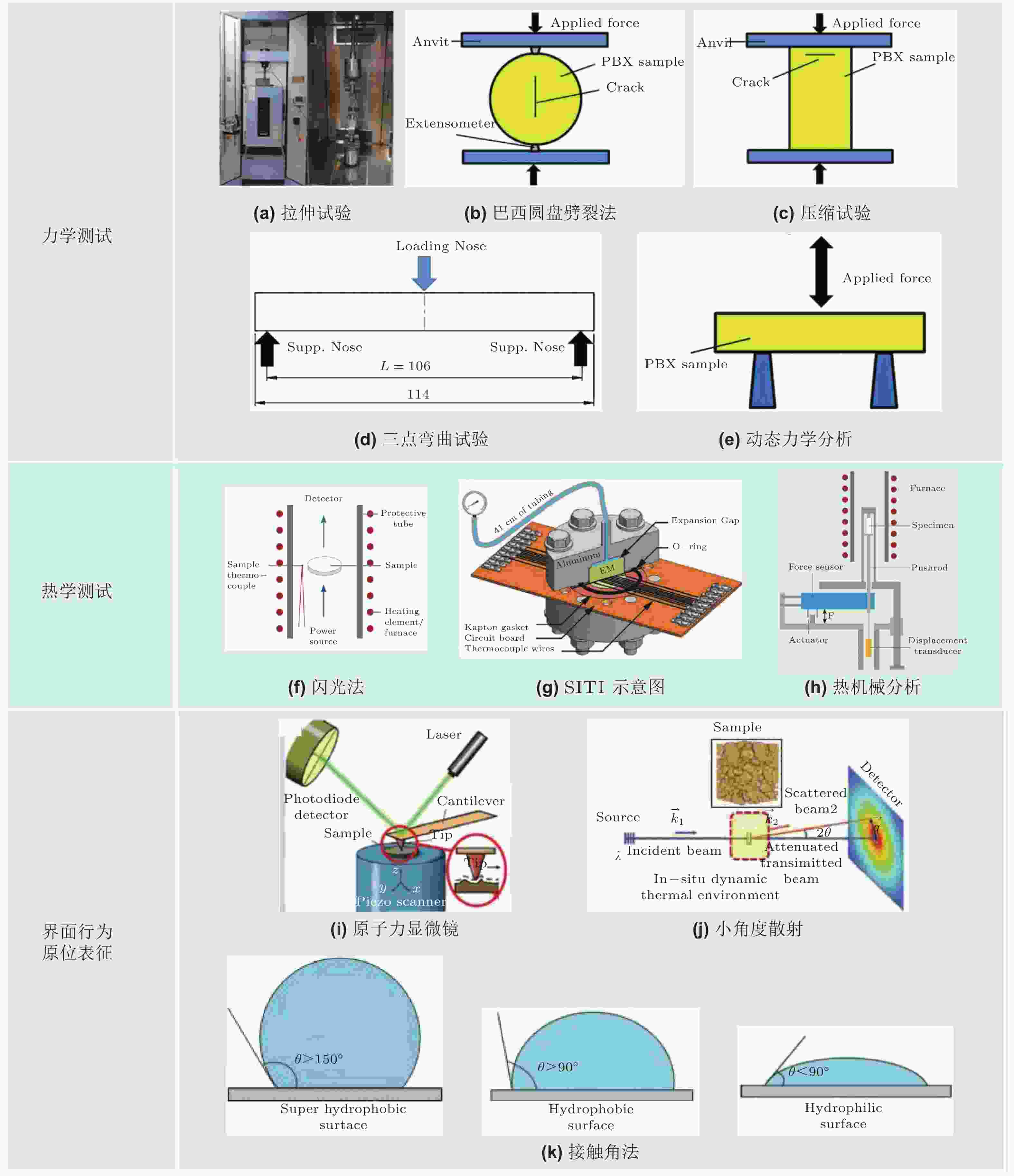
图 7 含能复合材料的常用力−热性能测试技术示意图. (a) (Wu et al. 2023), (b) ~ (c) (Zeng et al. 2025a), (d) (Iqbal et al. 2023), (e) (Zeng et al. 2025a), (f) (NETZSCH-Gerätebau GmbH 2025a), (g) (Lawless et al. 2020), (h) (NETZSCH-Gerätebau GmbH 2025b), (i) ~ (k) (Zeng et al. 2025b)
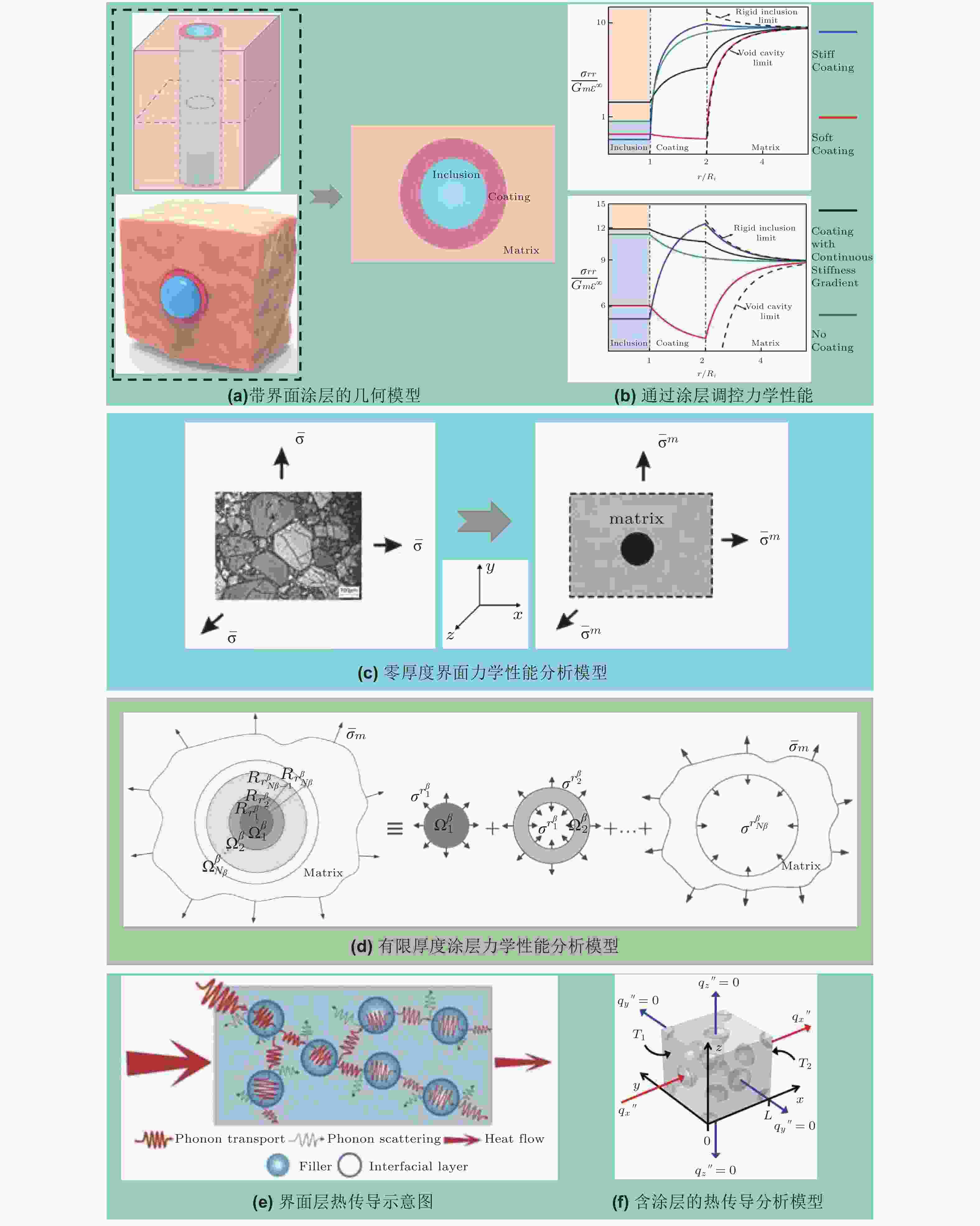
图 8 考虑界面效应的颗粒复合材料力−热性能分析模型. (a) (Ti et al. 2024a, Sun et al. 2025b), (b) (Chen X et al. 2020), (c) (Tan et al. 2005b), (d) (Hashemi et al. 2015), (e) (林夏泽和温变英 2022), (f) (Thiele et al. 2014)
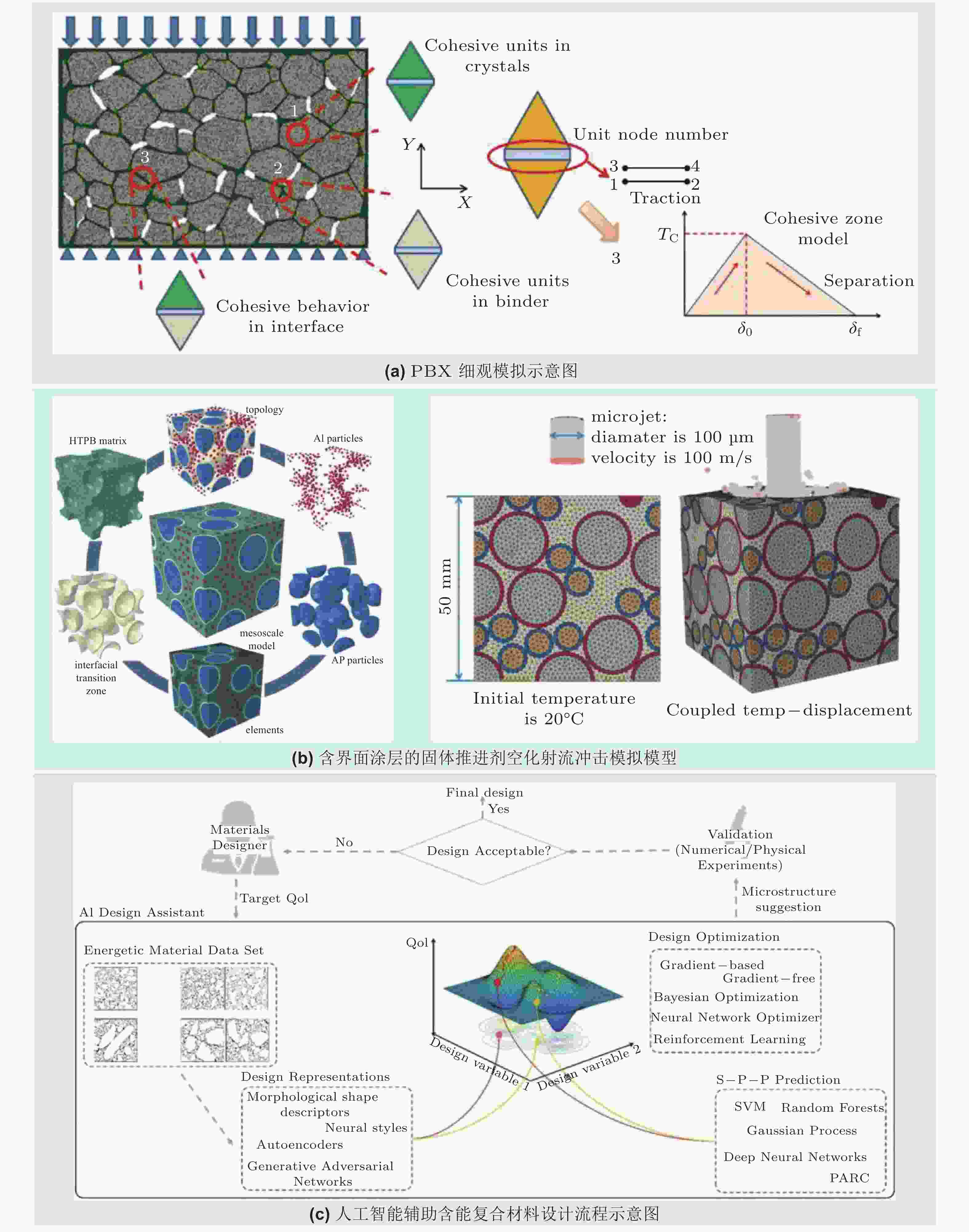
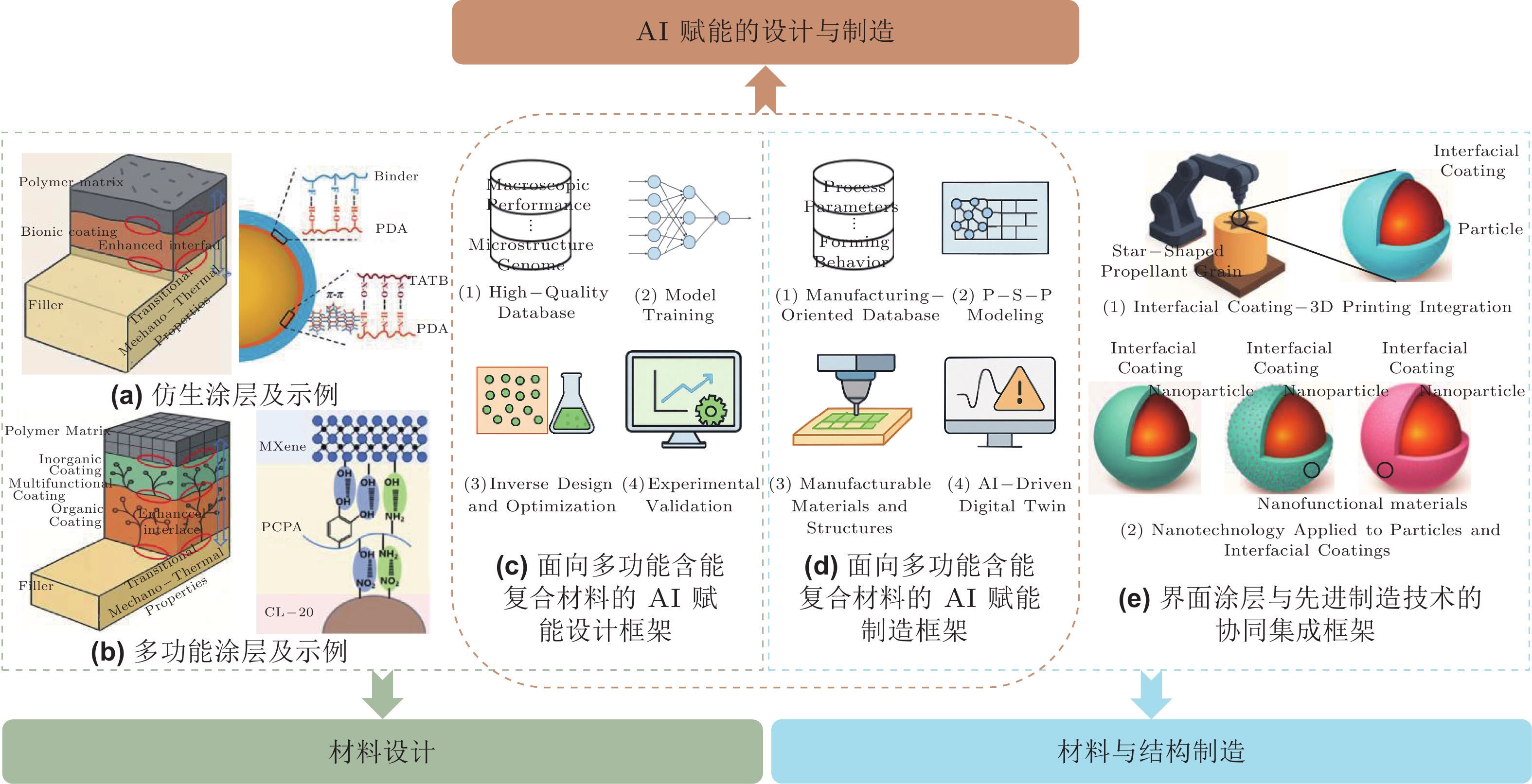
图 9 含能复合材料数值模拟与AI辅助设计示意图. (a) (Wang et al. 2024), (b) (赵蒙 等 2024), (c) (Choi et al. 2023)
表 1 含能复合材料力−热性能界面涂层协同调控实例及协同水平
含能复合材料体系 力学性能参数 热学性能参数 界面涂层策略 协同水平 E/MPa $ {\sigma }_{{\mathrm{m}}} $/MPa $ {\varepsilon }_{{\mathrm{b}}} $/% k/(W·mK−1) α/(℃−1) PBX-TATB
(Wang P et al. 2023)↑ +51.1%
—+55.6%
—+37.0% — nacre-like
structural layer★★☆ PBX-TATB
(Lin et al. 2023b)↑ ↑
↑↑
↑— −35.7% ZrW2O8 core +
PDA shell★☆★ PBX-HMX /TATB
(He et al. 2023)↑ ↑
↑—
—+186.0% ↓ silver nanowire +
graphene coating★★★ PBX-HMX /TATB
(He et al. 2024)↑ +63.0%
+39.0%+99.0%
↑+14.1% — MDI/GO/PEG
multi-scale coating★★☆ PBX-TATB
(Zheng et al. 2024)↑ +34.5%
+23.1%+30.4%
↑— −7.3% PDA layer +
NPBA layer★☆★ PBX-TATB
(Wang et al. 2025)↑ ↑
—↑
—+59.7% — graphene dual-network
coating★★☆ PBX-TATB
(Zheng et al. 2025)↑ +36.7%
+23.9%+31.5%
+16.3%— −8.4% PDA layer +
polymer brush★☆★ 注: E表示杨氏模量; $ {\sigma }_{{\mathrm{m}}} $和$ {\varepsilon }_{{\mathrm{b}}} $表示断裂强度和断裂伸长率; k和α分别表示热导率和热膨胀系数. “↑”和“↓”分别表示相应变量呈现上升或下降的趋势, 该趋势是根据文献内容推断得到的. “—”表示相应变量的变化趋势在文献中未被明确说明. 协同水平是基于表中汇总信息进行半定量评估后确定的. ★★★表示力学性能、热导率和热膨胀系数实现协同提升; ☆表示相应性能在文献报道中未被明确确定或未得到提升.  下载: 导出CSV
-
[1] 白晨, 杨昆, 吴艳青, 等. 2021. 不同类型装药侵彻安全性数值模拟. 高压物理学报, 35: 065101 (Bai C, Yang K, Wu Y Q, et al. 2021. Numerical simulation of penetration safety for different types of PBX charges. Chinese Journal of High Pressure Physics, 35: 065101).Bai C, Yang K, Wu Y Q, et al. 2021. Numerical simulation of penetration safety for different types of PBX charges. Chinese Journal of High Pressure Physics, 35: 065101 [2] 陈鹏万, 丁雁生, 陈力. 2002. 含能材料装药的损伤及力学性能研究进展. 力学进展, 32: 212-222 (Chen P W, Ding Y S, Chen L. 2002. Progress in the study of damage and mechanical properties of energetic materials. Advances in Mechanics, 32: 212-222).Chen P W, Ding Y S, Chen L. 2002. Progress in the study of damage and mechanical properties of energetic materials. Advances in Mechanics, 32: 212-222 [3] 龚建良, 刘佩进, 李强. 2013. 基于能量守恒的复合固体推进剂黏弹性本构关系. 固体火箭技术, 4: 529-533 (Gong J L, Liu P J, Li Q. 2013. Viscoelastic constitutive relation of composite solid propellant based on the first law of thermodynamics. Journal of Solid Rocket Technology, 4: 529-533).Gong J L, Liu P J, Li Q. 2013. Viscoelastic constitutive relation of composite solid propellant based on the first law of thermodynamics. Journal of Solid Rocket Technology, 4: 529-533 [4] 韩若寒, 付小龙, 蔚红建, 等. 2024. 复合固体推进剂细观力学性能模拟研究进展. 兵器装备工程学报, 45(8): 290-300 (Han R H, Fu X L, Yu H J, et al. 2024. Progress in simulation of mesomechanical properties of composite solid propellants. Journal of Ordnance Equipment Engineering, 45(8): 290-300).Han R H, Fu X L, Yu H J, et al. 2024. Progress in simulation of mesomechanical properties of composite solid propellants. Journal of Ordnance Equipment Engineering, 45(8): 290-300 [5] 黄钰棋, 赵红华, 白瑞祥, 等. 2025. 固体推进剂成型过程的热–化–力耦合数值研究. 力学与实践, 47: 522-528 (Huang Y Q, Zhao H H, Bai R X, et al. 2025. Thermo–chemo–mechanical coupling numerical study on the forming process of solid propellant. Mechanics in Engineering, 47: 522-528).Huang Y Q, Zhao H H, Bai R X, et al. 2025. Thermo–chemo–mechanical coupling numerical study on the forming process of solid propellant. Mechanics in Engineering, 47: 522-528 [6] 姬广富. 2025. 极端条件下含能材料的模拟研究思考. 高压物理学报, 39: 19-45 (Ji G F. 2025. Some viewpoints on the simulation research of energetic materials under extreme conditions. Chinese Journal of High Pressure Physics, 39: 19-45). doi: 10.11858/gywlxb.20240911Ji G F. 2025. Some viewpoints on the simulation research of energetic materials under extreme conditions. Chinese Journal of High Pressure Physics, 39: 19-45 doi: 10.11858/gywlxb.20240911 [7] 李常青. 1992. 炸药发展的现状和趋势. 爆炸与冲击, 12: 280-288 (Li C Q. 1992. Present status and trends in explosive development. Explosion and Shock Waves, 12: 280-288).Li C Q. 1992. Present status and trends in explosive development. Explosion and Shock Waves, 12: 280-288 [8] 李约瑟 著, 刘晓燕等 译. 2005. 中国科学技术史: 第5卷 化学及相关技术 第7分册 军事技术 火药的史诗. 北京: 科学出版社, 1-13 (Needham J. 2005. Science and civilisation in China, Vol. 5: Chemistry and chemical technology, part 7: Military technology—The epic of gunpowder. Beijing: Science Press, 1-13).Needham J. 2005. Science and civilisation in China, Vol. 5: Chemistry and chemical technology, part 7: Military technology—The epic of gunpowder. Beijing: Science Press, 1-13 [9] 林夏泽, 温变英. 2022. 界面效应对功能复合材料热传导行为的影响. 复合材料学报, 39: 1498-1510 (Lin X Z, Wen B Y. 2022. Influence of interfacial effect on heat conduction behavior of functional composites. Acta Materiae Compositae Sinica, 39: 1498-1510). doi: 10.13801/j.cnki.fhclxb.20211009.002Lin X Z, Wen B Y. 2022. Influence of interfacial effect on heat conduction behavior of functional composites. Acta Materiae Compositae Sinica, 39: 1498-1510 doi: 10.13801/j.cnki.fhclxb.20211009.002 [10] 庞旭明, 周剑秋, 杨晶歆, 等. 2016. 含孔隙及界面热阻的复合材料有效导热系数. 中国有色金属学报, 26: 1668-1674 (Pang X M, Zhou J Q, Yang J X, et al. 2016. Effective thermal conductivity of composite materials containing pores and interfacial thermal resistance. The Chinese Journal of Nonferrous Metals, 26: 1668-1674).Pang X M, Zhou J Q, Yang J X, et al. 2016. Effective thermal conductivity of composite materials containing pores and interfacial thermal resistance. The Chinese Journal of Nonferrous Metals, 26: 1668-1674 [11] 孙海涛, 詹梅, 樊晓光, 等. 2024. 高性能高聚物黏结炸药压制成型研究进展与展望. 中国机械工程, 35: 160-180 (Sun H T, Zhan M, Fan X G, et al. 2024. Research progress and prospects of compression molding of high-performance polymer-bonded explosives. China Mechanical Engineering, 35: 160-180).Sun H T, Zhan M, Fan X G, et al. 2024. Research progress and prospects of compression molding of high-performance polymer-bonded explosives. China Mechanical Engineering, 35: 160-180 [12] 王新颖, 王树山, 徐豫新, 等. 2016. RDX基PBX的做功能力及JWL状态方程参数确定. 爆炸与冲击, 36: 242-247 (Wang X Y, Wang S S, Xu Y X, et al. 2016. Energy output capability and determination of JWL equation-of-state parameters for RDX-based PBX. Explosion and Shock Waves, 36: 242-247).Wang X Y, Wang S S, Xu Y X, et al. 2016. Energy output capability and determination of JWL equation-of-state parameters for RDX-based PBX. Explosion and Shock Waves, 36: 242-247 [13] 王艺. 2020. 热循环载荷下 TATB 基 PBX 不可逆变形机理研究. [硕士论文]. 中国工程物理研究院 (Wang Y. 2020. Analysis of irreversible deformation mechanisms of TATB-based PBX under thermal cycling loads. [Master Thesis]. China Academy of Engineering Physics).Wang Y. 2020. Analysis of irreversible deformation mechanisms of TATB-based PBX under thermal cycling loads. [Master Thesis]. China Academy of Engineering Physics [14] 肖川, 宋浦, 张默贺. 2022. 含能材料发展的若干思考. 火炸药学报, 45: 435-438 (Xiao C, Song P, Zhang M H. 2022. Some thoughts on the development of energetic materials. Chinese Journal of Explosives & Propellants, 45: 435-438).Xiao C, Song P, Zhang M H. 2022. Some thoughts on the development of energetic materials. Chinese Journal of Explosives & Propellants, 45: 435-438 [15] 徐一航, 李道奎, 周仕明. 2025. 复合固体推进剂本构模型研究进展及发展趋势. 国防科技大学学报, 47: 1-22 (Xu Y H, Li D K, Zhou S M. 2025. Progress and development trends in constitutive modeling of composite solid propellants. Journal of National University of Defense Technology, 47: 1-22).Xu Y H, Li D K, Zhou S M. 2025. Progress and development trends in constitutive modeling of composite solid propellants. Journal of National University of Defense Technology, 47: 1-22 [16] 余天昊, 闫亚宾, 王晓媛. 2024. 复合固体推进剂界面多尺度数值模拟研究进展. 含能材料, 32: 554-569 (Yu T H, Yan Y B, Wang X Y. 2024. Advancements in multiscale numerical simulation of composite solid propellant interfaces. Chinese Journal of Energetic Materials (Hanneng Cailiao), 32: 554-569).Yu T H, Yan Y B, Wang X Y. 2024. Advancements in multiscale numerical simulation of composite solid propellant interfaces. Chinese Journal of Energetic Materials (Hanneng Cailiao), 32: 554-569 [17] 张娟娟, 高原文. 2012. 界面及热残余应力对超磁致伸缩复合材料有效性能的影响. 固体力学学报, 33: 136-145 (Zhang J J, Gao Y W. 2012. Effects of interface and thermal residual stress on effective properties of giant magnetostrictive composites. Chinese Journal of Solid Mechanics, 33: 136-145). doi: 10.3969/j.issn.0254-7805.2012.02.002Zhang J J, Gao Y W. 2012. Effects of interface and thermal residual stress on effective properties of giant magnetostrictive composites. Chinese Journal of Solid Mechanics, 33: 136-145 doi: 10.3969/j.issn.0254-7805.2012.02.002 [18] 赵蒙, 刘博, 周文君, 等. 2024. 高频空化冲击作用下HTPB固体推进剂的细观损伤机制. 火炸药学报, 47: 354-364 (Zhao M, Liu B, Zhou W J, et al. 2024. Mesoscale damage mechanisms of HTPB solid propellants under high-frequency cavitation impact. Chinese Journal of Explosives & Propellants, 47: 354-364).Zhao M, Liu B, Zhou W J, et al. 2024. Mesoscale damage mechanisms of HTPB solid propellants under high-frequency cavitation impact. Chinese Journal of Explosives & Propellants, 47: 354-364 [19] 周静静, 李子涵, 黄蒙, 等. 2024. 炸药热–力耦合响应机制研究进展. 固体火箭技术, 47: 446-455 (Zhou J J, Li Z H, Huang M, et al. 2024. Advances in thermo–mechanical coupling response mechanisms of explosives. Journal of Solid Rocket Technology, 47: 446-455).Zhou J J, Li Z H, Huang M, et al. 2024. Advances in thermo–mechanical coupling response mechanisms of explosives. Journal of Solid Rocket Technology, 47: 446-455 [20] ASTM International. 2012. Standard terminology for additive manufacturing technologies: ASTM F2792-12a. West Conshohocken (PA): ASTM International. [21] Axel H. 2017. Remarks on the evolution of explosives. Propellants, Explosives, Pyrotechnics, 42: 851-853. doi: 10.1002/prep.201780831 [22] Bachmann W E, Sheehan J C. 1949. A new method of preparing the high explosive RDX. Journal of the American Chemical Society, 71: 1842-1845. doi: 10.1021/ja01173a092 [23] Barnhart D, Bacher D, Davies J, et al. 2022. Low-temperature solid propellant investigations for mechanical properties. AIAA Aviation 2022 Forum. Chicago: American Institute of Aeronautics and Astronautics, 1–7. [24] Brailsford A D, Major K G. 1964. The thermal conductivity of aggregates of several phases, including porous materials. Journal of Physics D: Applied Physics, 15: 313-319. doi: 10.1088/0508-3443/15/3/311 [25] Chen N H, He C L, Pang S P. 2022. Additive manufacturing of energetic materials: Tailoring energetic performance via printing. Journal of Materials Science and Technology, 127: 29-47. doi: 10.1016/j.jmst.2022.02.047 [26] Chen W, Chen L, Lu J Y, et al. 2020. Effects of temperature and wax binder on thermal conductivity of RDX: A molecular dynamics study. Computational Materials Science, 179: 109698. doi: 10.1016/j.commatsci.2020.109698 [27] Chen X, He W, Liu S B, et al. 2019a. Volumetric response of an ellipsoidal liquid inclusion: Implications for cell mechanobiology. Acta Mechanica Sinica, 35: 338-342. doi: 10.1007/s10409-019-00850-5 [28] Chen X, Li M X, Liu S B, et al. 2019b. Translation of a coated rigid spherical inclusion in an elastic matrix: Exact solution and implications for mechanobiology. Journal of Applied Mechanics, 86: 051002. doi: 10.1115/1.4042575 [29] Chen X, Li M X, Liu S B, et al. 2020. Mechanics tuning of liquid inclusions via bio-coating. Extreme Mechanics Letters, 41: 101049. doi: 10.1016/j.eml.2020.101049 [30] Chen X, Ti F, Li M X, et al. 2021. Theory of fluid-saturated porous media with surface effects. Journal of the Mechanics and Physics of Solids, 151: 104392. doi: 10.1016/j.jmps.2021.104392 [31] Chen Y, Liu Y F, Shi L, et al. 2015. Study on the synthesis and interfacial interaction performance of novel dodecylamine-based bonding agents used for composite solid propellants. Propellants, Explosives, Pyrotechnics, 40: 50-59. doi: 10.1002/prep.201300187 [32] Choi J B, Nguyen P C H, Sen O, et al. 2023. Artificial intelligence approaches for energetic materials by design: State of the art, challenges, and future directions. Propellants, Explosives, Pyrotechnics, 48: e202200276. doi: 10.1002/prep.202200276 [33] Chu K, Li W S, Dong H F, et al. 2012. Modeling the thermal conductivity of graphene nanoplatelet-reinforced composites. Europhysics Letters, 100: 36001. doi: 10.1209/0295-5075/100/36001 [34] Dean S W, Potter J K, Yetter R A, et al. 2013. Energetic intermetallic materials formed by cold spray. Intermetallics, 43: 121-130. doi: 10.1016/j.intermet.2013.07.019 [35] Deng S C, Luo Y J, Qu Y Z, et al. 2023. Improving the mechanical performances of polymer-bonded explosives using monomer-tuned polythioureas. Energetic Materials Frontiers, 4: 85-92. doi: 10.1016/j.enmf.2023.04.001 [36] Deng Y C, Wu X Z, Deng P, et al. 2021. Fabrication of energetic composites with 91% solid content by 3D direct writing. Micromachines, 12: 1160. doi: 10.3390/mi12101160 [37] Duan B H, Li J K, Mo H C, et al. 2021. The art of framework construction: Core–shell structured micro-energetic materials. Molecules, 26: 5650. doi: 10.3390/molecules26185650 [38] Felske J D. 2004. Effective thermal conductivity of composite spheres in a continuous medium with contact resistance. International Journal of Heat and Mass Transfer, 47: 3453-3461. doi: 10.1016/j.ijheatmasstransfer.2004.01.013 [39] Feng Z K, Wen Z C, Li H P, et al. 2024. Mechanism study on the interface enhancement effect of NPBA functional groups on NPBA–HMX. Materials Today Communications, 40: 110052. doi: 10.1016/j.mtcomm.2024.110052 [40] Gan J Y, Zhang X, Zhang W, et al. 2022. Research progress of bonding agents and their performance evaluation methods. Molecules, 27: 340. doi: 10.3390/molecules27020340 [41] Gao B W, Liu Y Z, Guo X F, et al. 2025. A low-cost bionic interface modification strategy for enhancing the safety performance of energetic powders using PCPA@MXene double coating. Energetic Materials Frontiers, 6: 95-102. doi: 10.1016/j.enmf.2025.01.002 [42] Grilli N, Duarte C A, Koslowski M. 2018. Dynamic fracture and hot-spot modeling in energetic composites. Journal of Applied Physics, 123: 065101. doi: 10.1063/1.5009297 [43] Gunasegaram D R, Barnard A S, Matthews M J, et al. 2024. Machine learning-assisted in situ adaptive strategies for the control of defects and anomalies in metal additive manufacturing. Additive Manufacturing, 81: 104013. doi: 10.1016/j.addma.2024.104013 [44] Guo Y Y, Liu Y, Xie J N, et al. 2025. Preparation of spherical HMX@PDA-based PBX by coaxial droplet microfluidic technology: Enhancing interfacial effects and safety performance of composite microspheres. Defence Technology, 45: 73-83. doi: 10.1016/j.dt.2024.10.010 [45] Hale G C. 1925. The nitration of hexamethylenetetramine. Journal of the American Chemical Society, 47: 2754-2763. [46] Hashemi R, Spring D W, Paulino G H. 2015. On small deformation interfacial debonding in composite materials containing multi-coated particles. Journal of Composite Materials, 49: 3439-3455. doi: 10.1177/0021998314565431 [47] Hashin Z. 1990. Thermoelastic properties of fiber composites with imperfect interface. Mechanics of Materials, 8: 333-348. doi: 10.1016/0167-6636(90)90051-G [48] Hassanzadeh-Aghdam M K, Mahmoodi M J, Ansari R. 2016. Interphase effects on the thermo-mechanical properties of three-phase composites. Proceedings of the Institution of Mechanical Engineers, Part C: Journal of Mechanical Engineering Science, 230: 3361-3371. doi: 10.1177/0954406215612830 [49] Hasselman D P H, Johnson L F. 1987. Effective thermal conductivity of composites with interfacial thermal barrier resistance. Journal of Composite Materials, 21: 508-515. doi: 10.1177/002199838702100602 [50] He G S, Dai Y, Wang P, et al. 2023. Achieving superior thermal conductivity in polymer-bonded explosives using a preconstructed 3D graphene framework. Energetic Materials Frontiers, 4: 202-212. doi: 10.1016/j.enmf.2023.07.002 [51] He G S, Liu J H, Gong F Y, et al. 2018. Bio-inspired mechanical and thermal conductivity reinforcement of highly explosive-filled polymer composites. Composites Part A: Applied Science and Manufacturing, 107: 1-9. doi: 10.1016/j.compositesa.2017.12.012 [52] He G S, Wang P, Zhong R L, et al. 2024. Enhancing mechanical properties and thermal conductivity in polymer-bonded explosives by multi-scale surface modification of carbon fibers. Composites Part A: Applied Science and Manufacturing, 177: 107918. doi: 10.1016/j.compositesa.2023.107918 [53] He G S, Yang Z J, Pan L P, et al. 2017. Bioinspired interfacial reinforcement of polymer-based energetic composites with a high loading of solid explosive crystals. Journal of Materials Chemistry A, 5: 13499-13510. doi: 10.1039/C7TA03424E [54] He S S, Zhang H B, Li G, et al. 2022. Solid-phase ripening of hexanitrostilbene (HNS) nanoparticles: Effects of temperature and solvent vapour. Energetic Materials Frontiers, 3: 240-247. doi: 10.1016/j.enmf.2022.11.002 [55] Herman M J, Liu C, Cady C, et al. 2023. Biologically inspired reinforcement of polymer-bonded composites using polydopamine. Composites Part B: Engineering, 254: 110563. doi: 10.1016/j.compositesb.2023.110563 [56] Huang B B, Xue Z H, Fu X L, et al. 2021. Advanced crystalline energetic materials modified by coating/intercalation techniques. Chemical Engineering Journal, 417: 128044. doi: 10.1016/j.cej.2020.128044 [57] Inayathullah S, Buddala R. 2025. Review of machine learning applications in additive manufacturing. Results in Engineering, 25: 103676. doi: 10.1016/j.rineng.2024.103676 [58] Iqbal M, Zhang R, Ryan P, et al. 2023. Mechanical characterisation and cohesive law calibration for a nitrocellulose-based cyclotetramethylene tetranitramine (HMX) polymer-bonded explosive. Experimental Mechanics, 63: 97-113. doi: 10.1007/s11340-022-00895-x [59] Jiao Y K, Li S N, Li G P, et al. 2022. Effect of fluoropolymer content on thermal and combustion performance of direct-writing high-solid nanothermite composites. RSC Advances, 12: 5612-5618. doi: 10.1039/D1RA08970F [60] Karuppusamy M, Thirumalaisamy R, Palanisamy S, et al. 2025. A review of machine learning applications in polymer composites: Advancements, challenges, and future prospects. Journal of Materials Chemistry A, 13: 16290-16308. doi: 10.1039/D5TA00982K [61] Kirby L, Udaykumar H S, Song X. 2024. Pressure-assisted binder jetting for additive manufacturing of mock energetic composites. Propellants, Explosives, Pyrotechnics, 49: e202300175. doi: 10.1002/prep.202300175 [62] Kong S, Liao D J, Jia Y M, et al. 2022. Performances and direct writing of CL-20-based ultraviolet-curing explosive ink. Defence Technology, 18: 140-147. doi: 10.1016/j.dt.2020.11.015 [63] Kontiza A, Kartsonakis I A. 2024. Smart composite materials with self-healing properties: A review on design and applications. Polymers, 16: 2115. doi: 10.3390/polym16152115 [64] Kubat J, Rigdahl M, Welander M. 1990. Characterization of interfacial interactions in high-density polyethylene filled with glass spheres using dynamic-mechanical analysis. Journal of Applied Polymer Science, 39: 1527-1539. doi: 10.1002/app.1990.070390711 [65] Lawless Z D, Hobbs M L, Kaneshige M J. 2020. Thermal conductivity of energetic materials. Journal of Energetic Materials, 38: 214-239. doi: 10.1080/07370652.2019.1679285 [66] Lei S Y, Wang S, Lu F Y, et al. 2021. Research on irreversible growth mechanism of PBX due to thermal cycling. E3S Web of Conferences, 257: 01051. doi: 10.1051/e3sconf/202125701051 [67] Li M M, Yang W T, Xu M H, et al. 2021. Study of photocurable energetic resin-based propellants fabricated by 3D printing. Materials and Design, 207: 109891. doi: 10.1016/j.matdes.2021.109891 [68] Li N, Wang W Z, Zhang Z Z, et al. 2024. Design and evaluation of a kind of polymer-bonded explosives with improved mechanical sensitivity and thermal properties. Defence Technology, 40: 13-24. doi: 10.1016/j.dt.2024.04.005 [69] Lichtman M A. 2017. Alfred Nobel and his prizes: From dynamite to DNA. Rambam Maimonides Medical Journal, 8: e0035. doi: 10.5041/RMMJ.10311 [70] Lin C M, Huang B, Gong F Y, et al. 2019. Core@double-shell structured energetic composites with reduced sensitivity and enhanced mechanical properties. ACS Applied Materials & Interfaces, 11: 30341-30351. doi: 10.1021/acsami.9b10506 [71] Lin C M, Gong F Y, Qian W, et al. 2021. Tunable interfacial interaction intensity: Construction of a bio-inspired interface between polydopamine and energetic crystals. Composites Science and Technology, 211: 108816. doi: 10.1016/j.compscitech.2021.108816 [72] Lin C M, Bai L F, Wei L Y, et al. 2023. Zirconium tungstate reinforced energetic composites with inhibited thermal expansion and reduced thermal stress. Chemical Engineering Journal, 461: 141986. doi: 10.1016/j.cej.2023.141986 [73] Lin C M, Bai L F, Yang Z J, et al. 2023a. Research progress in thermal expansion characteristics of TATB-based polymer bonded explosives. Energetic Materials Frontiers, 4: 178-193. doi: 10.1016/j.enmf.2023.09.003 [74] Lin C M, Wen Y S, Wei L Y, et al. 2023b. Construction of zirconium tungstate-modified polymer-bonded energetic composites with highly inhibited thermal expansion via bio-inspired interfacial reinforcement. Composites Part A: Applied Science and Manufacturing, 175: 107794. doi: 10.1016/j.compositesa.2023.107794 [75] Lin C M, Yang X R, He G S, et al. 2023c. Mussel-inspired interfacial reinforcement of thermoplastic polyurethane-based energetic composites. Composites Science and Technology, 232: 109875. doi: 10.1016/j.compscitech.2022.109875 [76] Lin G M, Zong H Z, Wang S W, et al. 2025. Investigation of mixing performance and safety characteristics of polymer-based energetic materials simulant via screw-pressing blending extrusion charges. Defence Technology, 44: 287-305. doi: 10.1016/j.dt.2024.10.008 [77] Liu S B, Yang H Q, Bian Z T, et al. 2019. Regulation on mechanical properties of spherically cellular fruits under osmotic stress. Journal of the Mechanics and Physics of Solids, 127: 182-190. doi: 10.1016/j.jmps.2019.03.007 [78] Liu Z P, Wang J R, He G S, et al. 2024. Engineering the thermal conductivity of polymer-bonded explosives by interfacial thermal resistance reduction and structural designs: A review. Advanced Composites and Hybrid Materials, 8: 1-27. doi: 10.1007/s42114-024-01076-1 [79] Lu D K, Zhang B R, Liu L, et al. 2025. Three-dimensional cohesive finite element simulations coupled with machine learning to predict mechanical properties of polymer-bonded explosives. Composites Science and Technology, 259: 110947. doi: 10.1016/j.compscitech.2024.110947 [80] Lu M L, Zheng Z Y, Zeng Y Y, et al. 2025. Molecular dynamics simulation of interfacial thermal conductance in RDX/PVDF mixture explosives. Computational Materials Science, 253: 113857. doi: 10.1016/j.commatsci.2025.113857 [81] Lv J, Wu Q, Zhou Z P, et al. 2022. Bionic functional layer strategy to construct synergistic-effect-based high-safety CL-20@PDA@GO core–shell–shell structural composites. Journal of Alloys and Compounds, 924: 166494. doi: 10.1016/j.jallcom.2022.166494 [82] Ma X X, Li Y X, Hussain I, et al. 2020. Core–shell structured nanoenergetic materials: Preparation and fundamental properties. Advanced Materials, 32: e2001291. doi: 10.1002/adma.202001291 [83] Muravyev N V, Fershtat L, Zhang Q H. 2024. Synthesis, design and development of energetic materials: Quo vadis. Chemical Engineering Journal, 486: 150410. doi: 10.1016/j.cej.2024.150410 [84] NATO Standardization Agency. 1998. Policy for introduction, assessment and testing for insensitive munitions: STANAG 4439. Brussels: NATO Standardization Agency. [85] NETZSCH-Gerätebau GmbH. 2025a. LFA 427: Thermal diffusivity and thermal conductivity between −120 ℃ and 2800 ℃—Methods, techniques and applications. Selb: NETZSCH, 2-3. [86] NETZSCH-Gerätebau GmbH. 2025b. TMA 512 hyperion® series: Methods, techniques and applications. Selb: NETZSCH, 2-21. [87] Nan C W, Birringer R, Clarke D R, et al. 1997. Conductivity of particulate composites with interfacial thermal resistance. Journal of Applied Physics, 81: 6692-6699. doi: 10.1063/1.365209 [88] Naseem H, Yerra J, Murthy H, et al. 2021. Ageing studies on AP/HTPB-based composite solid propellants. Energetic Materials Frontiers, 2: 111-124. doi: 10.1016/j.enmf.2021.02.001 [89] Nielsen A T, Christian S L, Chafin A P, et al. 1994. Synthesis of tetranitrotoluenes. Journal of Organic Chemistry, 59: 1714-1718. [90] Noel J S. 1973. Solid propellant grain structural integrity analysis: NASA SP-8073. Washington: NASA. [91] Pal R. 2008. Thermal conductivity of three-component composites of core–shell particles. Materials Science and Engineering A, 498: 135-141. doi: 10.1016/j.msea.2007.10.123 [92] Pietron J J, Mirkarimi P B. 2022. Review of the effects of polymer binder properties on microstructure and irreversible volume growth of plastic bonded explosives formulations. Propellants, Explosives, Pyrotechnics, 47: e202100379. doi: 10.1002/prep.202100379 [93] Prakash C, Gunduz I E, Oskay C, et al. 2018. Effect of interface chemistry and strain rate on particle–matrix delamination in an energetic material. Engineering Fracture Mechanics, 191: 46-64. doi: 10.1016/j.engfracmech.2018.01.010 [94] Qin Z Q, Li D P, Ou Y P, et al. 2023. Recent advances in polydopamine for surface modification and enhancement of energetic materials: A mini-review. Crystals, 13: 976. doi: 10.3390/cryst13060976 [95] Sburlati R, Kashtalyan M, Cianci R. 2017. Effect of graded interphase on the coefficient of thermal expansion for composites with spherical inclusions. International Journal of Solids and Structures, 110: 80-88. doi: 10.1016/j.ijsolstr.2017.02.001 [96] Shah G O, Arora G. 2024. Analyzing thermal conductivity of composites through different theoretical frameworks. Evergreen, 11: 1740-1752. doi: 10.5109/7236826 [97] Shen J P, Wang H Y, Kline D J, et al. 2020. Combustion of 3D-printed 90 wt% loading reinforced nanothermite. Combustion and Flame, 215: 86-92. doi: 10.1016/j.combustflame.2020.01.021 [98] Sideridis E, Kytopoulos V N, Kyriazi E, et al. 2005. Determination of thermal expansion coefficient of particulate composites by the use of a triphase model. Composites Science and Technology, 65: 909-919. doi: 10.1016/j.compscitech.2004.10.019 [99] Song J N, Zhang Y. 2019. Effect of an interface layer on thermal conductivity of polymer composites studied by the design of double-layered and triple-layered composites. International Journal of Heat and Mass Transfer, 141: 1049-1055. doi: 10.1016/j.ijheatmasstransfer.2019.07.002 [100] Song S C, Li Y N, Li J, et al. 2025. Thermomechanically coupled microstructural evolution in polymer-bonded explosives: A 3D imaging and artificial intelligence-driven quantitative analysis. Journal of Applied Physics, 138: 035103. doi: 10.1063/5.0279914 [101] Sun X C, Chen X, Wang M, et al. 2021. Characterizing in situ poroelastic properties of cytoplasm by the translation of a rigid spherical inclusion. Acta Mechanica Sinica, 37: 194-200. doi: 10.1007/s10409-020-01038-y [102] Sun X C, Ti F, Chen F, et al. 2025a. Effective thermo-mechanical properties of compliant solids with small compressible liquid inclusions. Acta Mechanica Sinica, 41: 624575. doi: 10.1007/s10409-024-24575-x [103] Sun X C, Yu C L, Ti F, et al. 2025b. Compressible spherical liquid inclusion: Surface effects, role of coating, and large deformation. Langmuir, 41: 21319-21336. doi: 10.1021/acs.langmuir.5c01651 [104] Sun Z W, Xu J S, Zhou C S, et al. 2024. Damage characteristics and failure mechanism analysis of NEPE propellant at high strain rates. Scientific Reports, 14: 28452. doi: 10.1038/s41598-024-78669-9 [105] Sun Z, Zhang T F, Lu Z H, et al. 2025c. Nanoscale interfacial reinforcement of highly filled composites constructed by a self-healing energetic polymer with triple dynamic bonds. European Polymer Journal, 237: 114200. doi: 10.1016/j.eurpolymj.2025.114200 [106] Tan H, Huang Y, Liu C, et al. 2005a. The Mori–Tanaka method for composite materials with nonlinear interface debonding. International Journal of Plasticity, 21: 1890-1918. doi: 10.1016/j.ijplas.2004.10.001 [107] Tan H, Liu C, Huang Y, et al. 2005b. The cohesive law for the particle/matrix interfaces in high explosives. Journal of the Mechanics and Physics of Solids, 53: 1892-1917. doi: 10.1016/j.jmps.2005.01.009 [108] Tan H, Huang Y, Liu C, et al. 2007a. Constitutive behaviors of composites with interface debonding: The extended Mori–Tanaka method for uniaxial tension. International Journal of Fracture, 146: 139-148. doi: 10.1007/s10704-007-9155-5 [109] Tan H, Huang Y, Liu C, et al. 2007b. The uniaxial tension of particulate composite materials with nonlinear interface debonding. International Journal of Solids and Structures, 44: 1809-1822. doi: 10.1016/j.ijsolstr.2006.09.004 [110] Tan H, Huang Y, Liu C. 2008. The viscoelastic composite with interface debonding. Composites Science and Technology, 68: 3145-3149. doi: 10.1016/j.compscitech.2008.07.014 [111] Teja P S, Sudhakar B, Dhass A D, et al. 2020. Numerical and experimental analysis of hydroxyl-terminated polybutadiene solid rocket motor using ANSYS. Materials Today: Proceedings, 33: 308-314. doi: 10.1016/j.matpr.2020.04.097 [112] Thiele A M, Kumar A, Sant G, et al. 2014. Effective thermal conductivity of three-component composites containing spherical capsules. International Journal of Heat and Mass Transfer, 73: 177-185. doi: 10.1016/j.ijheatmasstransfer.2014.02.002 [113] Ti F, Chen X, Yang H Q, et al. 2021. A theory of mechanobiological sensation: Strain amplification/attenuation of coated liquid inclusion with surface tension. Acta Mechanica Sinica, 37: 145-155. doi: 10.1007/s10409-020-01017-3 [114] Ti F, Chen X, Li M X, et al. 2022. Cylindrical compressible liquid inclusion with surface effects. Journal of the Mechanics and Physics of Solids, 161: 104813. doi: 10.1016/j.jmps.2022.104813 [115] Ti F, Chen X, Li M X, et al. 2023. A cuboidal open-cell model for constitutive modeling of surface effects in fluid-saturated porous materials. Journal of the Mechanics and Physics of Solids, 173: 105246. doi: 10.1016/j.jmps.2023.105246 [116] Ti F, Yu C L, Li M X, et al. 2024a. Cross-scale mechanobiological regulation of cylindrical compressible liquid inclusion via coating. Journal of Physics: Condensed Matter, 36: 395101. doi: 10.1088/1361-648X/ad5ace [117] Ti F, Yu C L, Li M X, et al. 2024b. Effective mechanical behaviors of transversely isotropic materials containing compressible liquid inclusions with surface effects. International Journal of Solids and Structures, 299: 112903. doi: 10.1016/j.ijsolstr.2024.112903 [118] Tkachev D, Dubkova Y, Zhukov A, et al. 2023. Photocurable high-energy polymer-based materials for 3D printing. Polymers, 15: 4252. doi: 10.3390/polym15214252 [119] Vo H T, Todd M, Shi F G, et al. 2001. Towards model-based engineering of underfill materials: CTE modeling. Microelectronics Journal, 32: 331-338. doi: 10.1016/S0026-2692(00)00152-X [120] Wang G J, Wu Y Q, Yang K, et al. 2024. Optimization of mechanical and safety properties by designing interface characteristics within energetic composites. Defence Technology, 42: 59-72. doi: 10.1016/j.dt.2024.08.007 [121] Wang H Y, Shen J P, Kline D J, et al. 2019. Direct writing of a 90 wt% particle-loading nanothermite. Advanced Materials, 31: e1806575. doi: 10.1002/adma.201806575 [122] Wang M, Liu S B, Xu Z M, et al. 2020. Characterizing poroelasticity of biological tissues by spherical indentation: An improved theory for large relaxation. Journal of the Mechanics and Physics of Solids, 138: 103920. doi: 10.1016/j.jmps.2020.103920 [123] Wang P, Chen Y L, Meng L, et al. 2023. Nacre-inspired interface structure design of polymer-bonded explosives toward significantly enhanced mechanical performance. Defence Technology, 27: 83-92. doi: 10.1016/j.dt.2022.10.013 [124] Wang S W, Zhang Y L, Wu C, et al. 2023. Equal-material manufacturing of a thermoplastic melt-cast explosive using thermal–pressure coupling solidification treatment technology. ACS Omega, 8: 16251-16262. doi: 10.1021/acsomega.3c00709 [125] Wang X Y, Wang P, Chen J, et al. 2025. Efficiently enhancing thermal conductivity of polymer-bonded explosives via the construction of primary–secondary thermal conductivity networks. Defence Technology, 48: 95-103. doi: 10.1016/j.dt.2025.01.018 [126] Wang Y L, Zhang W, Xiao K C, et al. 2021. Experimental and simulation study of the phase separation of neutral polymeric bonding agent in nitrate ester plasticized polyether propellant and its application. Colloids and Surfaces A: Physicochemical and Engineering Aspects, 610: 125665. doi: 10.1016/j.colsurfa.2020.125665 [127] Whelan A J. 2011. The development of a warhead into an integrated weapon system to provide an advanced battlefield capability. London: University College London. [128] Wu C F, Lu Y Y, Jiang M, et al. 2023. Mechanical properties and failure mechanisms of highly filled hydroxyl-terminated polybutadiene propellant under different tensile loading conditions. Polymers, 15: 3869. doi: 10.3390/polym15193869 [129] Wu Y J, Fang L, Xu Y B. 2019. Predicting interfacial thermal resistance by machine learning. npj Computational Materials, 5: 56. doi: 10.1038/s41524-019-0193-0 [130] Wubuliaisan M, Wu Y Q, Hou X, et al. 2024. Effect of neutral polymeric bonding agent on tensile mechanical properties and damage evolution of NEPE propellant. Defence Technology, 32: 357-367. doi: 10.1016/j.dt.2023.04.006 [131] Xie Z L, Zhu J N, Dou Z L, et al. 2024. Liquid metal interface mechanochemistry disentangles energy density and biaxial stretchability trade-off in composite capacitor films. Nature Communications, 15: 7817. doi: 10.1038/s41467-024-52234-4 [132] Xu C H, An C W, Li Q B, et al. 2018. Preparation and performance of pentaerythritol tetranitrate-based composites by direct ink writing. Propellants, Explosives, Pyrotechnics, 43: 1149-1156. doi: 10.1002/prep.201800069 [133] Yan Q L, Zeman S, Elbeih A. 2012. Recent advances in thermal analysis and stability evaluation of insensitive plastic bonded explosives (PBXs). Thermochimica Acta, 537: 1-12. doi: 10.1016/j.tca.2012.03.009 [134] Yang H Y, Chen F Y, Hu Y W, et al. 2023. A review on surface coating strategies for anti-hygroscopicity of the high-energy oxidizer ammonium dinitramide. Defence Technology, 33: 237-269. doi: 10.1016/j.dt.2023.08.012 [135] Yang J, Lu Z H, Zhou X, et al. 2023. Current self-healing binders for energetic composite material applications. Molecules, 28: 428. doi: 10.3390/molecules28010428 [136] Yang K, Wu Y Q, Duan H Z, et al. 2021. Sensitization and desensitization of PBXs stemming from microcracks and microvoids in response to pressure–time loading. Applied Physics Letters, 119: 1-6. [137] Yang X L, Gong F Y, Zhang K, et al. 2021. Enhanced creep resistance and mechanical properties for CL-20- and FOX-7-based PBXs by crystal surface modification. Propellants, Explosives, Pyrotechnics, 46: 572-578. doi: 10.1002/prep.202000277 [138] Ye B Y, Song C K, Huang H, et al. 2020. Direct ink writing of 3D honeycombed CL-20 structures with low critical size. Defence Technology, 16: 588-595. doi: 10.1016/j.dt.2019.08.019 [139] Zang X W, Zhou X, Bian H T, et al. 2023. Prediction and construction of energetic materials based on machine learning methods. Molecules, 28: 322. doi: 10.2139/ssrn.5193897 [140] Zeng C C, Gong F Y, Lin C M, et al. 2021. Bio-inspired energetic composites with enhanced interfacial, thermal and mechanical performance via a “grafting-to” approach. Energetic Materials Frontiers, 2: 218-227. [141] Zeng C C, Li G, Lin C M, et al. 2025a. Interfacial reinforcement of polymer-bonded explosives by grafting a neutral bonding agent with enhanced mechanical properties. ACS Omega, 10: 9441-9452. doi: 10.1021/acsomega.4c10364 [142] Zeng C C, Lin C M, Yang Z J, et al. 2025b. Progress in characterization of interface structure and properties in polymer bonded explosives. Defence Technology. [143] Zhang J J, Shi L W, Luo P C, et al. 2023. Mechanical properties and deformation behaviors of the hydroxyl-terminated polybutadiene/ammonium perchlorate interface by molecular dynamics simulation. Computational Materials Science, 221: 112077. doi: 10.1016/j.commatsci.2023.112077 [144] Zhang S J, Gao Z G, Jia Q, et al. 2020. Bio-inspired strategy for HMX@hBNNS dual-shell energetic composites with enhanced desensitization and improved thermal property. Advanced Materials Interfaces, 7: 2001054. doi: 10.1002/admi.202001054 [145] Zhang Z B, Gao H L, Chen S M, et al. 2025. Anisotropically thermal-protective porous ceramics enabled by nacre-like framework. Advanced Materials, e2506308. [146] Zhao X, Yu M H, Liu D, et al. 2025. Synergistically enhanced safety and energy density of energetic materials via interfacial constraint. Advanced Composites and Hybrid Materials, 8: 275. doi: 10.1007/s42114-025-01356-4 [147] Zheng S J, Zeng C C, Gong F Y, et al. 2024. Improvement of mechanical properties of TATB-based polymer bonded explosive by surface confinement and interfacial strengthening. Surfaces and Interfaces, 52: 104896. doi: 10.1016/j.surfin.2024.104896 [148] Zheng S J, Zeng C C, Zhang J H, et al. 2025. Enhancement of mechanical properties of TATB-based polymer bonded explosive by surface-grafting polymer brushes. Polymer, 328: 128401. doi: 10.1016/j.polymer.2025.128401 [149] Zhu C L, Bamidele E A, Shen X Y, et al. 2024. Machine learning-aided design and optimization of thermal metamaterials. Chemical Reviews, 124: 4258-4331. doi: 10.1021/acs.chemrev.3c00708 [150] Ziegel K D, Romanov A. 1973. Modulus reinforcement in elastomer composites. I. Inorganic fillers. Journal of Applied Polymer Science, 17: 1119-1131. doi: 10.1016/0010-4361(74)90569-2 [151] Zong H Z, Guo C, Wang Z H, et al. 2024. Preparation of TNT/HMX-based melt-cast explosives with enhanced mechanical performance by fused deposition modeling (FDM). Journal of Energetic Materials, 42: 543-561. doi: 10.1080/07370652.2022.2120569 [152] Zou Z J, Qiang H F, Li Y Y, et al. 2023. Review on the dewetting of the particle–matrix interface in composite solid propellants. Propellants, Explosives, Pyrotechnics, 48: e202200270. doi: 10.1002/prep.202200270 -

 下载:
下载:






计量
- 文章访问数: 813
- HTML全文浏览量: 175
- PDF下载量: 98
- 被引次数: 0