


-
摘要: 理解与预测物质微观结构及其演化行为, 并揭示其与宏观性能之间的关联规律, 是固体力学关注的核心科学问题之一. 从 Galileo 的木梁弯曲实验、Cauchy 基于微元的应力定义, 到基于 Arrhenius 关系的加速蠕变实验设计, 力学中的模型假设与理论解析持续推动物质科学的发展和材料、结构工程的进步, 原子模拟、连续介质仿真等方法在学术与工业界得到广泛的应用. 然而, 物质的变形与失效过程常具有多时空尺度、多物理场、多机制耦合与非线性演化特征. 基于“观察−假设−模型”的研究思路在面对上述复杂性时遭遇挑战. 在高性能计算和高通量实验的基础上, 数据科学与人工智能方法的发展使我们可以从互补角度来重新审视复杂性问题, 拓展科学发现与工程设计边界. 相比智能技术在视觉、语言等数字空间中的应用, 工程科学对物质世界的探索在数据质量、模型可解释性与推断能力方面提出更高要求. 在统计学习模型中引入数学约束或物理传递策略有助于克服性能−效率均衡与泛化、可理解性等挑战, 构建具备物理一致性和广度的数据库与数字库有望以“重构现实”的方式理解复杂系统的演化规律. 在认知科学的推动下, 物理智能等技术正逐步具备在复杂、动态场景中协助甚至开展科学探索与推理的能力. 本文聚焦材料力学性能与结构长时服役行为, 探讨固体力学中的典型复杂性, 从学习理论、开放科学的视角展望本领域基础与应用研究的发展方向.Abstract: Understanding the relationships between material microstructures and their mechanical performance and using them to make predictions are pivotal topics in solid mechanics. From Galileo’s beam bending analysis, Cauchy’s stress definition to Arrhenius-based creep laws, theoretical and simulation frameworks find great success in addressing engineering problems. Yet, the spatiotemporal complexity challenges the conventional ‘observation-hypothesis-model’ approach for structural integrity in key industrial sectors such as aerospace, nuclear energy, and semiconductors. Recent progress and fusion of high-performance computing, high-throughput experiments, data science, and artificial intelligence provide a complementary solution to scientific discovery and engineering deployment on these issues. However, unlike their applications in vision and language domains, engineering science demands stronger data-model inference capabilities. High-quality, physically consistent databases and digital libraries are needed to enhance model performance, generalization, and interpretability. Concepts such as “physics transfer” and “reality reconstruction” offer guiding principles for modeling and predicting complex behaviors. With further support from cognitive science, intelligent agents and physical intelligence are increasingly capable of assisting, or even replacing, researchers in conducting exploration and reasoning in complex, dynamic scenarios. This paper reviews key insights of the complexities in solid mechanics and discusses active research areas through the lenses of learning theory and open science, with particular emphasis on multiscale mechanics and the long-term service behavior of materials and structures.
-
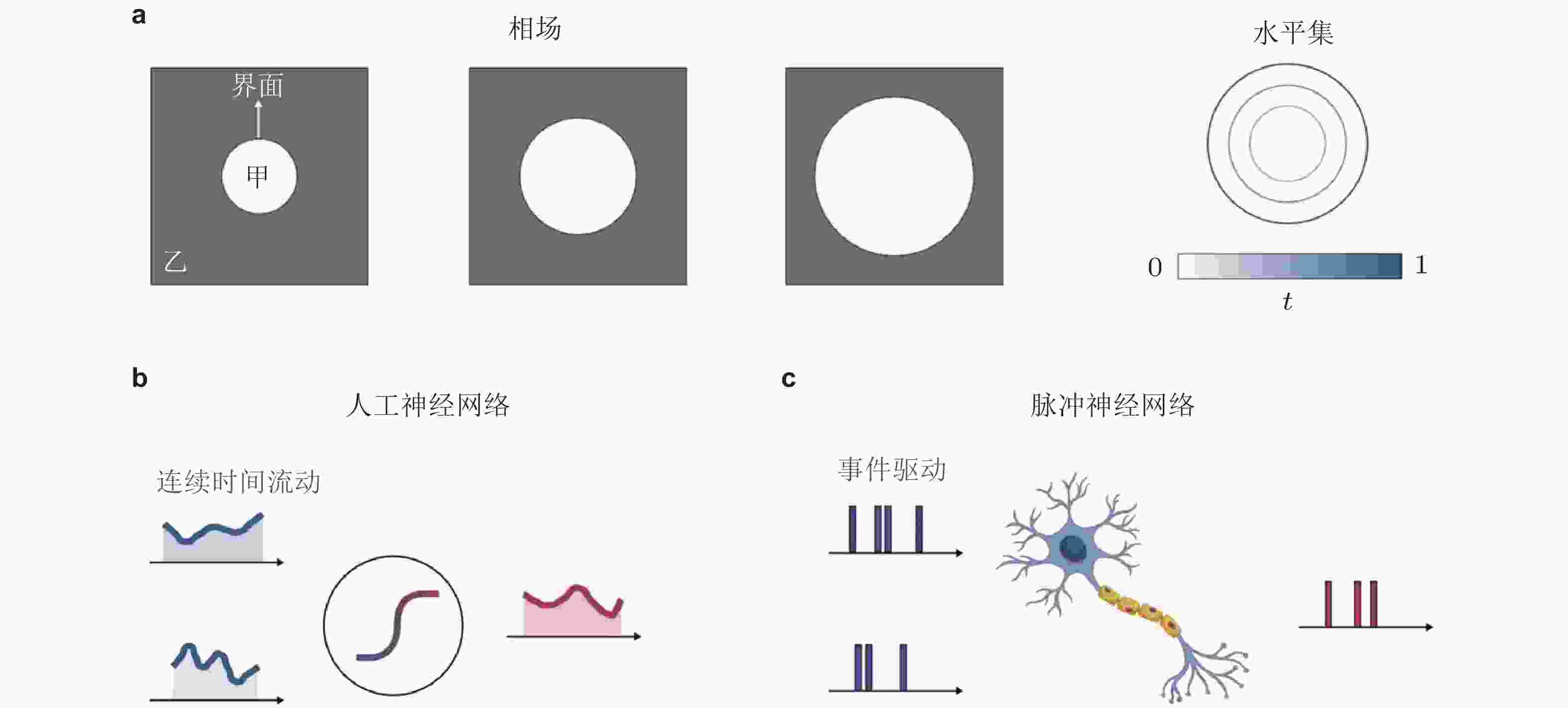
图 3 (a) 微结构演化的相场与水平集描述, (b) ~ (c) 人工神经网络与脉冲神经网络 (Zhao & Xu 2025a)

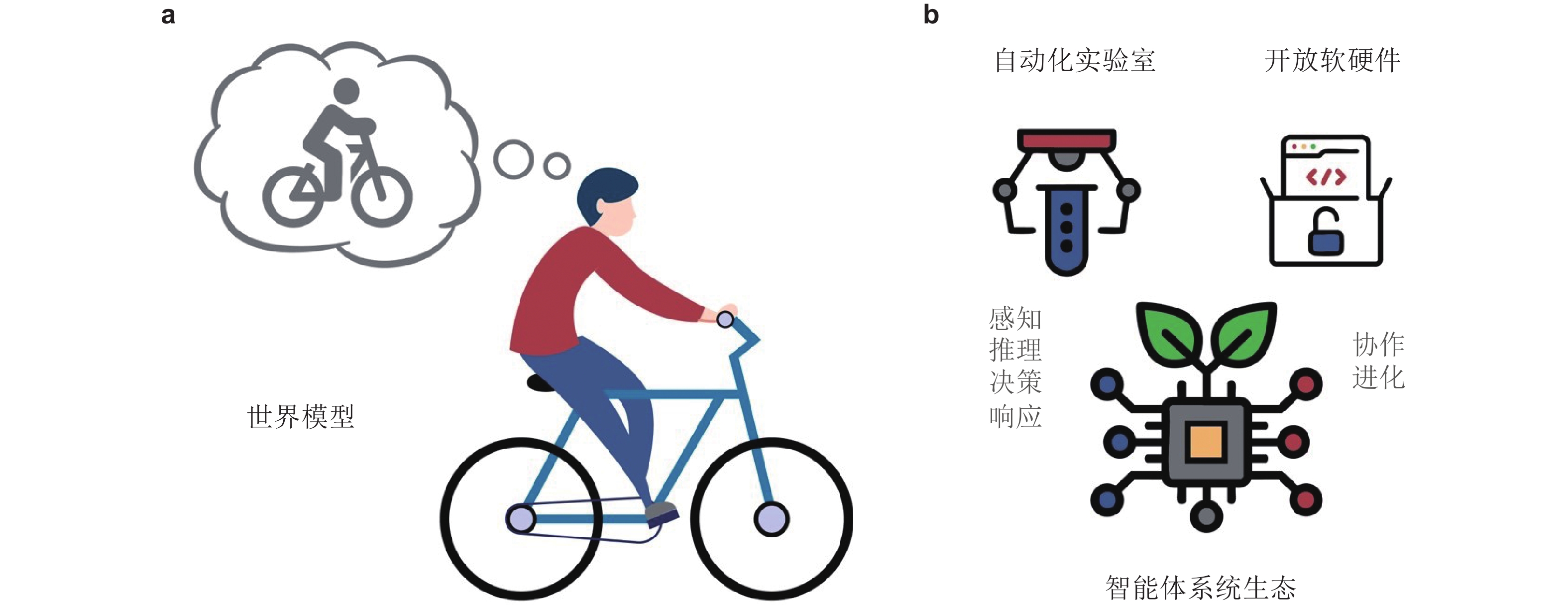
图 7 (a) 世界模型 (Ha & Schmidhuber 2018), (b) 智能体系统生态
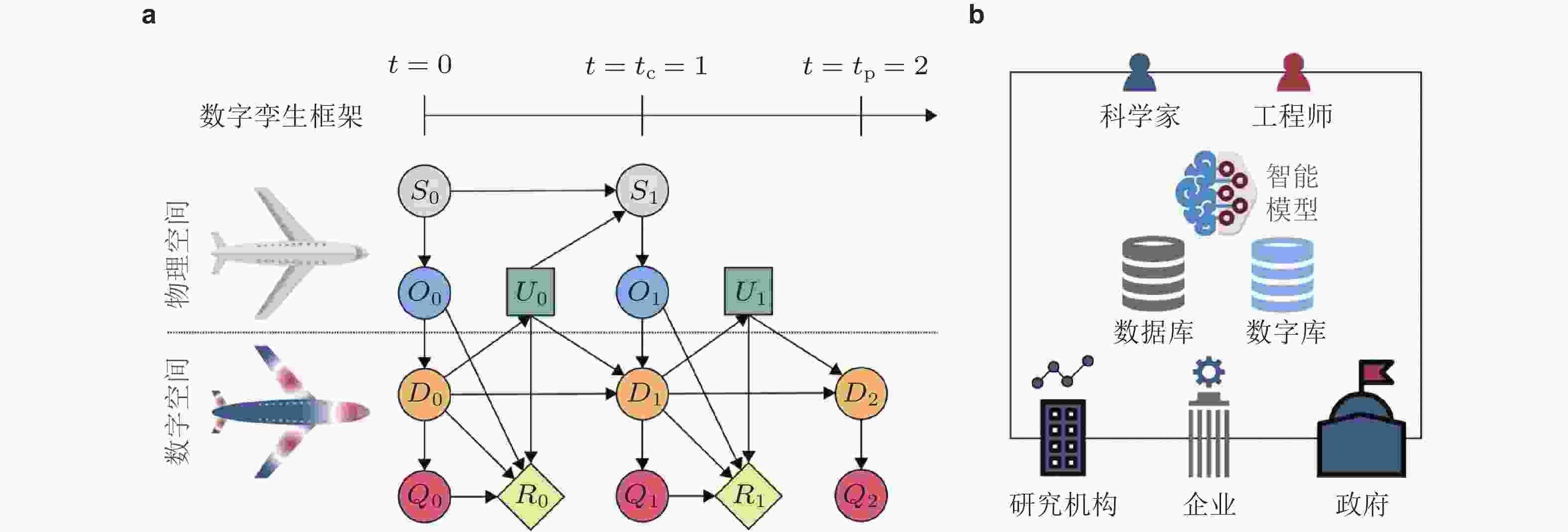
图 8 (a) 数字孪生框架 (S: 物理状态, O: 物理观测量, D: 数字状态, Q: 目标量, R: 奖励, U: 控制输入)(Kapteyn et al. 2021), (b) 开放科学生态
-
[1] 甘磊, 吴昊, 仲政. 2025. 数据驱动的金属疲劳寿命模型研究进展. 力学进展, 55(1): 30-79 (Gan L, Wu H, Zhong Z. 2025. Advances in data-driven models for fatigue life prediction of metallic materials. Adv. Mech., 55(1): 30-79).Gan L, Wu H, Zhong Z. 2025. Advances in data-driven models for fatigue life prediction of metallic materials. Adv. Mech., 55(1): 30-79. [2] 王鹏, 孙升, 张庆, 张统一. 2024. 力学信息学简介. 自然杂志, 40(5): 313-322 (Wang P, Sun S, Zhang Q, Zhang T Y. 2024. Introduction to mechanics informatics. Chin. J. Nat., 40(5): 313-322). doi: 10.3969/.issn.0253-9608.2018.05.001Wang P, Sun S, Zhang Q, Zhang T Y. 2024. Introduction to mechanics informatics. Chin. J. Nat., 40(5): 313-322. doi: 10.3969/.issn.0253-9608.2018.05.001 [3] 王润梓, 廖鼎, 张显程, 朱顺鹏, 涂善东, 郭素娟. 2021. 高温结构蠕变疲劳寿命设计方法: 从材料到结构. 机械工程学报, 57(16): 66-86 (Wang R Z, Liao D, Zhang X C, et al. 2021. Creep-fatigue life design methods in high-temperature structures: From materials to components. J. Mech. Eng., 57(16): 66-86). doi: 10.3901/JME.2021.16.066Wang R Z, Liao D, Zhang X C, et al. 2021. Creep-fatigue life design methods in high-temperature structures: From materials to components. J. Mech. Eng., 57(16): 66-86. doi: 10.3901/JME.2021.16.066 [4] 轩福贞, 朱明亮, 王国彪. 2021. 结构疲劳百年研究的回顾与展望. 机械工程学报, 57(6): 26-51 (Xuan F Z, Zhu M L, Wang G B. 2021. Retrospect and prospect on century-long research of structural fatigue. J. Mech. Eng., 57(6): 26-51). doi: 10.3901/JME.2021.06.026Xuan F Z, Zhu M L, Wang G B. 2021. Retrospect and prospect on century-long research of structural fatigue. J. Mech. Eng., 57(6): 26-51. doi: 10.3901/JME.2021.06.026 [5] 杨强, 孟松鹤, 仲政, 解维华, 郭早阳, 金华, 张幸红. 2020. 力学研究中“大数据”的启示、应用与挑战. 力学进展, 50(1): 202011 (Yang Q, Meng S H, Zhong Z, et al. 2020. Big data in mechanical research: Potentials, applications and challenges. Adv. Mech., 50(1): 202011).Yang Q, Meng S H, Zhong Z, et al. 2020. Big data in mechanical research: Potentials, applications and challenges. Adv. Mech., 50(1): 202011. [6] 杨卫. 2024. 数智力学−驾驭数智时代的力学. 力学进展, 54(4): 629-638 (Yang W. 2024. Digintel mechanics—Governing the digintel era. Adv. Mech., 54(4): 629-638).Yang W. 2024. Digintel mechanics—Governing the digintel era. Adv. Mech., 54(4): 629-638. [7] Abramson J, Adler J, Dunger J, et al. 2024. Accurate structure prediction of biomolecular interactions with AlphaFold 3. Nature, 630(8016): 493-500. doi: 10.1038/s41586-024-07487-w [8] Abu-Mostafa Y S, Magdon-Ismail M, Lin H T. 2012. Learning from Data. AMLBook New York. [9] Polymathic AI. 2025. The well: A collection of machine learning datasets for spatiotemporal physical systems. Accessed: 2025-02-25. [10] Allen A, Markou S, Tebbutt W, et al. 2025. End-to-end data-driven weather prediction. Nature, 641(8065): 1172-1179. doi: 10.1038/s41586-025-08897-0 [11] Allen M P, Tildesley D J. 1987. Computer simulation of liquids. Clarendon. [12] Angelopoulos A, Cahoon J F, Alterovitz R. 2024. Transforming science labs into automated factories of discovery. Sci. Robot., 9(95): eadm6991. doi: 10.1126/scirobotics.adm6991 [13] Archetype AI. 2024. Archetype AI: Official website. https://www.archetypeai.io. Accessed: 2024-05-05. [14] Augustine M T. 2024. A survey on universal approximation theorems. arXiv preprint arXiv: 2407.12895. [15] Bahri Y, Dyer E, Kaplan J, et al. 2024. Explaining neural scaling laws. Proc. Natl. Acad. Sci., 121(27): e2311878121. doi: 10.1073/pnas.2311878121 [16] Bansal H, Lin Z, Xie T, et al. 2024. Videophy: Evaluating physical commonsense for video generation. arXiv preprint arXiv: 2406.03520. [17] Barducci A, Bonomi M, Parrinello M. 2011. Metadynamics. Wiley Interdiscip. Rev.: Comput. Mol. Sci., 1(5): 826-843. doi: 10.1002/wcms.31 [18] Battaglia P, Pascanu R, Lai M, et al. 2016. Interaction networks for learning about objects, relations and physics. Adv. Neural Inf. Process. Sys., 30: 4509-4517. [19] Batzner S, Musaelian A, Sun L, et al. 2022. E(3)-equivariant graph neural networks for data-efficient and accurate interatomic potentials. Nat. Commun., 13(1): 2453. doi: 10.1038/s41467-022-29939-5 [20] Behler J, Parrinello M. 2007. Generalized neural-network representation of high-dimensional potential-energy surfaces. Phys. Rev. Lett., 98(14): 146401. doi: 10.1103/PhysRevLett.98.146401 [21] Belsky A, Hellenbrandt M, Karen V L, et al. 2002. New developments in the inorganic crystal structure database (ICSD): Accessibility in support of materials research and design. Acta Cryst. B, 58(3): 364-369. doi: 10.1107/S0108768102006948 [22] Ben Mahmoud C, Gardner J L, Deringer V L. 2024. Data as the next challenge in atomistic machine learning. Nat. Comput. Sci., 4(6): 384-387. doi: 10.1038/s43588-024-00636-1 [23] Ben-David S, Blitzer J, Crammer K, et al. 2010. A theory of learning from different domains. Mach. Learn., 79: 151-175. doi: 10.1007/s10994-009-5152-4 [24] Benito T, Barrientos A. 2024. An intelligent human-machine interface architecture for long-term remote robot handling in fusion reactor environments. Appl. Sci., 14(11): 4814. doi: 10.3390/app14114814 [25] Bonatti C, Mohr D. 2021. One for all: Universal material model based on minimal state-space neural networks. Sci. Adv., 7(26): eabf3658. doi: 10.1126/sciadv.abf3658 [26] Bronstein M M, Bruna J, Cohen T, et al. 2021. Geometric deep learning: Grids, groups, graphs, geodesics, and gauges. arXiv preprint arXiv: 2104.13478. [27] Brunton S L, Proctor J L, Kutz J N. 2016. Discovering governing equations from data by sparse identification of nonlinear dynamical systems. Proc. Natl. Acad. Sci., 113(15): 3932-3937. doi: 10.1073/pnas.1517384113 [28] Cai S, Mao Z, Wang Z, et al. 2021. Physics-informed neural networks (PINNs) for fluid mechanics: A review. Acta Mech. Sin., 37(12): 1727-1738. doi: 10.1007/s10409-021-01148-1 [29] Canty R B, Bennett J A, Brown K A, et al. 2025. Science acceleration and accessibility with self-driving labs. Nat. Commun., 16(1): 3856. doi: 10.1038/s41467-025-59231-1 [30] Chen C, Ong S P. 2022. A universal graph deep learning interatomic potential for the periodic table. Nat. Comput. Sci., 2(11): 718-728. doi: 10.1038/s43588-022-00349-3 [31] Chen P C, Gao M, McCandler C A, et al. 2024. Complete miscibility of immiscible elements at the nanometre scale. Nat. Nanotechnol., 19: 775-781. doi: 10.1038/s41565-024-01626-0 [32] Chmiela S, Vassilev-Galindo V, Unke O T, et al. 2023. Accurate global machine learning force fields for molecules with hundreds of atoms. Sci. Adv., 9(2): eadf0873. doi: 10.1126/sciadv.adf0873 [33] Collins K M, Sucholutsky I, Bhatt U, et al. 2024. Building machines that learn and think with people. Nat. Human Behav., 8(10): 1851-1863. doi: 10.1038/s41562-024-01991-9 [34] Consortium E. 2022. European virtual human twin. Accessed: 2023-10-15. [35] Cornelio C, Dash S, Austel V, et al. 2023. Combining data and theory for derivable scientific discovery with AI-Descartes. Nat. Commun., 14(1): 1777. doi: 10.1038/s41467-023-37236-y [36] Corrosion Data Center (CORRDATA). 2025. CORRDATA: Corrosion data and resources. https://www.corrdata. org.cn/. Accessed: 2025-07-02. [37] Curtarolo S, Ceder G. 2002. Dynamics of an inhomogeneously coarse grained multiscale system. Phys. Rev. Lett., 88(25): 255504. doi: 10.1103/PhysRevLett.88.255504 [38] Cybenko G. 1989. Approximation by superpositions of a sigmoidal function. Math. Control. Signals Syst., 2(4): 303-314. doi: 10.1007/BF02551274 [39] Deng B, Zhong P, Jun K, et al. 2023. CHGNet as a pretrained universal neural network potential for charge-informed atomistic modelling. Nat. Mach. Intell., 5(9): 1031-1041. doi: 10.1038/s42256-023-00716-3 [40] Dirac P A M. 1929. Quantum mechanics of many-electron systems. Proc. Roy. Soc. London. A, 123(792): 714-733. doi: 10.1098/rspa.1929.0094 [41] Drori I. 2022. The science of deep learning. Cambridge University Press. [42] Elder K, Grant M, Provatas N, et al. 2001. Sharp interface limits of phase-field models. Phys. Rev. E, 64(2): 021604. doi: 10.1103/PhysRevE.64.021604 [43] Everson R, Sirovich L. 1995. Karhunen−Loeve procedure for gappy data. J. Opt. Soc. Am. A, 12(8): 1657-1664. doi: 10.1364/JOSAA.12.001657 [44] Figshare. 2025. Figshare. Accessed: 2025-06-29. [45] Fortunato S, Bergstrom C T, Börner K, et al. 2018. Science of science. Science, 359(6379): eaao0185. doi: 10.1126/science.aao0185 [46] Gardiner R, Goodwin P, Dodd S, et al. 1996. Non-equilibrium synthesis of new materials. Adv. Perform. Mater., 3: 343-364. doi: 10.1007/BF00136796 [47] Ghaboussi J, Garrett Jr J, Wu X. 1991. Knowledge-based modeling of material behavior with neural networks. J. Eng. Mech., 117(1): 132-153. [48] Ghafarollahi A, Buehler M J. 2025. Automating alloy design and discovery with physics-aware multimodal multiagent AI. Proc. Natl. Acad. Sci., 122(4): e2414074122. doi: 10.1073/pnas.2414074122 [49] Git SCM. 2025. Git: Fast, scalable, distributed revision control system. https://git-scm.com/. Accessed: 2025-06-29. [50] Gottweis J, Weng W H, Daryin A, et al. 2025. Towards an AI co-scientist. arXiv preprint arXiv: 2502.18864. [51] Guo K, Yang Z, Yu C H, et al. 2021. Artificial intelligence and machine learning in design of mechanical materials. Mater. Hori., 8(4): 1153-1172. doi: 10.1039/D0MH01451F [52] Ha D, Schmidhuber J. 2018. World models. arXiv preprint arXiv: 1803.10122. [53] Han Y, Ding C, Wang J, et al. 2025. Efficient crystal structure prediction based on the symmetry principle. Nat. Comput. Sci., 5: 255-267. doi: 10.1038/s43588-025-00775-z [54] Harris P, Shanahan P. 2024. A virtuous cycle: Generative AI and discovery in the physical sciences. Available at https://mit-genai.pubpub.org/pub/ewp5ckmf/release/1. [55] Henkes A, Eshraghian J K, Wessels H. 2024. Spiking neural networks for nonlinear regression. R. Soc. Open Sci., 11(5): 231606. doi: 10.1098/rsos.231606 [56] Hornik K, Stinchcombe M, White H. 1989. Multilayer feedforward networks are universal approximators. Neural Netw., 2(5): 359-366. doi: 10.1016/0893-6080(89)90020-8 [57] Horton M K, Huck P, Yang R X, et al. 2025. Accelerated data-driven materials science with the materials project. Nat. Mater., 1–11. [58] Hummer G. 2004. From transition paths to transition states and rate coefficients. J. Chem. Phys., 120(2): 516-523. doi: 10.1063/1.1630572 [59] Isihara A. 2013. Statistical physics. Academic Press. [60] Jacobsen A, Miranda Azevedo R de, Juty N, et al. 2020. FAIR principles: Interpretations and implementation considerations. Data Intell., 2(1-2): 160018. [61] Jin R, Yuan X, Gao E. 2023. Atomic stiffness for bulk modulus prediction and high-throughput screening of ultrain-compressible crystals. Nat. Commun., 14: 4258. doi: 10.1038/s41467-023-39826-2 [62] Jing B, Stärk H, Jaakkola T, et al. 2024. Generative modeling of molecular dynamics trajectories. arXiv preprint arXiv: 2409.17808. [63] Jung H, Covino R, Arjun A, et al. 2023. Machine-guided path sampling to discover mechanisms of molecular self-organization. Nat. Comput. Sci., 3(4): 334-345. doi: 10.1038/s43588-023-00428-z [64] Kabir M, Lau T T, Rodney D, et al. 2010. Predicting dislocation climb and creep from explicit atomistic details. Phys. Rev. Lett., 105(9): 095501. doi: 10.1103/PhysRevLett.105.095501 [65] Kang B, Yue Y, Lu R, et al. 2024. How far is video generation from world model? A physical law perspective. arXiv preprint arXiv: 2411.02385. [66] Kapteyn M G, Knezevic D J, Huynh D, et al. 2022. Data-driven physics-based digital twins via a library of component-based reduced-order models. Int. J. Numer. Methods Eng., 123(13): 2986-3003. doi: 10.1002/nme.6423 [67] Kapteyn M G, Pretorius J V, Willcox K E. 2021. A probabilistic graphical model foundation for enabling predictive digital twins at scale. Nat. Comput. Sci., 1(5): 337-347. doi: 10.1038/s43588-021-00069-0 [68] Kay W, Carreira J, Simonyan K, et al. 2017. The kinetics human action video dataset. arXiv preprint arXiv: 1705.06950. [69] Kennedy M C, O’Hagan A. 2001. Bayesian calibration of computer models. J. Roy. Stat. Soc. B, 63(3): 425-464. doi: 10.1111/1467-9868.00294 [70] Kirchdoerfer T, Ortiz M. 2016. Data-driven computational mechanics. Comput. Meth. Appl. Mech. Eng., 304: 81-101. doi: 10.1016/j.cma.2016.02.001 [71] Ko T W, Finkler J A, Goedecker S, et al. 2021. A fourth-generation high-dimensional neural network potential with accurate electrostatics including non-local charge transfer. Nat. Commun., 12: 398. doi: 10.1038/s41467-020-20427-2 [72] Kovachki N, Li Z, Liu B, et al. 2023. Neural operator: Learning maps between function spaces with applications to PDEs. J. Mach. Learn. Res., 24(89): 1-97. [73] Lake B M, Ullman T D, Tenenbaum J B, et al. 2017 Building machines that learn and think like people. Behav. Brain Sci., 40: e253. [74] LeCun Y, Bottou L, Bengio Y, et al. 2002. Gradient-based learning applied to document recognition. Proc. IEEE, 86(11): 2278-2324. [75] Li B, Deng B, Shou W, et al. 2024. Computational discovery of microstructured composites with optimal stiffness-toughness trade-offs. Sci. Adv., 10(5): eadk4284. doi: 10.1126/sciadv.adk4284 [76] Li H, Xu Z, Taylor G, et al. 2017. Visualizing the loss landscape of neural nets. arXiv preprint arXiv: 1712.09913. [77] Li K, Rubungo A N, Lei X, et al. 2025. Probing out-of-distribution generalization in machine learning for materials. Commun. Mater., 6(1): 9. doi: 10.1038/s43246-024-00731-w [78] Li Z, Kovachki N, Azizzadenesheli K, et al. 2020. Fourier neural operator for parametric partial differential equations. arXiv preprint arXiv: 2010.08895. [79] Liu B, Li X, Zhang J, et al. 2025a. Advances and challenges in foundation agents: From brain-inspired intelligence to evolutionary, collaborative, and safe systems. arXiv preprint arXiv: 2504.01990. [80] Liu D, Zhang J, Dinh A D, et al. 2025b. Generative physical AI in vision: A survey. arXiv preprint arXiv: 2501.10928. [81] Liu M, Artyukhov V I, Lee H, et al. 2013. Carbyne from first principles: Chain of C atoms, a nanorod or a nanorope. ACS Nano, 7(11): 10075-10082. doi: 10.1021/nn404177r [82] Liu X, Yu Z, Xiang N. 2023. Applying FAIR4RS principles to develop an integrated modeling environment for the magnetic confinement fusion. Sci. Data, 10(1): 592. doi: 10.1038/s41597-023-02470-y [83] Liu X, Zeng K, Luo Z, et al. 2025c. Fine-tuning universal machine-learned interatomic potentials: A tutorial on methods and applications. arXiv preprint arXiv: 2506.21935. [84] Liu Z, Wang B. 2023. Prediction of ideal strength by machine learning. Mater. Chem. Phys., 299: 127476. doi: 10.1016/j.matchemphys.2023.127476 [85] Liu Z, Kitouni O, Nolte N S, et al. 2022. Towards understanding grokking: An effective theory of representation learning. Adv. Neural Inf. Process. Sys., 36: 34651-34663. [86] Liu Z, Wang Y, Vaidya S, et al. 2024. KAN: Kolmogorov−Arnold networks. arXiv preprint arXiv: 2404.19756. [87] Lu C, Lu C, Lange R T, et al. 2024. The AI scientist: Towards fully automated open-ended scientific discovery. arXiv preprint arXiv: 2408.06292. [88] Lu L, Jin P, Karniadakis G E. 2019. DeepONet: Learning nonlinear operators for identifying differential equations based on the universal approximation theorem of operators. arXiv preprint arXiv: 1910.03193. [89] Lu P Y, Kim S, Soljačić M. 2020. Extracting interpretable physical parameters from spatiotemporal systems using unsupervised learning. Phys. Rev. X, 10(3): 031056. [90] Lundberg S M, Lee S I. 2017. A unified approach to interpreting model predictions. Adv. Neural Inf. Process. Sys., 31: 4768-477. [91] Luo Y, Li M, Yuan H, et al. 2023. Predicting lattice thermal conductivity via machine learning: A mini review. npj Comput. Mater., 9(1): 4. doi: 10.1038/s41524-023-00964-2 [92] Lyu Y, Yang Z, Liang H, et al. 2022. Artificial intelligence-assisted fatigue fracture recognition based on morphing and fully convolutional networks. Fatigue Fract. Eng. Mater. Struct., 45(6): 1690-1702. doi: 10.1111/ffe.13693 [93] Maass W. 1997. Networks of spiking neurons: The third generation of neural network models. Neural Netw., 10(9): 1659-1671. doi: 10.1016/S0893-6080(97)00011-7 [94] Mardt A, Pasquali L, Wu H, et al. 2018. VAMPnets for deep learning of molecular kinetics. Nat. Commun., 9: 5. doi: 10.1038/s41467-017-02388-1 [95] Martin R M. 2020. Electronic structure: Basic theory and practical methods. Cambridge University Press. [96] Martin R C. 2017. Clean architecture: A craftsman’s guide to software structure and design. Prentice Hall Press. [97] Materials Cloud. 2025. Materials cloud. Accessed: 2025-06-29. [98] MatWeb LLC. 2025. MatWeb: Online materials information resource. https://www.matweb.com. Accessed: 2025-07-02. [99] McGreivy N, Hakim A. 2024. Weak baselines and reporting biases lead to overoptimism in machine learning for fluid-related partial differential equations. Nat. Mach. Intell., 6(10): 1256-1269. doi: 10.1038/s42256-024-00897-5 [100] Mehta P, Schwab D J. 2014 An exact mapping between the variational renormalization group and deep learning. arXiv preprint arXiv: 1410.3831. [101] Merchant A, Batzner S, Schoenholz S S, et al. 2023. Scaling deep learning for materials discovery. Nature, 624(7990): 80-85. doi: 10.1038/s41586-023-06735-9 [102] Moallemy-Oureh A, Beddar-Wiesing S, Nather R, et al. 2024. Marked neural spatio-temporal point process involving a dynamic graph neural network. arXiv preprint arXiv: 2206.03469. [103] Moro V, Loh C, Dangovski R, et al. 2025. Multi-modal foundation models for material property prediction and discovery. Newton, 1: 100016. doi: 10.1016/j.newton.2025.100016 [104] Mozaffar M, Bostanabad R, Chen W, et al. 2019. Deep learning predicts path-dependent plasticity. Proc. Natl. Acad. Sci., 116(52): 26414-26420. doi: 10.1073/pnas.1911815116 [105] National Academies of Sciences E, Medicine. 2024. Foundational research gaps and future directions for digital twins. National Academies Press. [106] National Institute for Materials Science (NIMS). 2025. NIMS materials database. https://mits.nims.go.jp/ index_en.html. Accessed: 2025-07-02. [107] National Institute of Standards and Technology (NIST). 2025. NIST materials data repository. https://materialsdata. nist.gov. Accessed: 2025-07-02. [108] Noé F, Nuske F. 2013. A variational approach to modeling slow processes in stochastic dynamical systems. Multiscale Model. Simul., 11(2): 635-655. doi: 10.1137/110858616 [109] Noé F, Olsson S, Köhler J, et al. 2019. Boltzmann generators: Sampling equilibrium states of many-body systems with deep learning. Science, 365(6457): eaaw1147. doi: 10.1126/science.aaw1147 [110] Noether E. 1971. Invariant variation problems. Transp. Theory Stat. Phys., 1(3): 186-207. doi: 10.1080/00411457108231446 [111] Ogata S, Li J, Yip S. 2002. Ideal pure shear strength of aluminum and copper. Science, 298(5594): 807-811. doi: 10.1126/science.1076652 [112] Ohana R, McCabe M, Meyer L T, et al. 2024. The well: A large-scale collection of diverse physics simulations for machine learning. In: The Thirty-eight Conference on Neural Information Processing Systems Datasets and Benchmarks Track. [113] Open Science for Engineering. 2025. Open science for engineering. Accessed: 2025-06-22. [114] OpenAI. 2024. ChatGPT with deep research. https://openai.com/chatgpt. Accessed: 2025-06-28. [115] Pang J, Li S, Wang Z, Zhang Z. 2014. Relations between fatigue strength and other mechanical properties of metallic materials. Fatigue Fract. Engr. Mater. Struct., 37(9): 958-976. doi: 10.1111/ffe.12158 [116] Parliament E, Council. 2023. Regulation (EU) 2023/2854 of the European Parliament and of the Council of 13 December 2023 on harmonised rules on fair access to and use of data. Official Journal L 2023/2854, 22 December 2023. [117] Parliament E, Council. 2024. Regulation (EU) 2024/1689 of the European Parliament and of the Council of 13 June 2024 laying down harmonised rules on artificial intelligence. Official Journal L 2024/1689, 12 July 2024. [118] Pearl J. 2009. Causality. Cambridge University Press. [119] Polyak A, Zohar A, Brown A, et al. 2024. Movie Gen: A cast of media foundation models, 2025. arXiv preprint arXiv: 2410.13720. [120] Pozdnyakov S N, Willatt M J, Bartók A P, et al. 2020. Incompleteness of atomic structure representations. Phys. Rev. Lett., 125(16): 166001. doi: 10.1103/PhysRevLett.125.166001 [121] Prinz J H, Wu H, Sarich M, et al. 2011. Markov models of molecular kinetics: Generation and validation. J. Chem. Phys., 134(17). [122] Raccuglia P, Elbert K C, Adler P D, et al. 2016. Machine-learning-assisted materials discovery using failed experiments. Nature, 533(7601): 73-76. doi: 10.1038/nature17439 [123] Raissi M, Perdikaris P, Karniadakis G E. 2019. Physics-informed neural networks: A deep learning framework for solving forward and inverse problems involving nonlinear partial differential equations. J. Comput. Phys., 378: 686-707. doi: 10.1016/j.jcp.2018.10.045 [124] RCSB. 2025. Protein data bank (RCSB PDB). Accessed: 2025-06-29. [125] Ribeiro M T, Singh S, Guestrin C. 2016. Why should I trust you? Explaining the predictions of any classifier. In: Proc. 22nd ACM SIGKDD Int. Conf. Knowl. Discov. Data Min, 1135–1144. [126] Riebesell J, Goodall R E, Benner P, et al. 2025. A framework to evaluate machine learning crystal stability predictions. Nat. Mach. Intell., 7(6): 836-847. doi: 10.1038/s42256-025-01055-1 [127] Roberts D A, Yaida S, Hanin B. 2022. The principles of deep learning theory. Cambridge University Press. [128] Rubio P B, Chamoin L, Louf F. 2019. Real-time Bayesian data assimilation with data selection, correction of model bias, and on-the-fly uncertainty propagation. Comptes Rendus. Mécanique, 347(11): 762-779. [129] Rudin C. 2019. Stop explaining black box machine learning models for high stakes decisions and use interpretable models instead. Nat. Mach. Intell., 1(5): 206-215. doi: 10.1038/s42256-019-0048-x [130] Rudy S H, Brunton S L, Proctor J L, et al. 2017. Data-driven discovery of partial differential equations. Sci. Adv., 3(4): e1602614. doi: 10.1126/sciadv.1602614 [131] Saal J E, Kirklin S, Aykol M, et al. 2013. Materials design and discovery with high-throughput density functional theory: The open quantum materials database (OQMD). JOM, 65: 1501-1509. doi: 10.1007/s11837-013-0755-4 [132] Saeed W, Omlin C. 2023. Explainable AI (XAI): A systematic meta-survey of current challenges and future opportunities. Knowl-Based Syst., 263: 110273. doi: 10.1016/j.knosys.2023.110273 [133] Schilling-Wilhelmi M, Ríos-García M, Shabih S, et al. 2025. From text to insight: Large language models for chemical data extraction. Chem. Soc. Rev., 54: 1125-1150. doi: 10.1039/D4CS00913D [134] Shaikeea A J D, Cui H, O’Masta M, et al. 2022. The toughness of mechanical metamaterials. Nat. Mater., 21(3): 297-304. doi: 10.1038/s41563-021-01182-1 [135] Shao Q, Li R, Yue Z, et al. 2021. Data-driven discovery and understanding of ultrahigh-modulus crystals. Chem. Mater., 33(4): 1276-1284. doi: 10.1021/acs.chemmater.0c04146 [136] Sharkey L, Chughtai B, Batson J, et al. 2025. Open problems in mechanistic interpretability. arXiv preprint arXiv: 2501.16496 [137] Shea D E, Brunton S L, Kutz J N. 2021. SINDy-BVP: Sparse identification of nonlinear dynamics for boundary value problems. Phys. Rev. Res., 3(2): 023255. doi: 10.1103/PhysRevResearch.3.023255 [138] Shen S C, Buehler M J. 2022. Nature-inspired architected materials using unsupervised deep learning. Commun. Eng., 1: 37. doi: 10.1038/s44172-022-00037-0 [139] Shi P, Feng S, Xu Z. 2024. Non-equilibrium nature of fracture determines the crack paths. Extreme Mech. Lett., 68: 102151. doi: 10.1016/j.eml.2024.102151 [140] Shi P, Xu Z. 2024. Exploring fracture of h-BN and graphene by neural network force fields. J. Phys. Condens. Matter, 36(41): 415401. doi: 10.1088/1361-648X/ad5c31 [141] Shwartz-Ziv R, Tishby N. 2017. Opening the black box of deep neural networks via information. arXiv preprint arXiv: 1703.00810. [142] Song J, Shan Y, Zhang Z, et al. 2025. Phase-field-informed machine learning on creep behavior of Ni-based single-crystal superalloys. J. Mater. Inform., 5(3): 32. [143] Strohmann T, Melching D, Paysan F, et al. 2023. Towards self-driving labs for experimental mechanics: A data-centric approach for fatigue crack analysis in aerospace materials. Research Square rs.3.rs-3128435. [144] Strohmann T, Starostin-Penner D, Breitbarth E, Requena G. 2021. Automatic detection of fatigue crack paths using digital image correlation and convolutional neural networks. Fatigue Fract. Eng. Mater. Struct., 44(5): 1336-1348. doi: 10.1111/ffe.13433 [145] Surjadi J U, Portela C M. 2025. Enabling three-dimensional architected materials across length scales and timescales. Nat. Mater., 24: 493-505. doi: 10.1038/s41563-025-02119-8 [146] Sutton R. 2019. The Bitter Lesson. http://www.incompleteideas.net/IncIdeas/BitterLesson.html. [147] Talirz L, Kumbhar S, Passaro E, et al. 2020. Materials cloud, a platform for open computational science. Sci. Data, 7: 299. doi: 10.1038/s41597-020-00637-5 [148] Tang H, Chen Z, Yao X, et al. 2025. Mechanical performance dataset for alloy with applications at low temperatures. Sci. Data, 12: 1235. doi: 10.1038/s41597-025-05512-9 [149] Tang K, Zhang P, Zhao Y, et al. 2024. Deep learning-based semantic segmentation for morphological fractography. Eng. Fract. Mech., 303: 110149. doi: 10.1016/j.engfracmech.2024.110149 [150] Tenenbaum J B, Kemp C, Griffiths T L, et al. 2011. How to grow a mind: Statistics, structure, and abstraction. Science, 331(6022): 1279-1285. doi: 10.1126/science.1192788 [151] Tezsezen E, Yigci D, Ahmadpour A, et al. 2024. AI-based metamaterial design. ACS Appl. Mater. Interf., 16(23): 29547-29569. doi: 10.1021/acsami.4c04486 [152] Tian S, Zhou K, Yin W, et al. 2024. Machine learning enables the discovery of 2D Invar and anti-Invar monolayers. Nat. Commun., 15: 6977. doi: 10.1038/s41467-024-51379-6 [153] Tishby N, Pereira F C, Bialek W. 2000. The information bottleneck method. arXiv preprint physics/0004057. [154] Tishby N, Zaslavsky N. 2015. Deep learning and the information bottleneck principle. arXiv preprint arXiv: 1503.02406. [155] Tom G, Schmid S P, Baird S G, et al. 2024. Self-driving laboratories for chemistry and materials science. Chem. Rev., 124(16): 9633-9732. doi: 10.1021/acs.chemrev.4c00055 [156] Ullman T D, Stuhlmüller A, Goodman N D, et al. 2018. Learning physical parameters from dynamic scenes. Cogn. Psychol., 104: 57-82. doi: 10.1016/j.cogpsych.2017.05.006 [157] Valiant L G. 1984. A theory of the learnable. Commun. of the ACM, 27(11): 1134-1142. doi: 10.1145/1968.1972 [158] Valle-Pérez G, Louis A A. 2020. Generalization bounds for deep learning. arXiv preprint arXiv: 2012.04115. [159] Vapnik V. 1999. The nature of statistical learning theory. Springer. [160] Voter A F, Montalenti F, Germann T C. 2002. Extending the time scale in atomistic simulation of materials. Annu. Rev. Mater. Res., 32: 321-346. doi: 10.1146/annurev.matsci.32.112601.141541 [161] Wälchli D, Weber P, Chatzimanolakis M, et al. 2025. Inverse reinforcement learning for objective discovery in collective behavior of artificial swimmers. Phys. Rev. Fluids, 10(6): 064901. doi: 10.1103/646f-dt2k [162] Wang J, Olsson S, Wehmeyer C, et al. 2019. Machine learning of coarse-grained molecular dynamics force fields. ACS Cent. Sci., 5(5): 755-767. doi: 10.1021/acscentsci.8b00913 [163] Wang W, Gómez-Bombarelli R. 2019. Coarse-graining auto-encoders for molecular dynamics. npj Comput. Mater., 5: 125. doi: 10.1038/s41524-019-0261-5 [164] Wang Y, Sun J, Bai J, et al. 2024. Kolmogorov Arnold informed neural network: A physics-informed deep learning framework for solving forward and inverse problems based on Kolmogorov Arnold Networks. arXiv preprint arXiv: 2406.11045. [165] Wang Z, Wu K, Ding J, et al. 2025. Strut-buckling transformation enabling anomalous density-scaling toughening law in ultralight lattice metamaterials. Adv. Mater., 2419635. [166] Wei J, Wang X, Schuurmans D, et al. 2022. Chain of thought prompting elicits reasoning in large language models. arXiv preprint arXiv: 2201.11903. [167] Wen M, Tadmor E B. 2019. Hybrid neural network potential for multilayer graphene. Phys. Rev. B, 100(19): 195419. doi: 10.1103/PhysRevB.100.195419 [168] Wilczek F. 2022. Fundamentals: Ten keys to reality. Penguin. [169] Wilkinson M D, Dumontier M, Aalbersberg I J, et al. 2016. The FAIR guiding principles for scientific data management and stewardship. Sci. Data, 3: 160018. doi: 10.1038/sdata.2016.18 [170] Wines D, Choudhary K. 2025. CHIPS-FF: Evaluating universal machine learning force fields for material properties. ACS Mater. Lett., 7(6): 2105-2114. doi: 10.1021/acsmaterialslett.5c00093 [171] Wu J, Yildirim I, Lim J J, et al. 2015. Galileo: Perceiving physical object properties by integrating a physics engine with deep learning. Adv. Neural Inf. Process., 29: 127-135. [172] Wu L, Zhu Z, E W. 2017. Towards understanding generalization of deep learning: Perspective of loss landscapes. arXiv preprint arXiv: 1706.10239. [173] Xu Z. 2023a. Environmentally-assisted fatigue at small scales. In: Comprehensive Structural Integrity. Ed. by M H F Aliabadi, W O Soboyejo. Second Edition. Elsevier, pp. 131–162. [174] Xu Z. 2023b. Fracture of low-dimensional materials. In: Comprehensive Structural Integrity. Ed. by M H F Aliabadi, W O Soboyejo. Second Edition. Elsevier, pp. 196–216. [175] Xu Z. 2025. Reliability in heterogeneous integration: A theoretical view. In: EDTM 2025. IEEE, pp. 1–3. [176] Xu Z, Zhang Z. 2024. The need for standardizing fatigue data reporting. Nat. Mater., 23(7): 866-868. doi: 10.1038/s41563-024-01929-6 [177] Yamada Y, Lange R T, Lu C, et al. 2025. The AI Scientist-V2: Workshop-level automated scientific discovery via agentic tree search. arXiv preprint arXiv: 2504.08066. [178] Yang F, Zhao W, Ru Y, et al. 2024. Transfer learning enables the rapid design of single crystal superalloys with superior creep resistances at ultrahigh temperature. npj Comput. Mater., 10: 149. doi: 10.1038/s41524-024-01349-9 [179] Zeni C, Pinsler R, Zügner D, et al. 2025. A generative model for inorganic materials design. Nature, 639: 624-632. doi: 10.1038/s41586-025-08628-5 [180] Zenodo. 2025. Zenodo. Accessed: 2025-06-29. [181] Zhang L, Han J, Wang H, et al. 2018. Deep potential molecular dynamics: A scalable model with the accuracy of quantum mechanics. Phys. Rev. Lett., 120(14): 143001. doi: 10.1103/PhysRevLett.120.143001 [182] Zhang Z, Tang H, Xu Z. 2023. Fatigue database of complex metallic alloys. Sci. Data, 10: 447. doi: 10.1038/s41597-023-02354-1 [183] Zhang Z, Xu Z. 2022. Failure life prediction for carbon nanotubes. J. Mech. Phys. Solids, 164: 104907. doi: 10.1016/j.jmps.2022.104907 [184] Zhang Z, Xu Z. 2023. Fatigue database of additively manufactured alloys. Sci. Data, 10: 249. doi: 10.1038/s41597-023-02150-x [185] Zhao Y, Liu Y, Xu Z. 2023. Statistical learning prediction of fatigue crack growth via path slicing and re-weighting. Theo. Appl. Mech. Lett., 13(6): 100477. doi: 10.1016/j.taml.2023.100477 [186] Zhao Y, Song Y, Xu F, et al. 2025a. Predicting brain morphogenesis via physics-transfer learning. arXiv preprint arXiv: 2509.05305. [187] Zhao Y, Xu Z. 2025a. Neural network modeling of microstructure complexity using digital libraries. Mach. Learn.: Sci. Technol., 6: 045046 doi: 10.1088/2632-2153/ae1bf7 [188] Zhao Y, Xu Z. 2025b. Physics-transfer learning: A framework to address the accuracy-performance dilemma in modeling morphological complexities in brain development. In: ICLR 2025 Workshop on Machine Learning Multiscale Processes. [189] Zhao Y, Zhou H, Zhang Z, et al. 2025b. Discovering high-strength alloys via physics-transfer learning. Matter, 8(9): 102377. doi: 10.1016/j.matt.2025.102377 [190] Zheng X, Zhang X, Chen T T, et al. 2023. Deep learning in mechanical metamaterials: From prediction and generation to inverse design. Adv. Mater., 35(45): 2302530. doi: 10.1002/adma.202302530 [191] Zhou W, Yang Y, Zheng G, et al. 2020. Proton irradiation-decelerated intergranular corrosion of Ni-Cr alloys in molten salt. Nat. Commun., 11: 3430. doi: 10.1038/s41467-020-17244-y [192] Zhu R, Nong W, Yamazaki S, et al. 2024. WyCryst: Wyckoff inorganic crystal generator framework. Matter, 7(10): 3469-3488. doi: 10.1016/j.matt.2024.05.042 [193] Zills F, Schäfer M, Tovey S, et al. 2024. ZnTrack: Data as code. arXiv preprint arXiv: 2401.10603. -

 下载:
下载:





图(8)
计量
- 文章访问数: 2675
- HTML全文浏览量: 880
- PDF下载量: 1119
- 被引次数: 0